Ambardi park to build enclosure for lions in human wildlife conflict
Source:indian-masterminds ↗
આ શા માટે મહત્વનું છે
The management of the Asiatic lion population is a major environmental focus for Gujarat. Identifying locations like the Ambardi Safari Park and understanding strategies to mitigate human-wildlife conflict are directly relevant to GPSC Prelims Geography and Environment sections.
સારાંશ
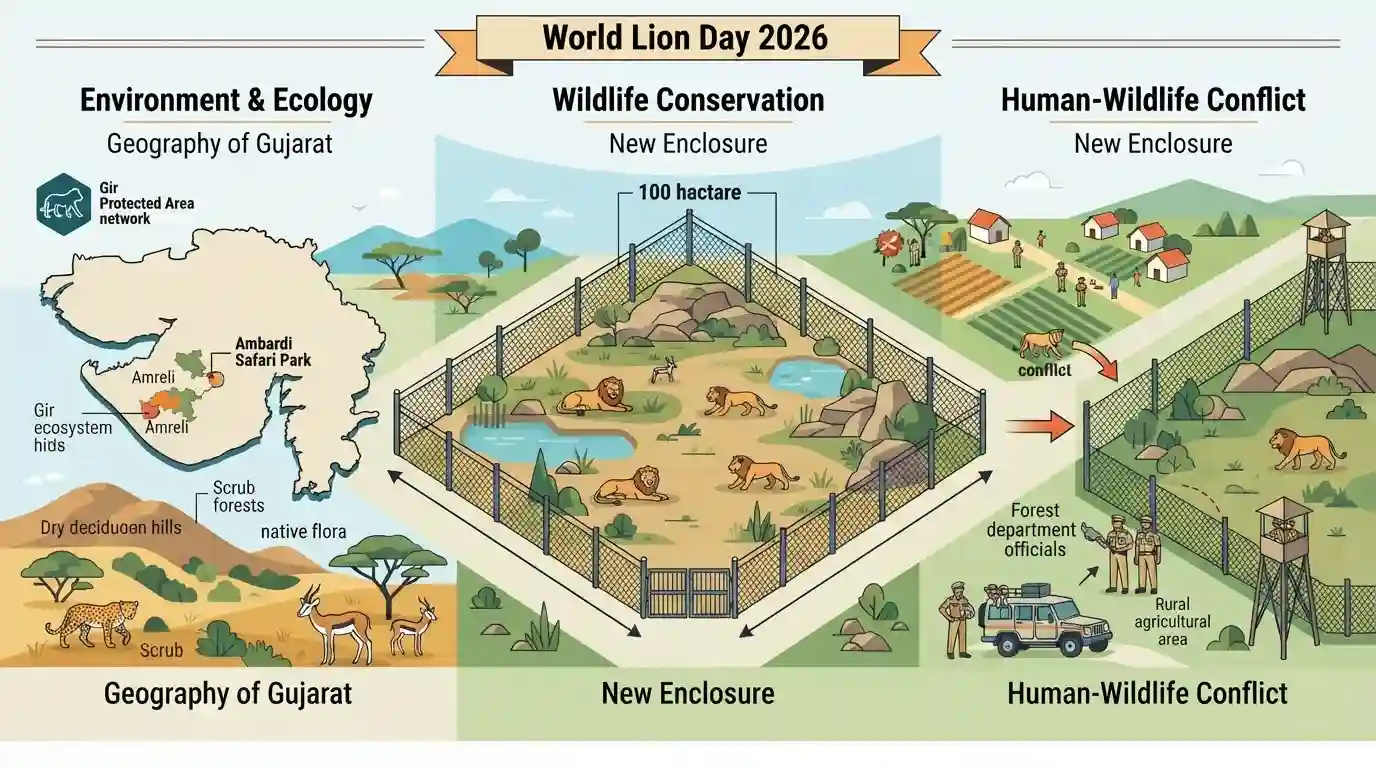
To mark World Lion Day 2026, the Gujarat Forest Department has planned a 100-hectare enclosure at the Ambardi Safari Park in Amreli for Asiatic lions involved in human-wildlife conflicts. The project aims to securely manage and conserve these lions, providing them a naturalistic habitat while ensuring the safety of nearby communities. Ambardi Safari Park, spanning 365 hectares and established in 2017, plays a key role in eco-tourism and protecting wildlife like leopards and chinkaras within the Gir Protected Area network.
મુખ્ય મુદ્દા
- On World Lion Day 2026, the Gujarat Forest Department announced a 100-hectare enclosure for lions involved in human attacks.
- The enclosure will be established within the Ambardi Safari Park in Amreli district.
- The initiative aims to mitigate human-wildlife conflict while ensuring the scientific conservation and rehabilitation of Asiatic lions.
- Ambardi Safari Park is part of the Gir Protected Area, established in 2017 to manage eco-tourism and reduce the burden on the Gir National Park.
મહત્વપૂર્ણ શબ્દો
Asiatic Lion

An endangered lion subspecies (Panthera leo persica) endemic to Saurashtra, Gujarat. It is legally protected under Schedule I of India's Wildlife (Protection) Act, 1972.
UPSC context
GS Paper III (Environment). Vital for studying endangered endemic species, in-situ conservation, and wildlife translocation challenges.
Human-Wildlife Conflict
Adverse interactions between people and wild animals that lead to crop damage, livestock predation, human casualties, or retaliatory killing of wildlife.
UPSC context
GS Paper III (Environment). Tests knowledge on biodiversity preservation, mitigation policies, and community-led conservation models.
Gir Protected Area
A dry deciduous forest ecosystem in Saurashtra, Gujarat, comprising Gir National Park and Wildlife Sanctuary, serving as the last wild refuge of the Asiatic lion.
UPSC context
GS Paper I (Geography) & GS III (Environment). Focuses on Protected Area Networks, ecosystem characteristics, and endemic species habitats.
Ambardi Safari Park
A 365-hectare reserved forest in Amreli district, Gujarat, serving as a wildlife tourism hub and conservation extension of the Gir Protected Area network.
UPSC context
GS Paper III (Environment). Tests localized in-situ conservation efforts, eco-tourism projects, and species relocation strategies.
Gujarat Forest Department
The administrative agency of Gujarat responsible for the management of the state's forests, national parks, wildlife sanctuaries, and species protection programs.
UPSC context
GS Paper III (Environment & Disaster Management). Highlights administrative frameworks enforcing the Wildlife Protection Act and handling state-level ecological challenges.
પ્રિલિમ્સ ટ્રેપ
Asiatic lions are naturally restricted exclusively to the core Gir National Park area.
Lions range across the wider Gir Protected Area network, including sanctuaries, national parks, and community lands in Saurashtra, not just the National Park core.
સંલગ્ન સ્થિર ખ્યાલો
What is the conservation status and distribution of the Asiatic Lion?
- IUCN Status: Classified as Endangered under the IUCN Red List after a historical decline.
- WPA Protection: Protected under Schedule I of the Wildlife (Protection) Act, 1972, ensuring highest legal protection.
- Natural Habitat: Naturally restricted to the Saurashtra region of Gujarat, spanning Gir National Park, Gir Sanctuary, Pania, and Mitiyala.
What are the key objectives of 'Project Lion'?
- Core Launch: Launched in 2020 to conserve Asiatic lions by focusing on habitat development and disease control.
- Conflict Resolution: Emphasizes mitigation through state-of-the-art veterinary care, GPS tracking, and community-led conservation (Gadhvi/Maldhari networks).
- Disease Prevention: Prioritizes intensive disease surveillance, particularly protecting the population from threats like Canine Distemper Virus (CDV).
આંતર-વિષય પેટર્ન
Human-Wildlife Conflict vs. Tribal Rights
Relocating pastoralist Maldhari communities from lion corridors highlights the ongoing friction between forest conservation laws (WPA, 1972) and traditional forest resource rights (FRA, 2006).
Conservation Ethics & Animal Welfare
The shift from culling or lifetime traditional caging to naturalistic rehabilitation enclosures reflects an evolving ethical paradigm in wildlife jurisprudence and environmental governance.

2026 Prelims may test Gir landscape geography, distinguishing between core National Park zones and multi-use protected area sanctuaries.
સંલગ્ન PYQ · 2
સંલગ્ન PYQ · 2
- 2026GPSC_PRELIMSGS1
The 'Great Indian Bustard (GIB)' (Ghorad) is frequently seen in the news in the context of wildlife conservation efforts in western India. Consider the following statements regarding this species: 1. Currently, the highest surviving wild population of the Great Indian Bustard in India is located in the semi-arid grasslands of Gujarat. 2. It is a long-distance migratory bird that travels from Central Asia to the Indian subcontinent to escape harsh winters. Which of the above statement(s) is/are correct?
- 2025GPSC_PRELIMSGS1
The Aravali Safari Park project proposed to be the world's largest safari park, will be developed in _________________.
