Global diplomatic reactions to Middle East escalation and strikes
Source:The Hindu ↗
Why It Matters
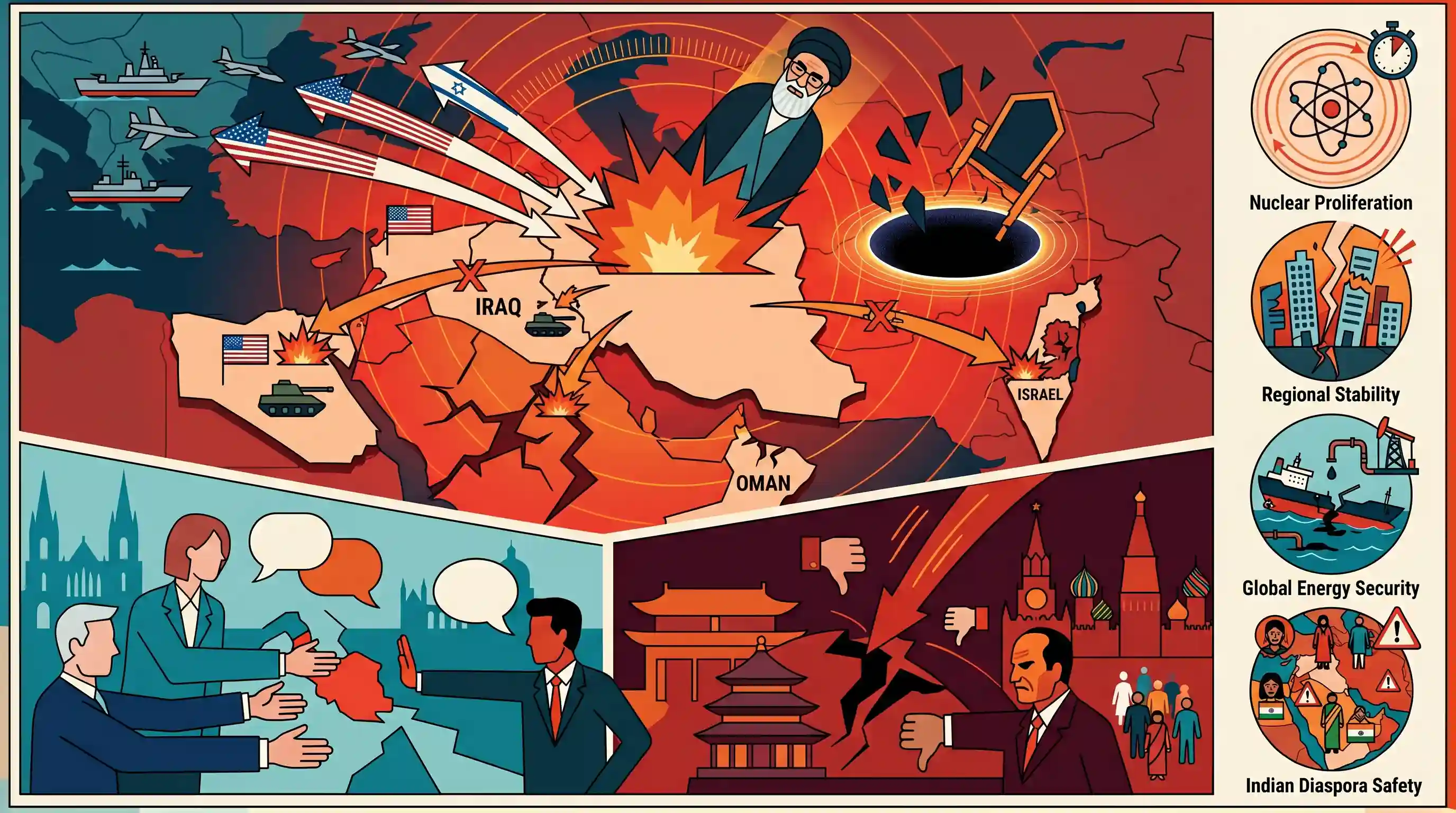
The crisis in West Asia directly impacts global geopolitical stability, energy security, and trade routes. For India, the conflict threatens its energy interests, delicate diplomatic balance between Israel and Arab/Iranian partners, and the safety of the large Indian diaspora in the Middle East, necessitating strategic evacuation and diplomatic maneuvering.
Summary
The US and Israel conducted joint military strikes on Iran, reportedly resulting in the death of Supreme Leader Ayatollah Ali Khamenei and creating a dangerous power vacuum. The strikes have severely escalated tensions across West Asia, prompting Iranian retaliatory attacks against US bases in Iraq and Syria, as well as Israel. The international response has been divided: Western European leaders urged diplomatic resolution while cautioning Iran, whereas nations like China, Russia, and Oman condemned the military attacks. The escalating conflict raises alarm over nuclear proliferation, regional stability, global energy security, and the safety of the Indian diaspora in the region.
Key Points
- US and Israeli joint military strikes on Iran reportedly resulted in the death of Iran's Supreme Leader, Ayatollah Ali Khamenei.
- The assassination leaves a power vacuum in Iran, as no successor had been designated, escalating regional instability.
- Iran retaliated by launching missiles at US military bases in Iraq and Syria, and at Israel.
- Western European nations like the UK, France, and Germany called for a return to diplomacy while warning Iran against further attacks.
- China, Russia, and Oman strongly opposed the military action, criticizing the violation of Iran's sovereignty.
- The International Campaign to Abolish Nuclear Weapons (ICAN) warned of severe risks of nuclear escalation due to the conflict.
- Concerns were raised regarding the safety of Indian citizens in the Middle East, with calls for the Indian government to initiate evacuation measures.
Important Terms
United Nations (UN)

Established in 1945, a 193-member intergovernmental body dedicated to maintaining international peace, security, and cooperation through principal organs like the Security Council and General Assembly.
UPSC context
GS Paper II (International Institutions); tests knowledge of global governance, UNSC reforms, and India's role in multilateralism.
Arab League
A regional intergovernmental organization founded in 1945, comprising 22 member states in West Asia and North Africa to coordinate political, economic, and social policies.
UPSC context
GS Paper II (West Asia Geopolitics); essential for understanding regional dynamics affecting India's energy security and diaspora.
International Campaign to Abolish Nuclear Weapons (ICAN)
A global civil society coalition founded in 2007 that promoted the Treaty on the Prohibition of Nuclear Weapons (TPNW) and received the 2017 Nobel Peace Prize.
UPSC context
GS Paper II and III (Nuclear Proliferation); tests understanding of disarmament treaties and global security frameworks.
European Council
An official European Union institution composed of the heads of state or government of the 27 member states, defining the EU's overall political direction.
UPSC context
GS Paper II (Regional Groupings); relevant for analyzing EU's strategic foreign policy and its impact on Indian interests.
Prelims Trap
"The International Campaign to Abolish Nuclear Weapons (ICAN) is a specialized agency of the United Nations."
ICAN is a global civil society coalition, not a UN body. It won the 2017 Nobel Peace Prize for promoting the UN Treaty on the Prohibition of Nuclear Weapons.
Static Concepts Connected
What are the primary maritime chokepoints affecting India's energy security in West Asia?
- Strait of Hormuz: Connects the Persian Gulf to the Gulf of Oman; processes ~20% of global oil trade, directly impacting India's crude imports.
- Bab el-Mandeb: Links the Red Sea to the Gulf of Aden; critical for broader Indian maritime trade routed through the Suez Canal.
How does India's 'De-hyphenation' policy function in West Asia?
- Independent Partnerships: Maintaining mutually exclusive strategic relationships with adversarial nations (like Israel, Iran, and Arab states) without cross-conditionality.
- Strategic Autonomy: Ensures India's energy security, defense ties, and diaspora interests are insulated from external regional rivalries or binary geopolitical camps.
Cross-Topic Patterns
West Asia conflict & Macroeconomic stability
Conflict in the Gulf impacts India's current account deficit via inflated crude oil prices and potential disruptions to the massive remittance inflows from the Indian diaspora in West Asia.
Nuclear treaties & Civil Society frameworks
The regional power vacuum and strikes revive debate around nuclear treaties (JCPOA, NPT, TPNW) and the role of non-state actors like ICAN in pushing global non-proliferation norms.

Expect a 2026 Prelims geography question mapping West Asian strategic chokepoints, paired with India's 'de-hyphenation' diplomatic stance.
Linked PYQs · 4
Linked PYQs · 4
- 2025MainsGS2
"Energy security constitutes the dominant kingpin of India's foreign policy, and is linked with India's overarching influence in Middle Eastern countries.” How would you integrate energy security with India's foreign policy trajectories in the coming years?
- 2018MainsGS2
“India’s relations with Israel have, of late, acquired a depth and diversity, which cannot be rolled back.” Discuss.
- 2017MainsGS2
The question of India's Energy Security constitutes the most important part of India's economic progress. Analyze India's energy policy cooperation with West Asian countries.
- 2023MainsGS2
Indian diaspora has scaled new heights in the West. Describe its economic and political benefits for India.
