FAO Report on Global Food Prices and Cereal Production Trends
Source:The Hindu ↗
Why It Matters
International food prices and global cereal stocks tracked by the FAO significantly influence India's domestic inflation, agricultural trade policy, and buffer stock management strategies. Understanding these metrics is critical for UPSC aspirants when analyzing food security and agricultural economics.
Summary
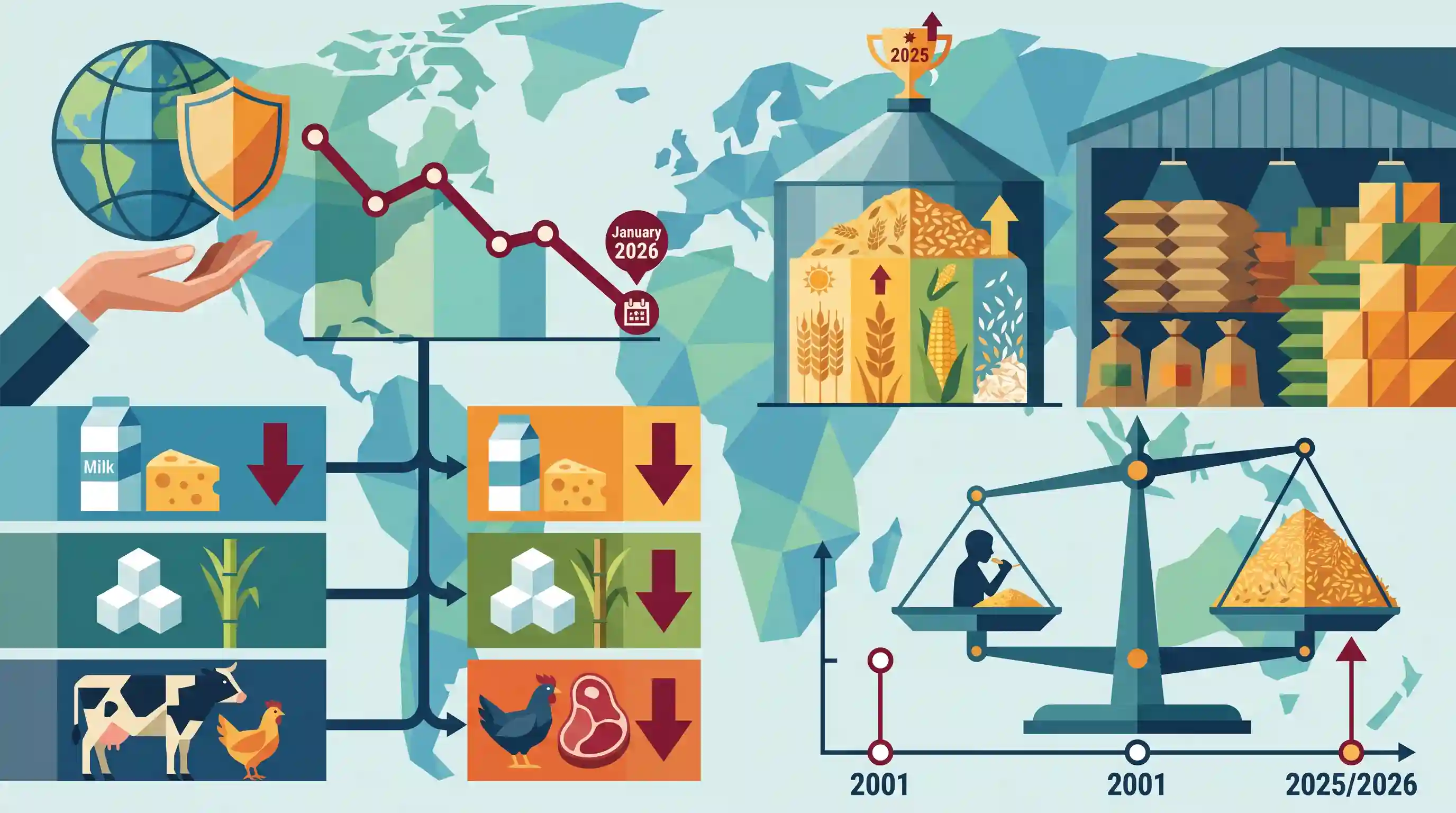
The United Nations Food and Agriculture Organization (FAO) reported that global food prices eased further in January 2026. The FAO Food Price Index fell for the fifth straight month, primarily pulled down by cheaper dairy, sugar, and meat products. Concurrently, the FAO projected record-breaking global cereal production for 2025 and an expansion of world cereal stocks, pushing the global stocks-to-use ratio to its highest point since 2001.
Key Points
- The FAO Food Price Index declined for a fifth consecutive month in January 2026, averaging 123.9 points, which is 22.7% below its March 2022 peak.
- The overall decline was driven by lower prices for dairy, sugar, and meat products, which offset increases in cereal and vegetable oil prices.
- Global cereal production for 2025 was revised upward to a record 3.023 billion metric tons, aided by higher wheat yields and improved maize prospects.
- World cereal stocks are projected to expand in the 2025/26 season, lifting the global stocks-to-use ratio to 31.8%, the highest level since 2001.
Important Terms
Food and Agriculture Organization (FAO)

A specialized UN agency established in 1945, headquartered in Rome, mandated to defeat hunger, improve nutrition, and coordinate international efforts in agriculture, forestry, and fisheries.
UPSC context
GS Paper 2: International Relations (UN agencies); GS Paper 3: Agriculture and Food Security. Tests understanding of global governance.
FAO Food Price Index (FFPI)
A measure of the monthly change in international prices of a basket of food commodities (cereals, oilseeds, dairy, meat, and sugar), used as a benchmark for global food inflation.
UPSC context
GS Paper 3: Economy and Agriculture. Vital for analyzing global inflation trends and their impact on India's food security and trade.
Stocks-to-use ratio
An indicator of the relationship between available commodity inventories (ending stocks) and total consumption (utilization). A higher ratio suggests a comfortable supply buffer and potential for lower prices.
UPSC context
GS Paper 3: Agriculture (Buffer stocks and food security). Tests technical knowledge of supply-demand dynamics in essential commodities.
Global Food Security
The state where all people have physical, social, and economic access to sufficient, safe, and nutritious food. It is a core target of Sustainable Development Goal 2 (Zero Hunger).
UPSC context
GS Paper 2: Social Justice; GS Paper 3: Economics of animal rearing and food processing. Essential for Mains essays and IR topics.
Agricultural Market Information System (AMIS)
An inter-agency platform hosted by the FAO that enhances food market transparency and policy response to prevent price volatility in crops like wheat, maize, rice, and soybeans.
UPSC context
GS Paper 3: Agriculture and Economy. Relevant for transparency in global supply chains and G20-led initiatives.
Prelims Trap
"The FAO Food Price Index measures retail food inflation across developing nations."
The FFPI exclusively tracks monthly changes in the international export prices of globally traded bulk commodities, not domestic retail inflation or consumer-level prices.
Static Concepts Connected
What are the core components of the FAO Food Price Index (FFPI)?
- Commodity Basket: It consists of five distinct commodity group price indices: cereals, vegetable oils, dairy, meat, and sugar.
- Base Period: The index currently uses 2014-2016 as its base period to calculate the average of international prices.
- Measurement Scope: It tracks trade-weighted international market prices, reflecting global export and import dynamics rather than local wholesale or retail prices.
What is the Agricultural Market Information System (AMIS)?
- Origin: It is an inter-agency platform launched by G20 Agriculture Ministers in 2011 to curb extreme global food price volatility.
- Monitored Crops: It specifically monitors the global supply and demand of four major crops: wheat, maize, rice, and soybeans.
- Secretariat: Its Secretariat is housed at the FAO headquarters in Rome, supported by multiple international organizations like the World Bank and WTO.
Cross-Topic Patterns
Global easing vs RBI inflation targeting
Plunging global food indices reduce India's imported inflation, especially for edible oils, potentially giving the RBI's Monetary Policy Committee more flexibility on repo rates.
Export realization and MSP reliance
Falling international commodity prices suppress Indian agricultural export values, often forcing farmers to rely heavier on MSP procurement to avoid distress sales during global gluts.

A Prelims question mixing the FFPI's 5 commodity basket with the 4 specific crops tracked by the G20's AMIS is highly probable in 2026.
Linked PYQs · 4
Linked PYQs · 4
- 2024MainsGS3
Elucidate the importance of buffer stocks for stabilizing agricultural prices in India. What are the challenges associated with the storage of buffer stock? Discuss.
- 2016PrelimsGS1
Which of the following is/are the indicator/indicators used by IFPRI to compute the Global Hunger Index Report? 1. Undernourishment 2. Child stunting 3. Child mortality Select the correct answer using the code given below.
- 2013MainsGS3
Food Security Bill is expected to eliminate hunger and malnutrition in India. Critically discuss various apprehensions in its effective implementation along with the concerns it has generated in WTO.
- 2019PrelimsGS1
The economic cost of food grains to the Food Corporation of India is Minimum Support Price and bonus (if any) paid to the farmers plus
