Gross environment product implementation and green policy
Source:The Hindu ↗
Why It Matters
The introduction of Gross Environment Product (GEP) by Uttarakhand sets a strong precedent for green accounting in India, directly tying into GS3 topics of environmental economics and sustainable development. Mission LiFE and criticisms of the environmental governance framework are also highly relevant for Mains questions evaluating India's climate policy and ecological conservation efforts.
Summary
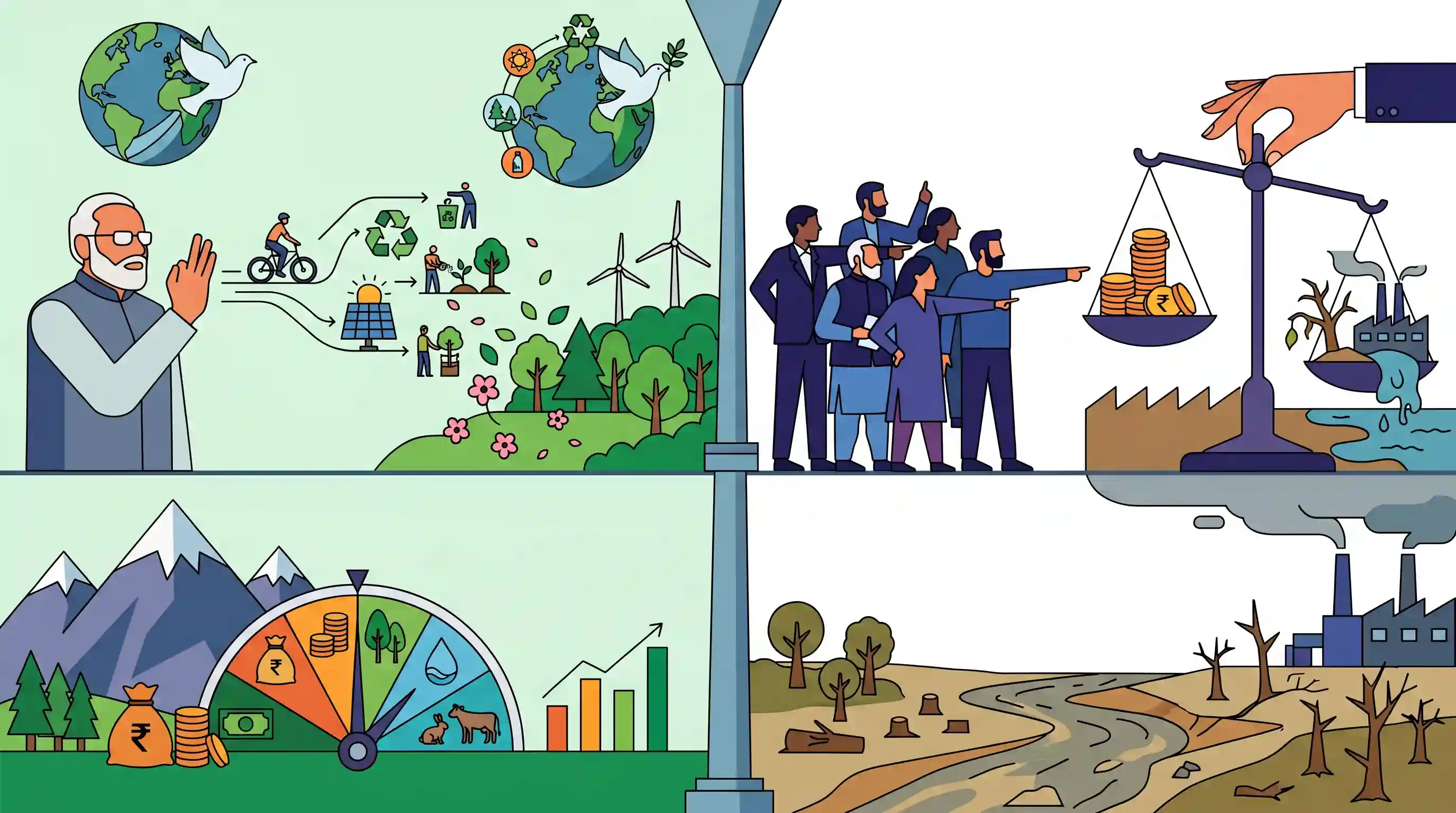
The article discusses the observance of World Environment Day 2026, hosted by Azerbaijan. In India, Prime Minister Narendra Modi advocated for sustainable development through \'Mission LiFE\' and expanding green cover. At the state level, Uttarakhand announced its pioneering implementation of the Gross Environment Product (GEP) to balance ecological conservation with economic growth. Meanwhile, the opposition criticized the central government for allegedly diluting environmental governance frameworks and overseeing the degradation of India's ecological wealth through selective accounting.
Key Points
- World Environment Day (June 5) was established by UNEP in 1973 and is being hosted by Azerbaijan in 2026.
- PM Narendra Modi emphasized the spirit of \'Mission LiFE\' (Lifestyle for Environment) and the principle of \'One Earth, One Family and One Future\' for sustainable growth.
- Uttarakhand Chief Minister highlighted that the state has become the first in India to implement Gross Environment Product (GEP) to harmonize ecology and economy.
- Congress President Mallikarjun Kharge criticized the ruling government for allegedly weakening environmental governance frameworks and dismantling natural forests under manipulated definitions.
Important Terms
Mission LiFE (Lifestyle for Environment)

An India-led global mass movement promoting sustainable lifestyles by replacing "mindless consumption" with "mindful utilization" of resources. It focuses on individual and community action to combat climate change.
UPSC context
GS Paper III: Environment; essential for answers on climate change mitigation, sustainable development goals, and India's global environmental leadership.
Gross Environment Product (GEP)
An assessment system that assigns monetary value to ecosystem services (e.g., air/water purification, carbon sequestration) to measure a region's ecological status alongside traditional economic indicators like GDP.
UPSC context
GS Paper III: Green Accounting; relevant for sustainable development and ecological conservation strategies (e.g., Uttarakhand's pioneering implementation).
United Nations Environment Programme (UNEP)
The principal UN body established in 1972 that sets the global environmental agenda, coordinates environmental activities, and publishes key reports like the Emissions Gap Report.
UPSC context
GS Paper II/III: International Organizations; critical for understanding global environmental governance and multilateral agreements.
Environmental Impact Assessment (EIA)
A statutory process under the Environment Protection Act, 1986, used to identify and evaluate the potential environmental, social, and economic impacts of a proposed development project before approval.
UPSC context
GS Paper III: Environmental Governance; a core topic regarding industrial regulation, sustainable development, and conservation laws.
World Environment Day
Celebrated annually on June 5th since 1973, it is the UN's primary vehicle for encouraging worldwide awareness and action for the protection of the environment.
UPSC context
General Awareness/Current Affairs; tests knowledge of global environmental themes, host countries (e.g., Azerbaijan 2026), and international cooperation milestones.
Prelims Trap
Gross Environment Product (GEP) is a national macroeconomic indicator published annually by NITI Aayog.
GEP is currently a state-level initiative pioneered by Uttarakhand to quantify ecological growth (air, water, soil, forests), not a national index compiled by NITI Aayog.
Static Concepts Connected
What are the four universally recognized categories of ecosystem services underlying GEP calculations?
- Provisioning services: Products obtained from ecosystems, such as food, freshwater, fuel, timber, and genetic resources.
- Regulating services: Benefits obtained from the regulation of ecosystem processes, including climate regulation, flood control, and water purification.
- Supporting services: Fundamental services necessary for the production of all other ecosystem services, like nutrient cycling and soil formation.
- Cultural services: Non-material benefits people obtain from ecosystems through spiritual enrichment, cognitive development, and recreation.
How does Green GDP fundamentally differ from Gross Environment Product (GEP)?
- Green GDP: An accounting metric that deducts the cost of environmental damage and resource depletion from the traditional Gross Domestic Product.
- GEP: An index that calculates the total economic value of all positive ecosystem products and services provided to humanity, rather than just deducting losses.
Cross-Topic Patterns
Mission LiFE & Circular Economy linkages
Mission LiFE connects behavioral economics to climate action, heavily aligning with India's concurrent push for Extended Producer Responsibility (EPR) guidelines and circular economy frameworks.
Ecological Devolution in Finance Commissions
Uttarakhand’s quantification of GEP builds upon the logic introduced by the 14th and 15th Finance Commissions, which adopted "forest and ecology" as a direct criterion for horizontal tax devolution.
Border Infrastructure vs Forest Clearances
The critique on 'diluted frameworks' links directly to the Forest (Conservation) Amendment Act 2023, which exempts areas within 100km of borders from central forest clearances for strategic infrastructure.

Expect a multi-statement Prelims question contrasting Green GDP with Uttarakhand’s GEP, alongside the four pillars of ecosystem services.
Linked PYQs · 5
Linked PYQs · 5
- 2021PrelimsGS1
The 'Common Carbon Metric', supported by UNEP, has been developed for
- 2019MainsGS3
Define the concept of carrying capacity of an ecosystem as relevant to an environment. Explain how understanding this concept is vital while planning for sustainable development of a region.
- 2014MainsGS3
Environmental Impact Assessment studies are increasingly undertaken before a project is cleared by the Government. Discuss the environmental impacts of coal-fired thermal plants located at coal pitheads.
- 2022PrelimsGS1
Which one of the following best describes the term "greenwashing"?
- 2025PrelimsGS1
Consider the following statements : Statement I: Circular economy reduces the emissions of greenhouse gases. Statement II: Circular economy reduces the use of raw materials as inputs. Statement III : Circular economy reduces wastage in the production process. Which one of the following is correct in respect of the above statements?
