Bandhavgarh Tiger Reserve Reports Increase in Wild Elephant Population
Source:etv-bharat ↗
Why It Matters
This is crucial for the MPPSC Prelims as it covers state-specific geography and environment updates, specifically regarding national parks, wildlife populations, and new scientific conservation methods like DNA-based censuses.
Summary
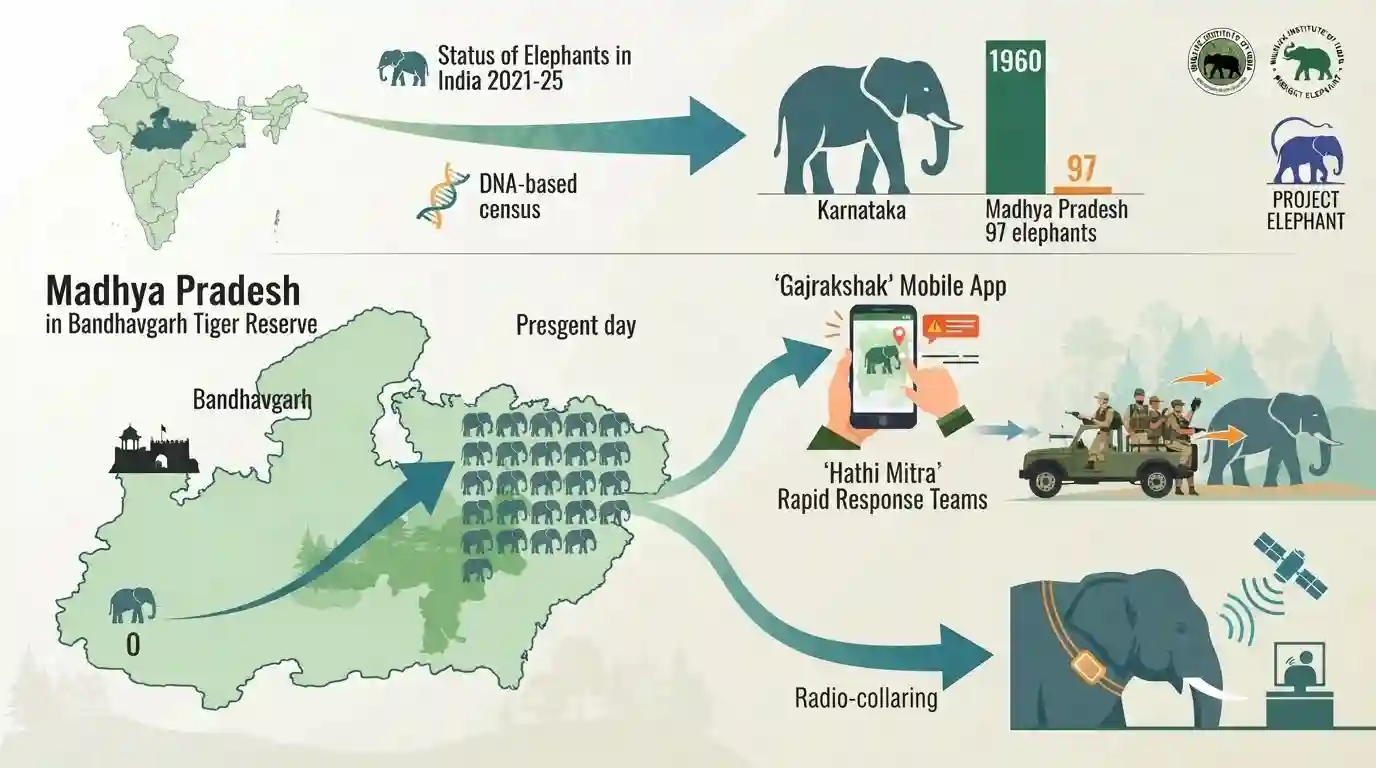
Bandhavgarh Tiger Reserve in Madhya Pradesh has witnessed a significant resurgence in its wild elephant population, nearing 100 individuals after being virtually absent for nearly a century. According to the "Status of Elephants in India 2021-25" report—based on India's first DNA-based elephant census by the Wildlife Institute of India and Project Elephant—Madhya Pradesh now hosts 97 wild elephants. Nationally, India has a total of 22,486 wild elephants, with Karnataka recording the highest numbers. The resurgence in MP is supported by conservation efforts, including the deployment of the 'Gajrakshak' mobile app, 'Hathi Mitra' rapid response teams, and radio-collaring to track and manage elephant movements.
Key Points
- Bandhavgarh Tiger Reserve in Madhya Pradesh has recorded nearly 100 wild elephants, a significant resurgence after nearly a century without them.
- The "Status of Elephants in India 2021-25" report confirms Madhya Pradesh has 97 wild elephants.
- The report is based on India's first-ever DNA-based elephant census, conducted by the Wildlife Institute of India (WII) and Project Elephant.
- India's total wild elephant population stands at 22,486, with Karnataka holding the highest number.
- Conservation and management efforts include the 'Gajrakshak' mobile application, 'Hathi Mitra' rapid response teams, and radio-collaring for tracking elephant movements.
Important Terms
Status of Elephants in India (SEI) 2021-25

India's first nationwide DNA-based wild elephant census. It estimated a national population of 22,446 (a decline from 2017) while highlighting shifting distributions, such as nearly 100 elephants permanently settling in Madhya Pradesh.
UPSC context
Crucial for GS-3 (Environment) to understand changing biodiversity baselines, habitat fragmentation, and current species estimation techniques in India.
DNA-based Elephant Census
A scientific population estimation method that analyzes genetic material from dung samples to uniquely identify individual elephants via mark-recapture models, replacing older, error-prone visual headcounts.
UPSC context
Important for GS-3 (Science & Tech in Conservation), illustrating the application of DNA fingerprinting to accurately monitor populations and genetic diversity.
Project Elephant
A Centrally Sponsored Scheme launched in 1992 by the MoEFCC. It provides financial and technical support to states to protect wild Asian elephants, secure their corridors, and mitigate human-elephant conflicts.
UPSC context
Essential for GS-3 (Biodiversity Conservation) regarding national policy frameworks and government interventions for protecting Schedule I flagship species.
Wildlife Institute of India (WII)
An autonomous institution under the Ministry of Environment, Forest and Climate Change that conducts specialized wildlife research and spearheaded India's recent DNA-based elephant population estimation.
UPSC context
Relevant for GS-3 (Environment) as it tests knowledge of India's premier scientific nodal agencies executing national wildlife conservation and monitoring programs.
Gaj Rakshak App
A technology-driven mobile application utilized in Madhya Pradesh that tracks real-time elephant movements and sends advance alerts to nearby villagers to prevent human-elephant encounters.
UPSC context
Highlights GS-3 (Disaster/Conflict Management) themes, showcasing how AI, GPS tracking, and mobile technology integrate into localized human-wildlife conflict mitigation models.
Prelims Trap
"The Status of Elephants 2021-25 census relies entirely on direct visual sightings and camera traps."
India transitioned to its first-ever DNA-based elephant census using dung samples and SECR modeling, moving away from older visual or dung-decay block counts.
Static Concepts Connected
What are the key features of Project Elephant and the MIKE programme?
- Centrally Sponsored: Launched in 1992 to protect elephants, their habitats, and corridors, while mitigating human-wildlife conflict.
- MIKE Programme: Established by CITES in 2003 to monitor the illegal killing of elephants and track poaching trends across range states.
- Heritage Status: The Asian Elephant was officially declared the National Heritage Animal of India in 2010.
What are the geographic and ecological characteristics of Bandhavgarh Tiger Reserve?
- Geographic Setting: Located in the Vindhya hill range of Madhya Pradesh, featuring a varied topography of valleys and steep ridges.
- Vegetation Type: Dominated by tropical moist deciduous forests, primarily comprising Sal trees, mixed forests, and extensive bamboo stretches.
- Species Reintroduction: Notable for the successful 2012 translocation and reintroduction of Gaurs (Indian Bison) from Kanha National Park.
Cross-Topic Patterns
Range Expansion via Inter-State Corridors
Elephants migrating from Chhattisgarh to MP highlight how habitat fragmentation and changing land-use force megaherbivores into historical ranges, emphasizing the critical role of inter-state eco-corridors.
DNA Profiling & Tech in Conservation
The shift to DNA-based SECR modeling for elephants mirrors technological upgrades in tiger conservation, highlighting a broader UPSC theme of transitioning from visual tracking to genetic methodologies.

Expect a 2026 multi-statement question contrasting Tiger and Elephant census methodologies (M-STrIPES vs DNA SECR) and their top host states.
Linked PYQs · 2
Linked PYQs · 2
- 2022MPPSC_PRELIMSGS1
Which of the following National Parks is the first in India to officially introduce a mascot named "Bhoorsingh the Barasingha"?
- 2025MPPSC_PRELIMSGS1
The Government of India passed the Environment (Protection) Act to protect and improve the quality of environment in:
