Civil Society Organizations and Non Communicable Disease Support
Source:The Hindu ↗
Why It Matters
Illustrates the practical contributions of civil society organizations, NGOs, and local government bodies in providing supportive care for non-communicable diseases. It serves as a good case study for answers discussing alternative models of public service delivery and community participation in healthcare.
Summary
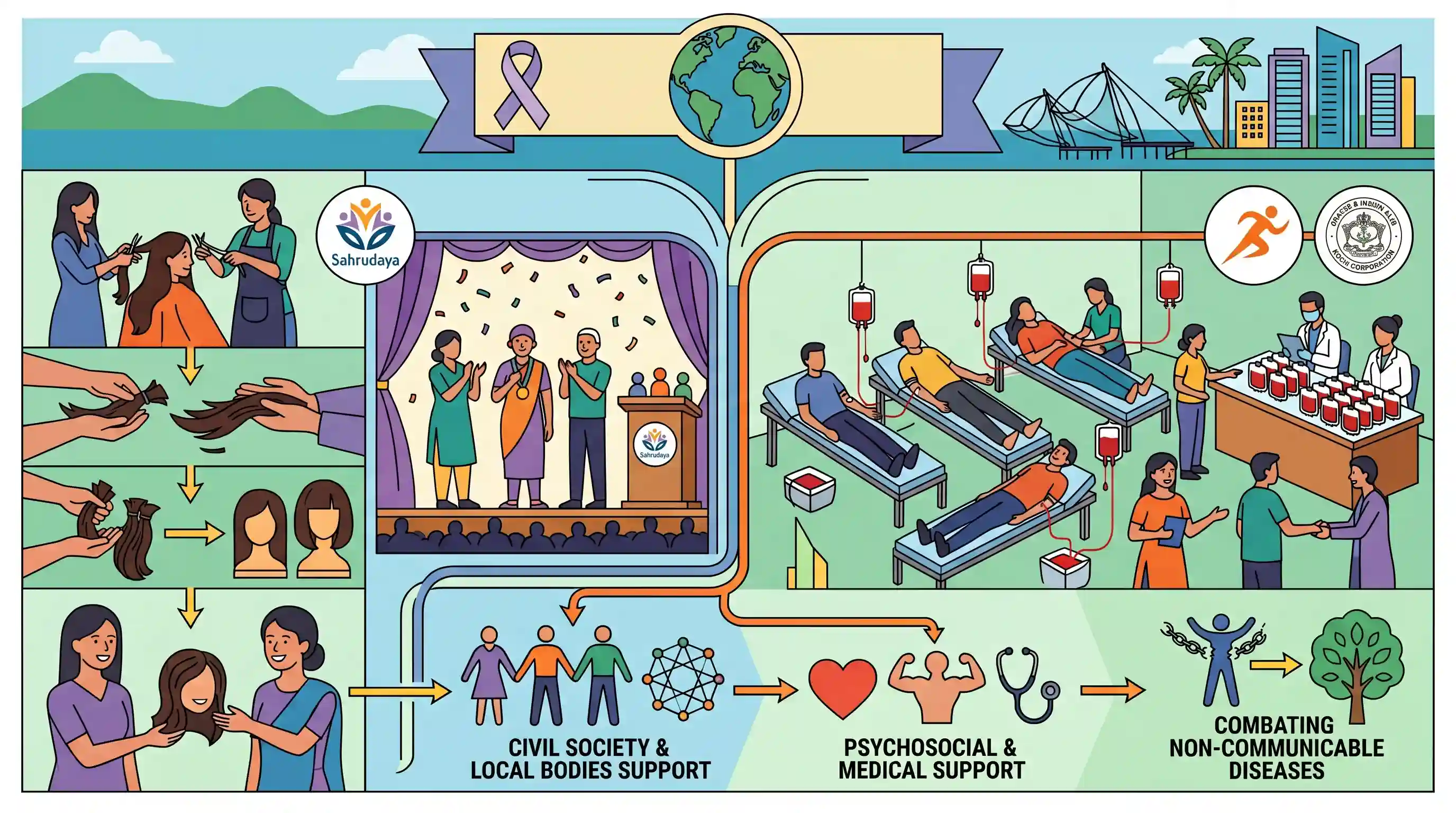
On World Cancer Day, community-driven initiatives were organized across Kochi, Kerala, to support cancer patients. Efforts included hair donation drives, the distribution of free wigs, and honoring cancer survivors, largely spearheaded by Sahrudaya, a social work organization. Additionally, a mega blood donation camp was held by the Orange Runners Club and Kochi Corporation. These activities highlight the essential role of civil society and local bodies in providing psychosocial and medical support to those affected by non-communicable diseases.
Key Points
- World Cancer Day was observed in Kochi with events focusing on patient support, including hair donation and the distribution of free wigs.
- Sahrudaya, the social work wing of the local archdiocese, spearheaded initiatives to instill confidence in cancer survivors and patients.
- A mega blood donation camp was jointly organized by the Orange Runners Club and the Kochi Corporation.
- The events underscore the vital role of civil society and community organizations in supplementing healthcare efforts for non-communicable diseases.
Important Terms
World Cancer Day

Global awareness initiative observed annually on February 4 to promote cancer prevention, early detection, and treatment. Led by the UICC, it aims to reduce the global disease burden and "close the care gap."
UPSC context
GS Paper II: Health/Social Sector. Important for questions on global health milestones, awareness campaigns, and disease control strategies.
Non-Communicable Diseases (NCDs)
Chronic illnesses like cancer, diabetes, and cardiovascular diseases that are not infectious. They cause 66% of deaths in India, making them a primary focus of the National Programme for Prevention and Control of NCDs.
UPSC context
GS Paper II & III: Health and S&T. Tests knowledge of India’s epidemiological transition and public health policy challenges.
Sahrudaya
The social service wing of the Ernakulam–Angamaly Archdiocese. It operates extensively in Kerala on healthcare (Asakiranam cancer project), housing, and rehabilitation, demonstrating how NGOs supplement state efforts in social welfare.
UPSC context
GS Paper II: Role of NGOs and Civil Society. A case study for civil society participation in social sector management and service delivery.
Kochi Corporation
The Urban Local Body (ULB) governing Kochi, Kerala. It implements decentralized health initiatives like Urban Health and Wellness Centres and is a member of the WHO Global Network of Age-friendly Cities.
UPSC context
GS Paper II: Governance/ULBs. Relevant for studying the role of local governments in public health and urban social justice.
Union for International Cancer Control (UICC)
The Geneva-based international organization that coordinates World Cancer Day. It works to integrate cancer control into the global health agenda and promotes the implementation of the World Cancer Declaration.
UPSC context
GS Paper II: International Organizations. Relevant for understanding global health governance and multi-stakeholder partnerships in disease control.
Sustainable Development Goal (SDG) 3.4
A United Nations target to reduce premature mortality from non-communicable diseases, including cancer, by one-third by 2030 through prevention and treatment. India is currently striving to meet this benchmark.
UPSC context
GS Paper II & III: Social Development/Health. A core metric for evaluating national and global progress in health and wellbeing.
Prelims Trap
"World Cancer Day is an official global health day organized directly by the World Health Organization."
World Cancer Day is spearheaded by the Union for International Cancer Control (UICC), a non-governmental organization, not the WHO/UN.
Static Concepts Connected
What is the National Programme for Prevention & Control of Non-Communicable Diseases (NP-NCD)?
- Renamed scope: Formerly NPCDCS, the programme was renamed to broaden its scope beyond cancer, diabetes, cardiovascular diseases, and stroke.
- Universal screening: Focuses on population-based screening for common NCDs (diabetes, hypertension, common cancers) at Ayushman Arogya Mandirs.
- NHM integration: Converges with the National Health Mission (NHM) to provide financial and infrastructure support up to the district hospital level.
How does the National Health Policy 2017 approach palliative care?
- Wellness focus: The policy shifts focus from purely curative sick-care to holistic wellness and comprehensive primary healthcare.
- Service integration: It formally recognizes and integrates palliative and rehabilitative care (including psychosocial support) into standard primary healthcare services.
Cross-Topic Patterns
NGOs bridging NCD healthcare gaps
Community-driven models highlight the GS2 syllabus area of 'Role of NGOs' by filling non-clinical, psychosocial gaps (like palliative care) left by strained state healthcare infrastructure.
NCD burden eroding demographic dividend
Rising NCD prevalence (accounting for 66% of deaths) in India’s active workforce connects GS2 health policies directly with GS3 concerns around human capital and economic growth.

Expect a GS2 Mains question on integrating civil society into public palliative care models to tackle India's rising NCD burden.
Linked PYQs · 3
Linked PYQs · 3
- 2024MainsGS2
Public charitable trusts have the potential to make India's development more inclusive as they relate to certain vital public issues. Comment.
- 2021MainsGS2
Can Civil Society and Non-Governmental Organizations present an alternative model of public service delivery to benefit the common citizen? Discuss the challenges of this alternative model.
- 2020MainsGS2
In order to enhance the prospects of social development, sound and adequate health care policies are needed particularly in the fields of geriatric and maternal health care. Discuss.
