World Bank Climate Finance Targets and Multilateral Policy Shift
Source:The Hindu ↗
Why It Matters
This development highlights the geopolitical vulnerability of global climate finance and MDBs to the political shifts in major donor nations (like the US). For India, which has a massive portfolio of World Bank-funded projects across renewable energy, water resources, and climate-resilient infrastructure, any dilution in multilateral climate commitments could impact the speed and predictability of funding for its domestic climate adaptation and mitigation programs under the Paris Agreement.
Summary
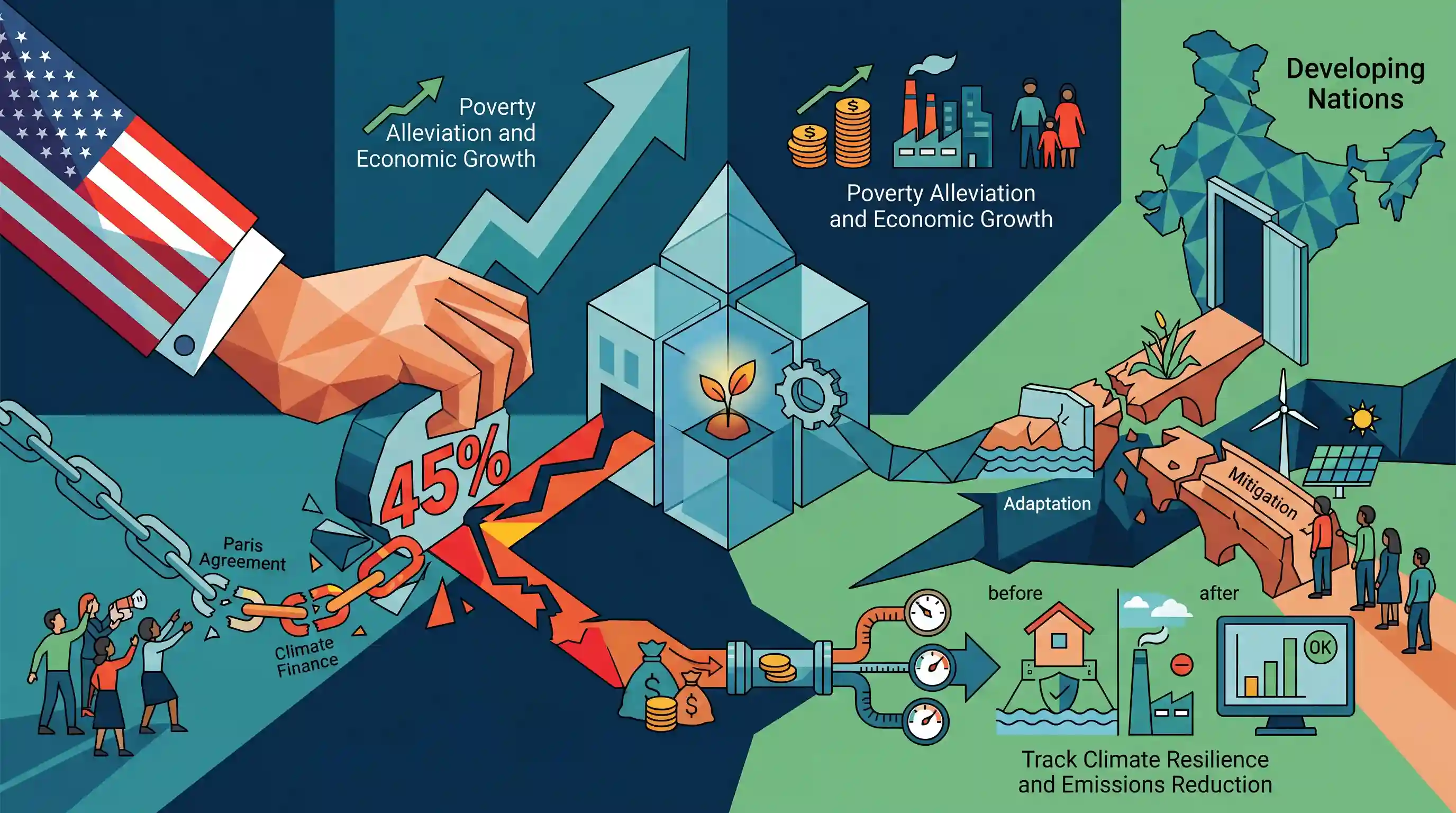
The World Bank Group has scrapped its 45% climate finance target from its Climate Change Action Plan (CCAP) following criticism from its largest shareholder, the United States. While the US Treasury claimed that these rigid climate targets distort the Bank's core mission of poverty alleviation and economic growth, climate advocates argue that the decision undermines international climate finance commitments. The World Bank maintains that it will transition from input-based targets to outcome-based metrics to track climate resilience and emissions reduction. This move raises concerns for developing nations like India, which rely heavily on multilateral development banks (MDBs) to fund critical climate adaptation and mitigation initiatives.
Key Points
- The World Bank Group (WBG) has retired its specific 45% funding target for climate-centric projects from its Climate Change Action Plan (CCAP).
- The decision follows intense pressure and criticism from the United States (the Bank's largest shareholder), with Treasury Secretary Scott Bessent arguing that the Bank should prioritize poverty reduction and economic growth over climate-focused percentage targets.
- The World Bank states it is shifting from input-based metrics (such as the 45% funding target) to outcome-based metrics, focusing on indicators like net greenhouse gas emissions reduced and number of people with enhanced resilience.
- Climate advocates and developing nations express deep concern, warning that removing explicit MDB financing targets weakens the collective capability to mobilize the $300 billion annually required for climate actions in developing countries.
- India has a vast array of World Bank-funded climate mitigation and adaptation projects (including freight rail electrification, Atal Bhujal Yojana, solar energy parks, forest restoration, and disaster resilience) which could face funding uncertainties.
Important Terms
World Bank Group

A family of five international organizations providing development loans, grants, and technical assistance to reduce poverty and foster shared prosperity in developing nations.
UPSC context
GS Paper II: Important International Institutions. Tests global development financing, multilateral bank structures, and international governance reforms.
Climate Change Action Plan (CCAP)
The World Bank Group's strategic framework designed to integrate climate action into development planning, scale up climate financing, and help countries align with Paris Agreement targets.
UPSC context
GS Paper III: Environment and Climate Change. Tests knowledge of institutional strategies, multilateral climate financing, and developmental outcomes.
Paris Agreement
A legally binding international treaty adopted at COP21 in 2015, aiming to limit global warming to well below 2°C, preferably 1.5°C, compared to pre-industrial levels.
UPSC context
GS Paper III: Environment. Tests understanding of global emission reduction treaties, Nationally Determined Contributions (NDCs), and climate mitigation frameworks.
World Bank
A vital international financial institution consisting of IBRD and IDA, working together to provide low-interest loans, credits, and grants to middle- and low-income nations.
UPSC context
GS Paper II: Important International Institutions. Tests distinction between WBG constituent bodies and their roles in public development finance.
Kyoto Protocol
An international treaty adopted in 1997 under the UNFCCC that committed industrialized nations to legally binding targets for reducing greenhouse gas emissions.
UPSC context
GS Paper III: Environment. Tests historical global treaties, the Principle of Common but Differentiated Responsibilities, and carbon market mechanisms.
Prelims Trap
The United States holds a permanent, formal veto seat in the IBRD Articles of Agreement, independent of its shareholding percentage.
The US veto is not a designated 'permanent member' privilege like the UNSC. It is purely mathematical: amendments require an 85% supermajority, and because the US holds 15.85% of shares, it can unilaterally block changes.
Static Concepts Connected
What is the structure and voting mechanism of the World Bank Group?
- Five Entities: Consists of IBRD, IDA, IFC, MIGA, and ICSID; however, the term 'World Bank' strictly refers only to IBRD and IDA.
- Share-Weighted Voting: Voting power is subscription-based, determined by the share capital held by each member state, rather than a 'one country, one vote' system.
- India's Position: India holds a 2.91% voting share in the IBRD, making it the seventh-largest shareholder globally.
What is the New Collective Quantified Goal (NCQG) under the UNFCCC?
- Origin: Agreed at COP29 in Baku (2024) to succeed the previous target of $100 billion per year.
- Core Target: Mandates developed nations to lead in mobilizing at least $300 billion annually by 2035 for developing countries.
- Global Scope: Positions the $300 billion target within a larger global climate investment goal of $1.3 trillion annually.
Cross-Topic Patterns
MDB reforms vs. Shareholder geopolitics
G20 pushes for MDB capital expansion under Indian presidency recommendations face direct resistance when top shareholders unilaterally alter lending criteria based on domestic political shifts.
Input targets vs. Outcome-based governance
The World Bank's pivot from 45% funding inputs to outcome metrics mirrors India's own domestic shift toward outcome-budgeting, altering how global environmental accountability is tracked.

MDB restructuring, the mathematical US veto in IBRD, and COP29 NCQG commitments are highly likely to merge into a single GS-2/3 question.
Linked PYQs · 3
Linked PYQs · 3
- 2025PrelimsGS1
Consider the following statements in respect of the International Bank for Reconstruction and Development (IBRD) : I. It provides loans and guarantees to middle income countries. II. It works single-handedly to help developing countries to reduce poverty. III. It was established to help Europe rebuild after the World War II. Which of the statements given above are correct?
- 2025MainsGS3
Write a review on India's climate commitments under the Paris Agreement (2015) and mention how these have been further strengthened in COP26 (2021). In this direction, how has the first Nationally Determined Contribution intended by India been updated in 2022?
- 2021MainsGS3
Describe the major outcomes of the 26th session of the Conference of the Parties (COP) to the United Nations Framework Convention on Climate Change (UNFCCC). What are the commitments made by India in this conference?
