RBI Forex Intervention and Rupee Stability Amid Geopolitical Crises
Source:Indian Express ↗
Why It Matters
Provides an excellent real-world example of RBI's managed floating exchange rate operations during times of geopolitical stress. It highlights the importance of macroeconomic buffers—specifically domestically denominated government debt and low current account deficits—in shielding emerging economies from global volatility and imported inflation.
Summary
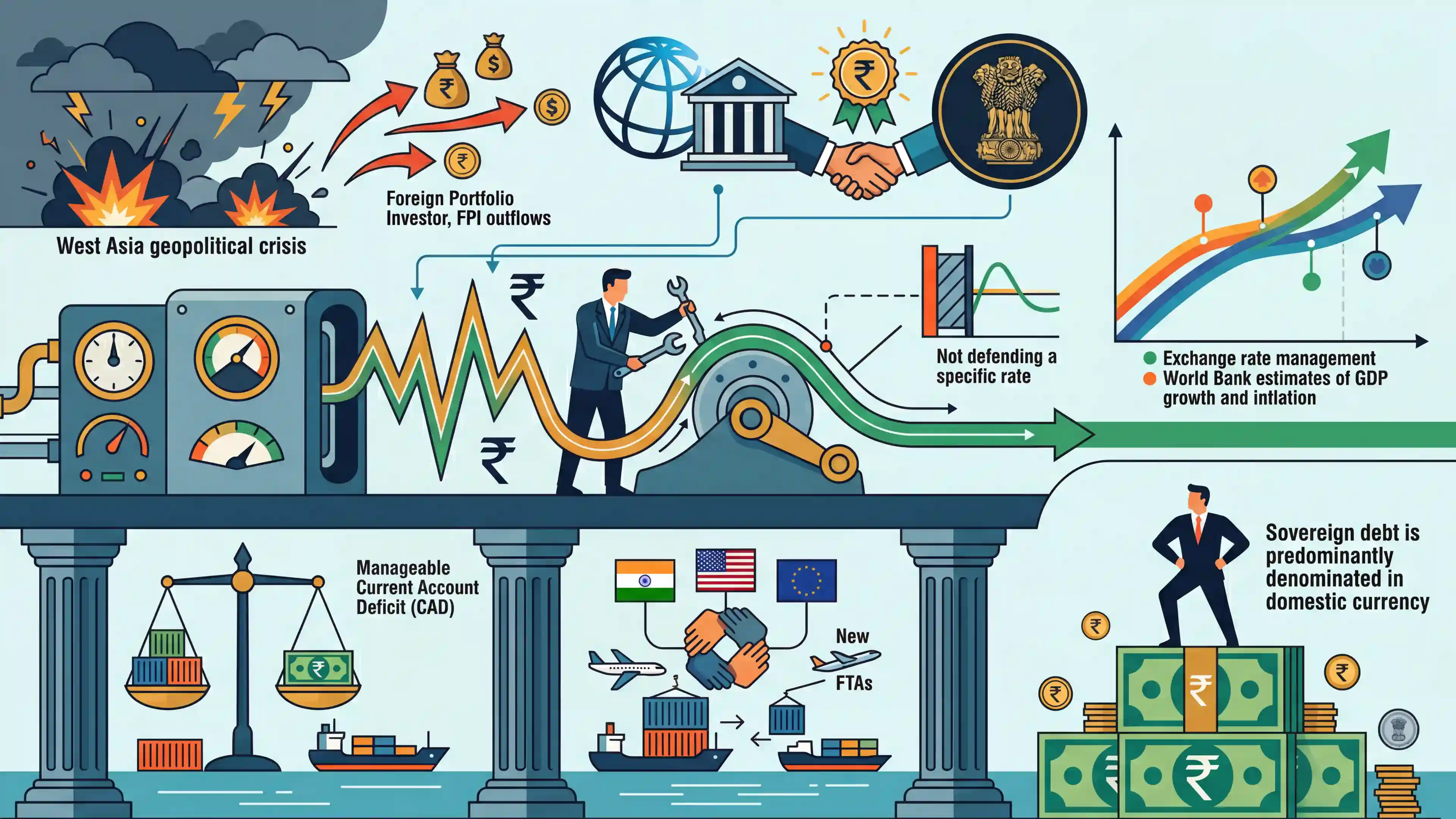
The World Bank has commended the Reserve Bank of India (RBI) for effectively managing short-term exchange rate volatility amid global headwinds, including the West Asia geopolitical crisis and Foreign Portfolio Investor (FPI) outflows. Despite the rupee's sharp depreciation, the RBI's interventions have ensured a smooth adjustment by mitigating disruptive volatility rather than defending a specific exchange rate. The World Bank also projects India’s GDP growth at 6.6% for FY27, expecting inflation to rise to 4.9%, while the RBI holds slightly more optimistic estimates. India's macroeconomic fundamentals remain exceptionally strong, largely due to a manageable current account deficit, new Free Trade Agreements with the US and EU, and crucially, sovereign debt that is predominantly denominated in domestic rupees rather than foreign currency.
Key Points
- The World Bank praised the Reserve Bank of India's (RBI) exchange rate management for effectively absorbing global shocks and preventing disruptive volatility in the rupee.
- RBI Governor Shaktikanta Das emphasized that the central bank intervenes in the forex market only to curb excessive short-term volatility, maintaining a managed floating exchange rate rather than targeting specific levels.
- The rupee faced intense depreciation pressures due to major geopolitical developments, including the US-Israel conflict with Iran and significant Foreign Portfolio Investment (FPI) outflows.
- The World Bank raised its FY27 GDP growth forecast for India to 6.6% but warned that retail inflation could reach 4.9%. The RBI expects 6.9% growth and 4.6% inflation.
- India's macroeconomic stability is heavily buffered by its low current account deficit and the fact that its government debt is almost entirely denominated in domestic currency (rupees), shielding the exchequer from currency depreciation risks.
- Recent Free Trade Agreements with the EU and the US are expected to boost exports and help offset geopolitical headwinds.
Important Terms
India-EU Free Trade Agreement (FTA)

A comprehensive trade pact concluded in January 2026 between India and the European Union, aiming to liberalize over 96% of trade in goods and services while enhancing sustainability.
UPSC context
GS II (International Relations) & GS III (Economy); tests trade diplomacy and impacts on domestic manufacturing and services sectors.
India-US Bilateral Trade Agreement (BTA)
A phased trade deal (first tranche nearing completion in April 2026) focused on preferential market access and tariff reductions between India and the United States.
UPSC context
GS II (Bilateral Relations); essential for understanding India's strategic economic pivot and trade negotiation dynamics with its largest trading partners.
Reserve Bank of India (RBI)
India's central bank and monetary authority, responsible for controlling inflation, managing rupee exchange rate volatility, and overseeing the banking system and foreign exchange reserves.
UPSC context
GS III (Indian Economy); core to monetary policy, currency management, and maintaining macroeconomic stability amidst global shocks.
World Bank
A global financial institution that provides loans and grants; in 2026, it commended India's macroeconomic management while projecting a 6.6% GDP growth for FY27.
UPSC context
GS II (International Institutions); tests knowledge of multilateral organizations and their influence on global economic policy and development.
Foreign Portfolio Investor (FPI)
An international investor holding Indian financial assets like stocks or bonds; FPIs are highly sensitive to global risks, often causing rapid capital flight during crises.
UPSC context
GS III (Economy); tests understanding of capital markets, external sector vulnerability, and the impact of global sentiment on domestic liquidity.
Managed Float
An exchange rate system where the central bank intervenes in the forex market to curb excessive volatility without fixing the currency to a specific value.
UPSC context
GS III (Economy); tests conceptual clarity on exchange rate regimes and the RBI's strategic role in currency stabilization.
Current Account Deficit (CAD)
An economic indicator measuring the gap between a country's total exports and imports; a manageable CAD is essential for long-term macroeconomic health and currency stability.
UPSC context
GS III (Economy); a core macroeconomic concept testing knowledge of the external sector and balance of payments.
West Asia Crisis
A 2026 geopolitical conflict (specifically involving Iran) that disrupted critical energy corridors like the Strait of Hormuz, causing global oil price spikes and market volatility.
UPSC context
GS II (International Relations); tests analysis of regional geopolitics and its direct economic consequences on India's energy security and trade.
Prelims Trap
The RBI intervenes in the forex market to defend a specific exchange rate target for the rupee.
India follows a 'managed floating' regime. The RBI intervenes solely to curb excessive short-term volatility and smooth adjustments, not to fix or defend a specific exchange rate.
Static Concepts Connected
How does India's 'managed floating' exchange rate system function?
- Market-determined: The value of the rupee is primarily driven by open market forces of demand and supply.
- RBI Intervention: The central bank buys or sells foreign currency reserves to smooth out extreme, disruptive volatility.
- No Fixed Target: Unlike fixed regimes, there is no predefined numerical target rate that the central bank defends.
Why is India's sovereign debt shielded from currency depreciation risks?
- Domestic Domination: The vast majority of India's public debt is internal and denominated in Indian Rupees.
- Low Currency Risk: Rupee depreciation does not increase the government's repayment burden or fiscal deficit for domestic debt.
- Private External Debt: India's external commercial borrowings and foreign-currency debt are largely held by the private sector, not the sovereign.
Cross-Topic Patterns
Currency Depreciation and Imported Inflation
A weakening rupee makes inelastic imports like crude oil costlier, directly linking external capital flight to domestic retail inflation and complicating RBI's monetary policy.
Geopolitics, FPIs and Safe-Haven Flight
West Asian conflicts trigger risk-aversion, causing FPIs to pull capital from emerging markets like India toward safe-haven assets, straining the balance of payments.

Expect a 2026 prelims question linking RBI's managed float, FPI outflows, and the domestic-currency composition of India's sovereign debt.
Linked PYQs · 3
Linked PYQs · 3
- 2025PrelimsGS1
Which of the following are the sources of income for the Reserve Bank of India? I. Buying and selling Government bonds II. Buying and selling foreign currency III. Pension fund management IV. Lending to private companies V. Printing and distributing currency notes Select the correct answer using the code given below.
- 2024PrelimsGS1
Consider the following statements : 1. In India, Non-Banking Financial Companies can access the Liquidity Adjustment Facility window of the Reserve Bank of India. 2. In India, Foreign Institutional Investors can hold the Government Securities (G-Secs). 3. In India, Stock Exchanges can offer separate trading platforms for debts. Which of the statements given above is/are correct?
- 2022PrelimsGS1
With reference to the Indian economy, consider the following statements: 1. A share of the household financial savings goes towards government borrowings. 2. Dated securities issued at market-related rates in auctions form a large component of internal debt. Which of the above statements is/are correct?
