India and New Zealand bilateral defence and maritime security ties
Source:The Hindu ↗
Why It Matters
This highlights the growing strategic footprint of India-New Zealand ties, moving beyond traditional trade to include substantive defence, maritime security, and strategic alignment in the Indo-Pacific. It is highly relevant for GS-2 (Bilateral Relations, Geopolitics) and GS-3 (Security).
Summary
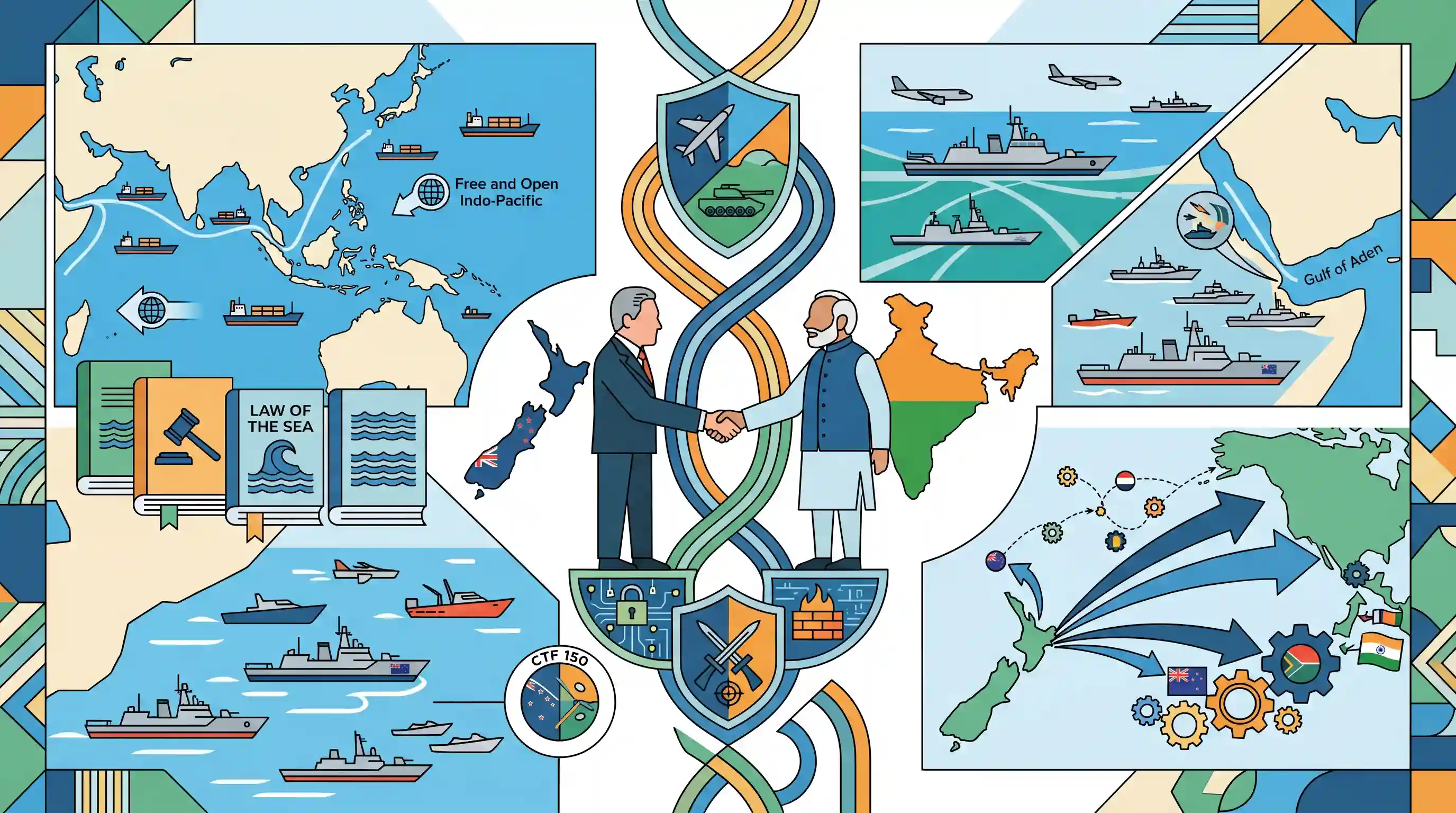
New Zealand's Deputy Prime Minister Winston Peters, during his visit to India, highlighted an expanding bilateral partnership focusing on defence, cybersecurity, and counter-terrorism. Both nations are committed to maintaining a free and open Indo-Pacific, anchored in the UNCLOS framework. The collaboration includes securing strategic trade routes, with New Zealand currently leading the Combined Task Force 150 (CTF 150) in the Indian Ocean and Gulf of Aden. The dialogue also emphasized the 'small states matter' doctrine in maintaining global norms, marking New Zealand's strategic pivot toward stronger engagement in Asia.
Key Points
- New Zealand's Deputy PM Winston Peters emphasized working closely with India on defence, cyber security, and counter-terrorism, signaling a strategic shift to engage more with South and Southeast Asia.
- Both nations aim to maintain a free and open Indo-Pacific, strictly adhering to the United Nations Convention on the Law of the Sea (UNCLOS) to ensure freedom of navigation.
- The visit underscored the significance of the recently signed Defence Cooperation Arrangement and mutual efforts to secure critical trade routes.
- New Zealand currently leads the Combined Task Force 150 (CTF 150), a 34-nation naval partnership tackling terrorism, piracy, and smuggling in the Indian Ocean and Gulf of Aden.
- Peters also advocated for the 'small states matter' framework, highlighting that countries regardless of size have a vital role in upholding international rules and norms.
Important Terms
United Nations Convention on the Law of the Sea (UNCLOS)

A 1982 international treaty establishing a comprehensive legal framework for all maritime activities. It defines maritime zones like Territorial Seas (12nm) and Exclusive Economic Zones (200nm), balancing coastal sovereignty with freedom of navigation.
UPSC context
GS Paper II (International Treaties) & GS Paper III (Maritime Security). Tests understanding of global maritime governance and India's EEZ rights.
Combined Task Force 150 (CTF 150)
A multinational naval task force under the Combined Maritime Forces (CMF) focused on counter-terrorism and maritime security. It disrupts illicit trade, including drugs and weapons smuggling, across the Indian Ocean and Gulf of Oman.
UPSC context
GS Paper II (Global Groupings) & GS Paper III (Maritime Security). Tests knowledge of multinational naval partnerships and India’s maritime role.
Defence Cooperation Arrangement (India-New Zealand)
A 2025 bilateral pact institutionalizing military ties between India and New Zealand. It covers regular dialogues, joint exercises, and industry collaboration to enhance maritime security and counter-terrorism in the Indo-Pacific region.
UPSC context
GS Paper II (Bilateral Relations). Tests awareness of India’s strategic extension and deepening security partnerships with Pacific-rim nations.
Small States Matter Doctrine
A strategic principle advocating that smaller nations are vital for upholding global norms and international law. It emphasizes that small states can prevent a 'might is right' environment through collective engagement.
UPSC context
GS Paper II (International Relations). Tests conceptual understanding of strategic autonomy and the role of small powers in balancing global geopolitics.
Free and Open Indo-Pacific (FOIP)
A geopolitical vision advocating for a transparent, rules-based region where freedom of navigation, trade, and sovereignty are protected under international law. It aims to prevent regional hegemony and ensure stability.
UPSC context
GS Paper II (Regional Geopolitics). Tests knowledge of India’s central role in the Indo-Pacific and its strategic alignment with like-minded democracies.
Prelims Trap
CTF 150 is a UN-mandated naval task force deployed to combat piracy in the Indian Ocean.
CTF 150 is a non-treaty multinational naval partnership under the US-led Combined Maritime Forces (CMF), not a UN-mandated or UN-led peacekeeping mission.
Static Concepts Connected
What are the key maritime jurisdictional zones defined under UNCLOS?
- Territorial Sea: Extends up to 12 nautical miles from the baseline; the coastal state exercises near-absolute sovereignty over the airspace, water column, and seabed.
- Contiguous Zone: Extends up to 24 nautical miles; the state can enforce customs, taxation, sanitary, and immigration laws.
- Exclusive Economic Zone (EEZ): Extends up to 200 nautical miles; the coastal state holds sovereign rights over resource exploration, exploitation, and marine management, but not full sovereignty.
What is the Combined Maritime Forces (CMF) framework?
- US-Led Coalition: A US-led multi-national naval partnership headquartered in Bahrain, focusing on counter-narcotics, counter-smuggling, and anti-piracy across the Middle East, Red Sea, and Indian Ocean.
- Indian Membership: India officially elevated its status from an associate partner to a full member of the CMF in late 2023, enhancing interoperability in the region.
Cross-Topic Patterns
Pacific Islands + FIPIC outreach
New Zealand’s 'small states matter' doctrine aligns with India's Forum for India-Pacific Islands Cooperation (FIPIC), strategically counter-balancing China's expanding footprint in the South Pacific.
Red Sea disruptions + Maritime choke points
Securing the Gulf of Aden through CTF 150 links directly to broader supply chain resilience, frequently tested alongside recent Houthi-led Red Sea disruptions and strategic choke points.

Expect a matched-pair Prelims question linking maritime choke points (Gulf of Aden, Red Sea) with multinational task forces like CTF 150.
Linked PYQs · 3
Linked PYQs · 3
- 2014MainsGS2
With respect to the South China sea, maritime territorial disputes and rising tension affirm the need for safeguarding maritime security to ensure freedom of navigation and over flight throughout the region. In this context, discuss the bilateral issues between India and China.
- 2020MainsGS2
What is the significance of Indo-US defence deals over Indo-Russian defence deals? Discuss with reference to stability in the Indo-Pacific region.
- 2023MainsGS2
‘Sea is an important Component of the Cosmos’ Discuss in the light of the above statement the role of the IMO (International Maritime Organisation) in protecting environment and enhancing maritime safety and security.
