India Must Secure National Interests in Bilateral Trade Deals
Source:Indian Express ↗
Why It Matters
Indo-US relations are a cornerstone of India's foreign policy. Understanding the nuances of trade negotiations, defense deals, and strategic autonomy is critical for Mains GS2 (International Relations) and interview stages.
Summary
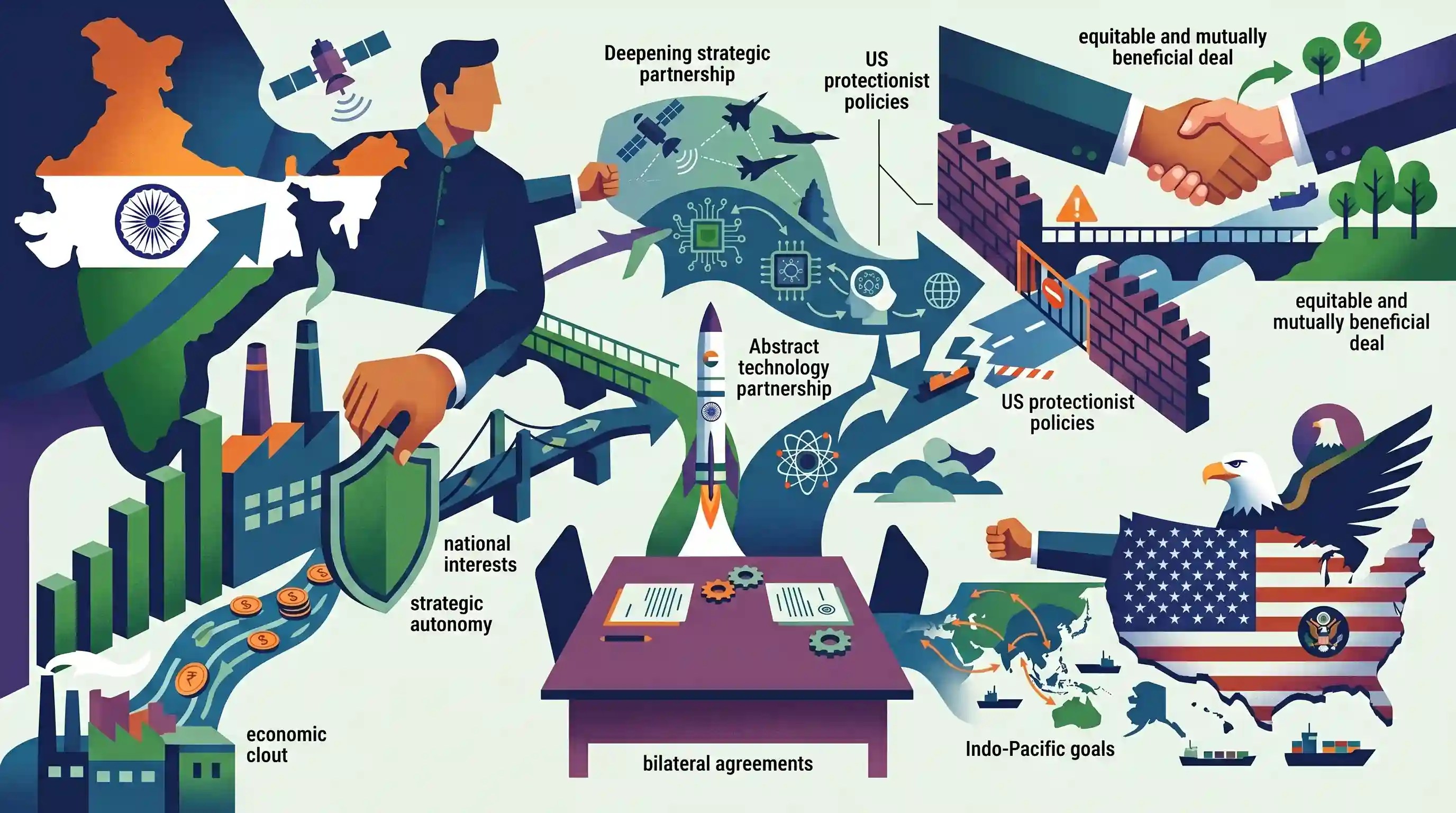
The article advocates for India to proactively negotiate bilateral agreements with the United States that firmly protect its national interests. While acknowledging the importance of the deepening Indo-US strategic partnership—spanning defense, technology (like iCET), and shared geopolitical goals in the Indo-Pacific—the author emphasizes that India must not compromise its strategic autonomy. By leveraging its growing economic clout and regional significance, India can better navigate US protectionist policies and trade barriers, ensuring that any comprehensive 'deal' reached is equitable and mutually beneficial.
Key Points
- India must strategically negotiate bilateral agreements with the US to secure its core national interests, particularly in trade, defense, and emerging technologies.
- The evolving Indo-US strategic partnership is vital for regional stability and balancing geopolitical dynamics in the Indo-Pacific.
- Agreements should not compromise India's strategic autonomy; India must push back against unequal compromises.
- India needs to leverage its growing market size and geopolitical weight to counter US protectionist measures, such as tariffs and immigration policies.
Important Terms
Initiative on Critical and Emerging Technology (iCET)

A 2023 India-US framework fostering bilateral cooperation in AI, semiconductors, space, and defense to enhance strategic depth and reduce technology-access barriers.
UPSC context
GS Paper II (International Relations); tests technology transfer and supply chain resilience.
Quadrilateral Security Dialogue (Quad)
An informal strategic forum of India, USA, Japan, and Australia focused on ensuring a free, open, and rules-based Indo-Pacific through multi-sectoral cooperation.
UPSC context
GS Paper II (International Relations); tests maritime security and regional balancing.
Strategic Autonomy
India's foreign policy principle of making independent sovereign decisions based on national interest, avoiding formal military alliances while engaging multiple global powers (multi-alignment).
UPSC context
GS Paper II (Foreign Policy); core for understanding India’s balancing act.
Indo-Pacific
A strategic maritime theater linking the Indian and Pacific Oceans, vital for global trade, security, and upholding a rules-based international order.
UPSC context
GS Paper II (Regional Groupings); central to India's SAGAR and Act East policies.
Major Defence Partner
A unique 2016 US status for India, allowing advanced technology sharing and defense trade at levels comparable to treaty allies without a formal alliance.
UPSC context
GS Paper II (Bilateral Relations); reflects the deepening Indo-US defense and strategic convergence.
Foundational Agreements
Four pacts (GSOMIA, LEMOA, COMCASA, BECA) signed between India and the US to facilitate military interoperability, logistics support, and geospatial intelligence sharing.
UPSC context
GS Paper II (Bilateral Relations); the structural basis of Indo-US defense cooperation.
Prelims Trap
"The Initiative on Critical and Emerging Technology (iCET) is a multilateral technology-sharing agreement under the Quad framework."
iCET is strictly a bilateral agreement between India and the United States. It is not a multilateral or Quad initiative, despite shared geopolitical goals.
Static Concepts Connected
How does 'Strategic Autonomy' differ from traditional 'Non-Alignment'?
- Non-Alignment (NAM): Historically focused on staying aloof from Cold War blocs and maintaining passive neutrality in global conflicts.
- Strategic Autonomy: Involves issue-based alignment where India actively partners with multiple poles without formal, restrictive alliance commitments.
- Defense Procurement: Evident in India purchasing S-400 systems from Russia while simultaneously signing foundational defense pacts (LEMOA, COMCASA) with the US.
What are the common US trade barriers affecting Indian exports?
- Section 232 Tariffs: Tariffs imposed by the US on steel and aluminum imports, controversially citing 'national security' concerns.
- GSP Withdrawal: The US revoked India's Generalized System of Preferences status in 2019, removing duty-free access for thousands of Indian goods.
- Non-Tariff Barriers: Stringent FDA inspections on pharmaceuticals and rigorous sanitary/phytosanitary (SPS) measures applied to Indian agricultural products.
Cross-Topic Patterns
Tech diplomacy: iCET and Semiconductor Mission
India's domestic PLI schemes for semiconductors heavily rely on the US iCET framework for high-tech transfer and joint R&D to bypass Chinese-dominated supply chains.
Protectionism masking as security and climate policy
Similar to US 'America First' tariffs, Western climate policies (like the EU's CBAM) are increasingly acting as non-tariff barriers, challenging India's export competitiveness under the guise of security or environment.

Expect a 2026 Prelims multi-statement question on iCET sectors, or a Mains prompt on reconciling strategic autonomy with US trade tariffs.
Linked PYQs · 3
Linked PYQs · 3
- 2020MainsGS2
What is the significance of Indo-US defence deals over Indo-Russian defence deals? Discuss with reference to stability in the Indo-Pacific region.
- 2023MainsGS2
‘The expansion and strengthening of NATO and a stronger US-Europe strategic partnership works well for India.’ What is your opinion about this statement ? Give reasons and examples to support your answer.
- 2018MainsGS2
What are the key areas of reform if the WTO has to survive in the present context of "Trade War', especially keeping in mind the interest of India?
