Jal Jeevan Mission projects stall due to pending central funds
Source:theprint ↗
Why It Matters
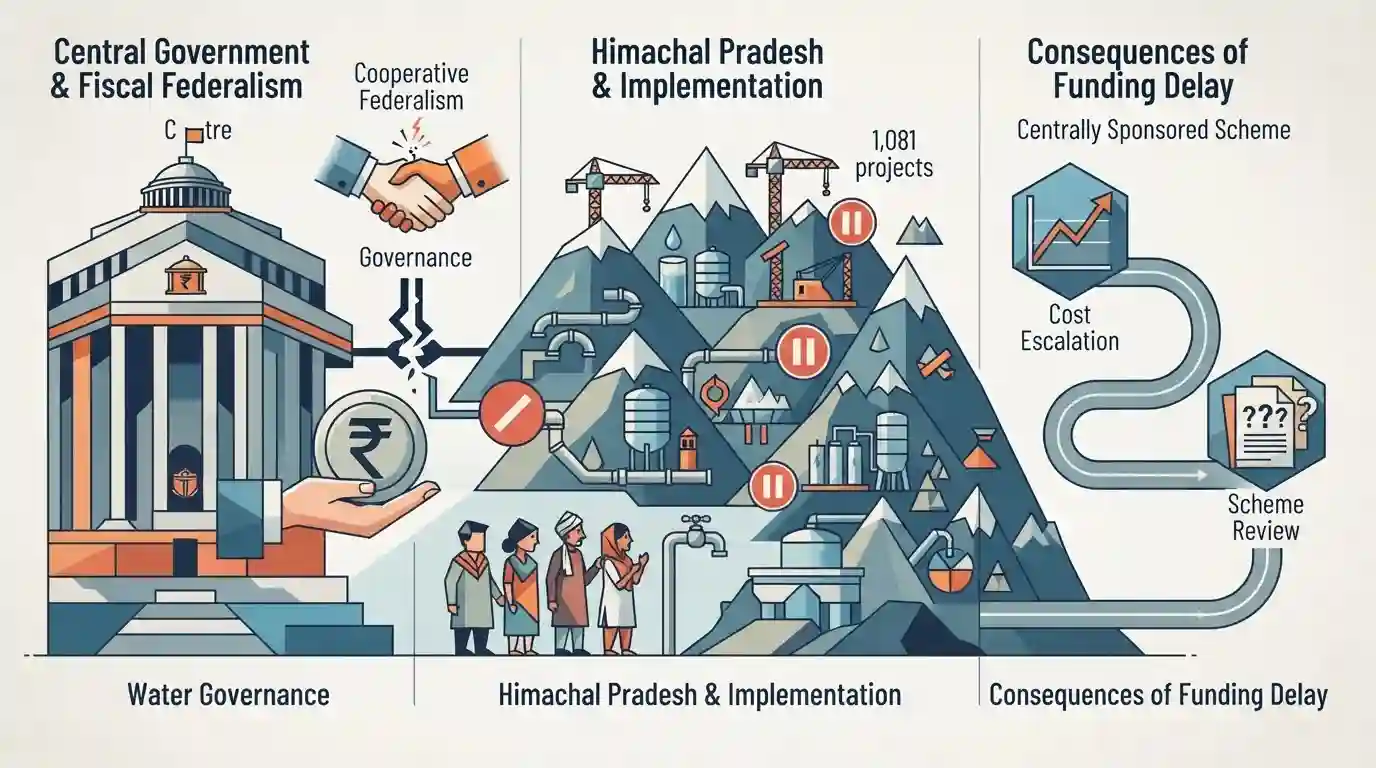
The issue exemplifies the real-world friction in fiscal federalism, demonstrating how delays in the release of the Central share of funds for Centrally Sponsored Schemes (CSS) can derail vital infrastructure projects, specifically drinking water supply under the Jal Jeevan Mission. It underlines the governance challenges faced by states, especially those with difficult topographies like Himachal Pradesh, in managing scheme implementations and cost overruns.
Summary
The implementation of 1,081 drinking water projects under the Jal Jeevan Mission has stalled in Himachal Pradesh because the Central Government has not released Rs 1,227 crore in pending funds. Deputy Chief Minister Mukesh Agnihotri informed the state assembly that the state has urged the Centre to either clear the dues or formally close the schemes. The funding delay highlights the vulnerabilities of Centrally Sponsored Schemes, particularly in difficult geographic terrains where cost escalations and changing project parameters further complicate execution.
Key Points
- Construction on 1,081 drinking water schemes in Himachal Pradesh under the Jal Jeevan Mission has been halted due to a funding shortfall.
- The State Government cited the non-release of approximately Rs 1,227 crore by the Central Government as the primary reason for the stalled works.
- Himachal Pradesh's Jal Shakti department has requested the Centre to either disburse the pending funds or officially close the incomplete schemes to resolve the financial limbo.
- Implementation in hard-to-reach, snow-bound areas like Pangi and Bharmour faces additional hurdles due to frequent changes in scheme parameters and consequent cost escalations.
Important Terms
Jal Jeevan Mission

A Centrally Sponsored Scheme aimed at providing functional household tap connections to all rural households. For special category states like Himachal Pradesh, it follows a 90:10 Centre-State funding ratio.
UPSC context
Crucial for GS Paper 2 and 3; tests knowledge of rural development, water governance, and Centre-State funding patterns.
Har Ghar Jal
A milestone status under the Jal Jeevan Mission, achieved when every rural household in a designated area is provided with a functional and assured tap water connection.
UPSC context
Important for Prelims and GS Paper 2, assessing state achievements in water governance, rural infrastructure, and public service delivery.
Centrally Sponsored Schemes
Developmental programs funded by the Union Government but implemented by State Governments. Funding is shared; for Himalayan states like Himachal Pradesh, the Centre contributes 90% of the funds.
UPSC context
Key to GS Paper 2 (Polity) for testing Centre-State relations, cooperative federalism, and the financial reliance of special category states.
Fiscal Federalism
The framework for dividing financial responsibilities and resources between the Union and State governments. It includes tax devolution, grants, and scheme funding, deeply impacting state budgets and developmental works.
UPSC context
Highly relevant for GS Paper 2 and 3, testing Centre-State financial relations, Finance Commission roles, and state fiscal constraints.
Prelims Trap
"Jal Jeevan Mission is 100% centrally funded for Himalayan and North-Eastern states."
While HP is a Special Category/Himalayan state, JJM is a Centrally Sponsored Scheme (CSS) with a 90:10 ratio, not 100% Central Sector funding.
Static Concepts Connected
How are Union Government schemes funded in Himachal Pradesh?
- CSS (90:10): Centrally Sponsored Schemes (CSS) like JJM operate on a 90:10 (Centre:State) ratio for Special Category States, including HP.
- General States (50:50): General states receive a 50:50 or 60:40 funding split for most CSS schemes, highlighting the financial concession given to Himalayan terrains.
- Central Sector Schemes: Unlike CSS, these schemes are 100% funded and implemented directly by the Union Government across all states (e.g., PM-KISAN).
What makes Pangi and Bharmour administratively and geographically distinct in HP?
- Pir Panjal Geography: Both are harsh, snow-bound tribal tehsils located in Chamba district, separated by the Pir Panjal range.
- Single Line Administration: They are governed under the unique 'Single Line Administration' system (introduced in Pangi in 1986) to bypass red tape and expedite development in difficult terrain.
- 5th Schedule Areas: Both are Scheduled Areas under the 5th Schedule of the Constitution, predominantly inhabited by the Pangwal and Gaddi tribes.
Cross-Topic Patterns
CSS delays and HP's fiscal federalism
Delays in CSS funds (like JJM) directly strain Himachal's debt-ridden exchequer, highlighting the practical challenges of cooperative federalism even when Special Category Status (90:10 funding) is applied.
Terrain cost escalation in tribal belts
Cost escalations and parameter changes in Pangi/Bharmour mirror identical hurdles in HP's hydro and PMGSY road projects, where Pir Panjal's harsh geography repeatedly inflates infrastructure budgets.

Expect a multi-statement Q combining JJM's 90:10 HP funding ratio, HP's 100% FHTC milestone, and Pir Panjal geography (Pangi/Bharmour).
Linked PYQs · 2
Linked PYQs · 2
- 2022HPAS_PRELIMSGS1
Which of the following statements about 'Jal-Jeevan-Mission' is not correct ? (i) In H.P. it is targeted to include every rural household in providing 'Functional Household Tap Connection (FHTC) to every family by June, 2022. (ii) Out of 17.28 lakh households, 15.80 lakh were provided FHTC upto December, 2021. (iii) In Himachal Pradesh 91% of the households have been provided with domestic connection against a national average of 45.50 percent. (iv) Himachal Pradesh places at 8th position in the country for providing FHTC.
- 2016HPAS_PRELIMSGS1
Which of the following statements is correct in reference to the Finance Commission of India ?
