Three-language formula controversy and linguistic federalism tensions
Source:The Hindu ↗
Why It Matters
The recurring debate over the 'imposition' of Hindi touches upon constitutional provisions regarding official languages (Article 343-351), the Eighth Schedule, and the balance of Centre-State relations. It illustrates the complexities of implementing national education frameworks like the three-language formula in a linguistically diverse federal structure.
Summary
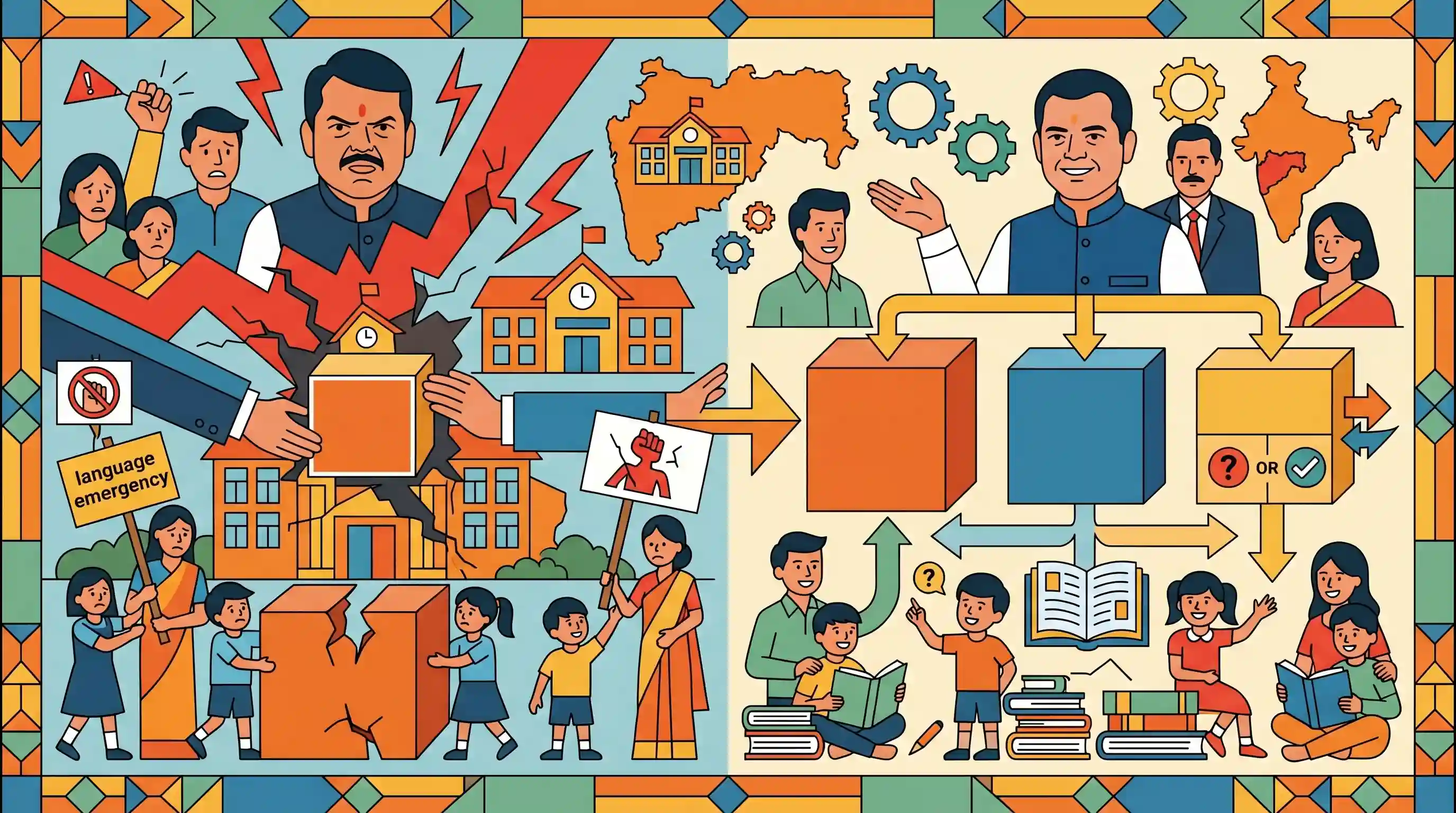
A political row has erupted in Maharashtra over the implementation of the three-language formula in schools, with Shiv Sena (UBT) chief Uddhav Thackeray accusing the BJP-led state government of imposing Hindi. The controversy stems from a recent order introducing Hindi as a third language in Marathi and English medium schools for Classes 1 to 5. While Chief Minister Devendra Fadnavis has clarified that Hindi remains optional and Marathi compulsory, Thackeray has termed the move a 'language emergency' intended to divide people on linguistic lines. The issue underscores persistent tensions over linguistic identity, regionalism, and federal friction regarding education policies in India.
Key Points
- Shiv Sena (UBT) leader Uddhav Thackeray has accused the BJP of imposing a 'language emergency' by attempting to mandate Hindi in Maharashtra.
- The dispute originated from a state government order to generally teach Hindi as a third language in Marathi and English medium schools for Classes 1 to 5.
- Maharashtra Chief Minister Devendra Fadnavis clarified that Hindi is optional and Marathi remains compulsory; schools can offer alternative Indian languages if demanded by at least 20 students per grade.
- Thackeray announced that his party would participate in civil society protests against the three-language formula, framing the issue as an infringement on linguistic identity and regional cohesion.
Important Terms
Three-language formula

A language policy framework (1968, 2020) where students learn three languages: mother tongue/regional language, Hindi, and English, designed to promote multilingualism and national integration across diverse states.
UPSC context
GS Paper II (Social Justice/Education). Tests understanding of linguistic pluralism, NEP 2020 implementation, and challenges in uniform policy across diverse states.
Linguistic Regionalism
Political or social movements driven by intense attachment to a native language, often seeking to protect regional identity against perceived cultural or linguistic imposition by the Centre.
UPSC context
GS Paper I (Society/Diversity) and GS Paper II (Federalism). Relevant for discussing national integration vs. sub-national aspirations and regional identity.
Article 351
A constitutional provision directing the Union to promote the spread and development of Hindi to serve as a medium of expression for India's composite culture.
UPSC context
GS Paper II (Polity). Essential for understanding the Union’s constitutional duty regarding language and the legal basis for Hindi promotion.
Concurrent List
Found in the Seventh Schedule (Entry 25), this list includes subjects where both Centre and States can legislate. Education was moved here from the State List by the 42nd Amendment.
UPSC context
GS Paper II (Polity). Explains the division of powers and legal friction in education policies like the three-language formula.
Official Language
The language used for government business. Under Article 343, Hindi (Devanagari script) is the Union's official language, while English continues for official purposes as per the Official Languages Act, 1963.
UPSC context
GS Paper II (Constitution). Tests the distinction between 'Official Language' and 'National Language' (India has none) and related constitutional protections.
Sub-nationalism
A political ideology emphasizing the identity and interests of a specific region or linguistic group within a nation, often manifesting as regional pride or 'Marathi Manoos' identity.
UPSC context
GS Paper I (Social Issues). Tests the impact of regional political parties and linguistic identity on national unity and state reorganisation logic.
Prelims Trap
Hindi is recognized as the National Language, and NEP 2020 mandates its inclusion in schools.
India has no National Language; Hindi is the Official Language (Art 343). Furthermore, NEP 2020 explicitly states no language will be imposed on any State.
Static Concepts Connected
What are the key Constitutional directives regarding language in India?
- Article 343: Declares Hindi in Devanagari script as the Official Language of the Union, alongside the continued use of English.
- Article 350A: Directs states to provide instruction in the mother-tongue at the primary stage for children belonging to linguistic minority groups.
- Article 351: Directs the Union to promote the spread of Hindi to serve as a medium of expression for India's composite culture.
How does NEP 2020 update the historical Three-Language Formula?
- State Flexibility: Retains the formula but emphasizes flexibility; states and students choose the languages, provided at least two are native to India.
- No Imposition: Explicitly mandates that no specific language (including Hindi) will be forced on any State or student.
- Medium of Instruction: Strongly advocates for using the mother tongue or local language as the medium of instruction at least until Grade 5.
Cross-Topic Patterns
Concurrent List friction in Education
Education sits in the Concurrent List. National frameworks like the NEP often clash with regional linguistic politics, making it a classic case study for federal friction.
Linguistic reorganization echoes
Current disputes over language imposition mirror the historical State Reorganization Commission debates, showing how linguistic identity remains a potent political mobilizer in federal dynamics.

Expect a 2026 prelims question contrasting Article 351's mandate to promote Hindi with NEP 2020's strict 'no language imposition' clause.
Linked PYQs · 5
Linked PYQs · 5
- 2025MainsGS2
Indian Constitution has conferred the amending power on the ordinary legislative institutions with a few procedural hurdles. In view of this statement, examine the procedural and substantive limitations on the amending power of the Parliament to change the Constitution.
- 2023MainsGS2
Compare and contrast the British and Indian approaches to Parliamentary sovereignty.
- 2020MainsGS2
Judicial Legislation is antithetical to the doctrine of separation of powers as envisaged in the Indian Constitution. In this context justify the filing of large number of public interest petitions praying for issuing guidelines to executive authorities.
- 2023MainsGS2
Skill development programmes have succeeded in increasing human resources supply to various sectors. In the context of the statement analyse the linkages between education, skill and employment.
- 2020MainsGS2
National Education Policy 2020 is in conformity with the Sustainable Development Goal-4 (2030). It intends to restructure and reorient education system in India. Critically examine the statement.
