Constitutional Amendment and Delimitation Federal Hurdles
Source:Indian Express ↗
Why It Matters
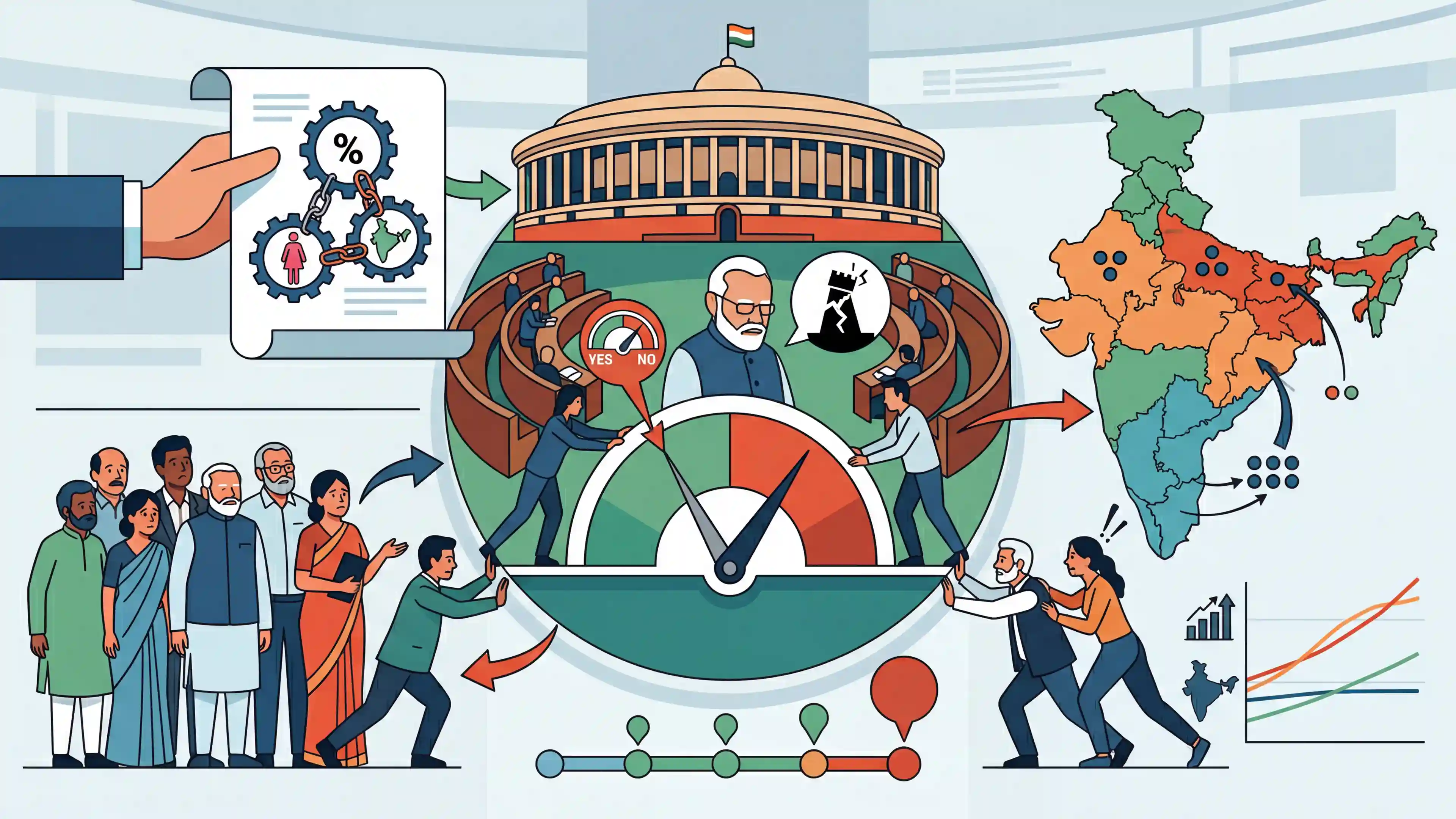
The defeat of a constitutional amendment provides a practical illustration of the stringent legislative checks (special majority requirement) embedded in Article 368. Additionally, the debate underscores a pivotal federal issue for India's future: balancing demographic shifts with equitable political representation among states during the impending delimitation process.
Summary
The Constitution (131st Amendment) Bill, 2026, marking the first major legislative defeat for the Modi government since 2014, failed to pass the Lok Sabha as it fell short of the required two-thirds special majority. The Bill sought to expedite the implementation of a 33% quota for women alongside initiating a delimitation exercise for an expanded Parliament. The unified Opposition voted against the amendment, raising federal concerns that the linked delimitation process would disproportionately penalize southern states for their successful population control measures by reducing their political representation.
Key Points
- The Constitution (131st Amendment) Bill, 2026, was defeated in the Lok Sabha, failing to secure the mandatory two-thirds special majority with 298 votes in favour and 230 against.
- The Bill aimed to simultaneously advance the 33% women's reservation quota and facilitate the delimitation of constituencies in an expanded Lok Sabha and state Assemblies.
- Opposition parties successfully blocked the Bill, alleging it was a political maneuver to redraw the electoral map in favour of the ruling party and reduce the parliamentary representation of southern states.
- Following the defeat, related bills on delimitation and Union Territories were deferred.
- The original 2023 women's reservation law remains legally intact despite the failure of this advancing amendment.
Important Terms
Constitution (131st Amendment) Bill, 2026

A 2026 legislative proposal to expedite 33% women's reservation by using 2011 census data for delimitation and expanding Lok Sabha seats; it failed to secure a two-thirds special majority.
UPSC context
GS Paper II: Indian Constitution and Amendments. Tests understanding of legislative procedures and the intersection of electoral reform with demographic data.
Nari Shakti Vandan Adhiniyam
The 106th Constitutional Amendment Act, 2023, which mandates 33% reservation for women in the Lok Sabha and State Legislative Assemblies, originally contingent on the next census and delimitation.
UPSC context
GS Paper I/II: Social Justice and Governance. Tests knowledge of gender-based affirmative action and statutory barriers to its implementation.
Delimitation of Constituencies
The act of redrawing boundaries of parliamentary and assembly constituencies based on the latest census to ensure 'one person, one vote, one value.'
UPSC context
GS Paper II: Representation of People Act. Tests understanding of Article 82 and the political implications of population-linked seat allocation.
Special Majority (Article 368)
Requirement under Article 368 needing support from a majority of the House total strength and two-thirds of members present and voting to pass constitutional amendments.
UPSC context
GS Paper II: Constitutional Amendment Process. Tests technical knowledge of Article 368 and the difference between simple and special majorities.
Federalism and North-South Divide
The constitutional distribution of power between Union and states; currently debated regarding how population-based seat allocation affects the political weight of Southern vs. Northern states.
UPSC context
GS Paper II: Issues and Challenges Pertaining to the Federal Structure. Tests analysis of inter-state equity and population control incentives.
Prelims Trap
The defeat of the 2026 Amendment Bill nullifies the 33% women's reservation mandate passed in 2023.
The original Nari Shakti Vandan Adhiniyam (106th Amendment, 2023) remains constitutionally intact. The defeated 2026 Bill merely sought to expedite its implementation and expand Parliament.
Static Concepts Connected
What constitutes a 'special majority' under Article 368?
- Total Membership: Requires a majority (more than 50%) of the total membership of the House, regardless of vacancies or absentees.
- Present & Voting: Requires an affirmative vote by at least two-thirds of the members who are present and voting in that House.
- No Joint Sittings: Unlike ordinary bills, Article 368 does not allow for joint sittings to resolve a legislative deadlock between the Houses.
What are the powers and restrictions of the Delimitation Commission?
- Statutory Authority: It is a high-powered statutory body appointed by the President, working in collaboration with the Election Commission of India.
- Absolute Finality: Its boundary-drawing orders have the force of law and cannot be challenged or questioned before any court.
- No Legislative Modification: Neither the Lok Sabha nor the State Legislative Assemblies can modify the final orders issued by the Commission.
- Constitutional Freeze: The 84th Amendment Act (2001) froze the state-wise allocation of Lok Sabha seats until the first census post-2026 is published.
Cross-Topic Patterns
Demographic transition & Federalism
Linking delimitation to post-2026 census data creates a federal paradox: southern states that successfully implemented national population control policies face a potential loss of parliamentary leverage at the Centre.
Tax Devolution & Finance Commissions
This political demographic penalty mirrors debates in the 15th and 16th Finance Commissions, where updating the population base year for tax devolution sparked similar North-South federal friction.

Expect a multi-statement Prelims question in 2026 combining Art 368 special majority rules, the 84th Amendment, and Delimitation powers.
Linked PYQs · 3
Linked PYQs · 3
- 2022PrelimsGS1
Consider the following statements: 1. A bill amending the Constitution requires a prior recommendation of the President of India. 2. When a Constitution Amendment Bill is presented to the President of India, it is obligatory for the President of India to give his/her assent. 3. A Constitution Amendment Bill must be passed by both the Lok Sabha and the Rajya Sabha by a special majority and there is no provision for joint sitting. Which of the statements given above are correct?
- 2024PrelimsGS1
As per Article 368 of the Constitution of India, the Parliament may amend any provision of the Constitution by way of : 1. Addition 2. Variation 3. Repeal Select the correct answer using the code given below:
- 2023MainsGS2
Discuss the contribution of civil society groups for women's effective and meaningful participation and representation in state legislatures in India.
