Womens Reservation Bill and Substantive Representation in Politics
Source:Indian Express ↗
Why It Matters
It evaluates the transition from mere numerical presence to substantive political empowerment for women under the Women's Reservation Bill, critical for GS2 Governance and Polity.
Summary
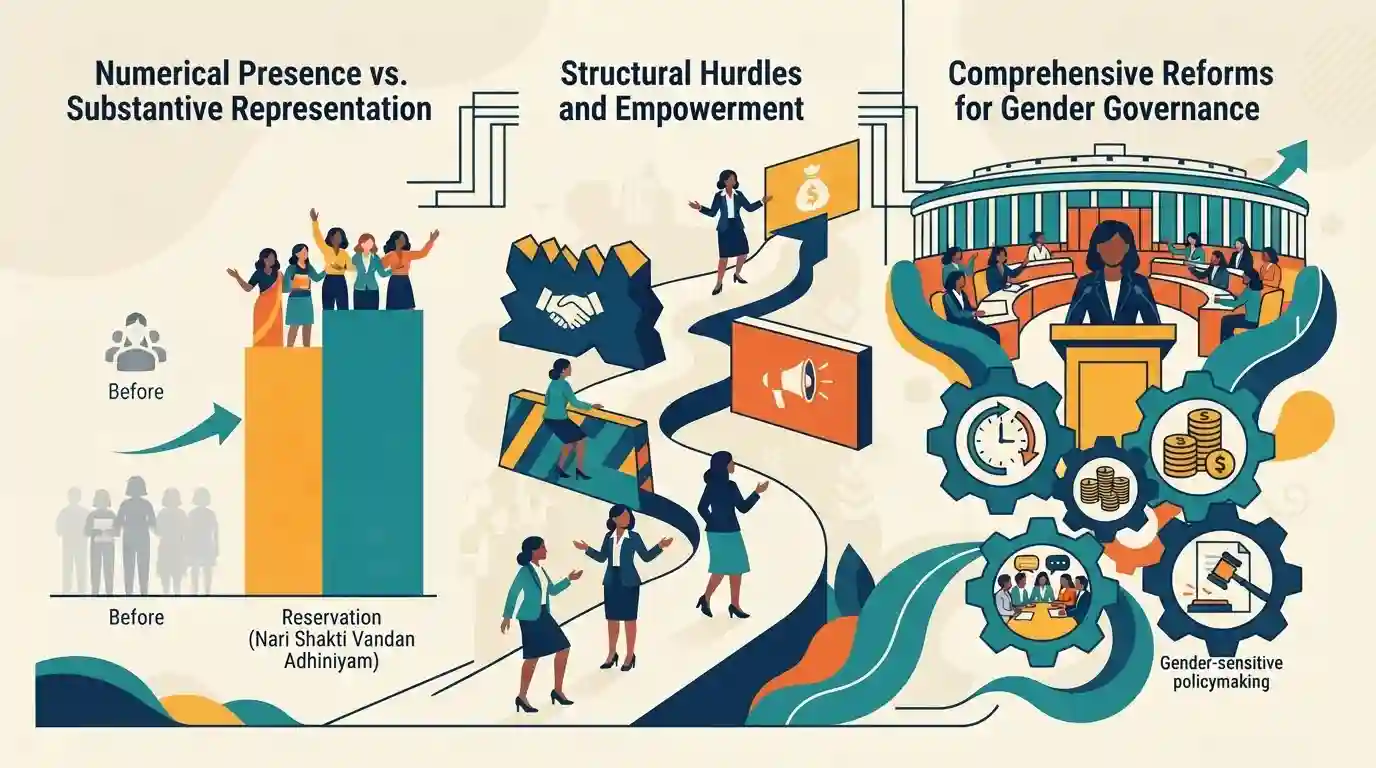
The article analyzes the Women's Reservation Bill (Nari Shakti Vandan Adhiniyam) beyond numerical presence, discussing the transition to substantive representation, structural hurdles faced by women in politics, and the comprehensive reforms needed for genuine gender empowerment in governance.
Key Points
- The Women's Reservation Bill moves the political discourse from mere presence to substantive and meaningful representation of women in governance.
- Structural barriers such as lack of financial resources, patriarchal party structures, and violence against women in public life hinder effective political participation.
- Gender equality in legislatures requires internal party democracy, capacity building, and changing societal attitudes alongside legislative quotas.
Important Terms
Nari Shakti Vandan Adhiniyam

The official legislative title of the Women's Reservation Bill enacted as the 106th Constitutional Amendment Act, 2023, providing 33% reservation for women in Lok Sabha and State Assemblies.
UPSC context
UPSC GS Paper II: Governance, Constitution, Polity - Women empowerment, legislative representation, and structural reforms in governance.
Women's Reservation Bill
A landmark constitutional amendment legislation ensuring one-third of seats for women in Parliament and state legislatures to boost substantive political representation.
UPSC context
UPSC GS Paper II: Parliament and State Legislatures, representation of women, and social justice.
Parliament
The supreme legislative body of India comprising the President, Lok Sabha, and Rajya Sabha, responsible for enacting laws and holding the executive accountable.
UPSC context
UPSC GS Paper II: Structure, organization, and functioning of the Parliament and the Executive.
Prelims Trap
mandates immediate implementation of one-third reservation for women in the upcoming Lok Sabha elections without census or delimitation preconditions.
Aspirants often assume the Nari Shakti Vandan Adhiniyam came into immediate effect for the very next general election, ignoring that it is contingent upon the publication of the first census post-enactment and subsequent delimitation.
Static Concepts Connected
What are the constitutional provisions and amendments related to women's political participation in India?
- Local Bodies Quotas: 73rd & 74th Amendments mandated not less than one-third reservation for women in Panchayats and Municipalities across all tiers.
- Election Commission: Article 324 empowers the Election Commission to ensure fair elections, but internal party democracy regarding ticket distribution remains largely unregulated.
- 106th Amendment Act: The 106th Constitutional Amendment Act (Nari Shakti Vandan Adhiniyam) provides 33% reservation in Lok Sabha and State Assemblies for 15 years.
Cross-Topic Patterns
Women's Quotas and Delimitation Mechanics
The 106th Amendment reflects how affirmative action statutes interact with federalism, delayed census execution, and delimitation timelines under Article 82.
Local Governance Realities and 'Sarpanch Pati'
Grassroots proxy representation ('Sarpanch Pati') mirrors the gap between de jure decentralization under the 73rd/74th Amendments and de facto patriarchal control.

Expect statements distinguishing descriptive vs. substantive representation, or tying quotas to delimitation & census triggers.
Linked PYQs · 3
Linked PYQs · 3
- 2023MainsGS2
Discuss the contribution of civil society groups for women's effective and meaningful participation and representation in state legislatures in India.
- 2025MainsGS2
Women's social capital complements in advancing empowerment and gender equity. Explain.
- 2023MainsGS2
Explain the constitutional perspectives of Gender Justice with the help of relevant Constitutional Provisions and case laws.
