Women Coalition Demands Immediate Implementation of Quota
Source:The Hindu ↗
Why It Matters
This development highlights the ongoing debate surrounding the timeline and hurdles in implementing the Nari Shakti Vandan Adhiniyam. Linking the quota to the Census and delimitation has raised federal concerns (especially among southern states fearing loss of parliamentary representation) and gender justice concerns, making it a critical topic for UPSC GS-II (Polity & Governance) and essay papers on gender empowerment.
Summary
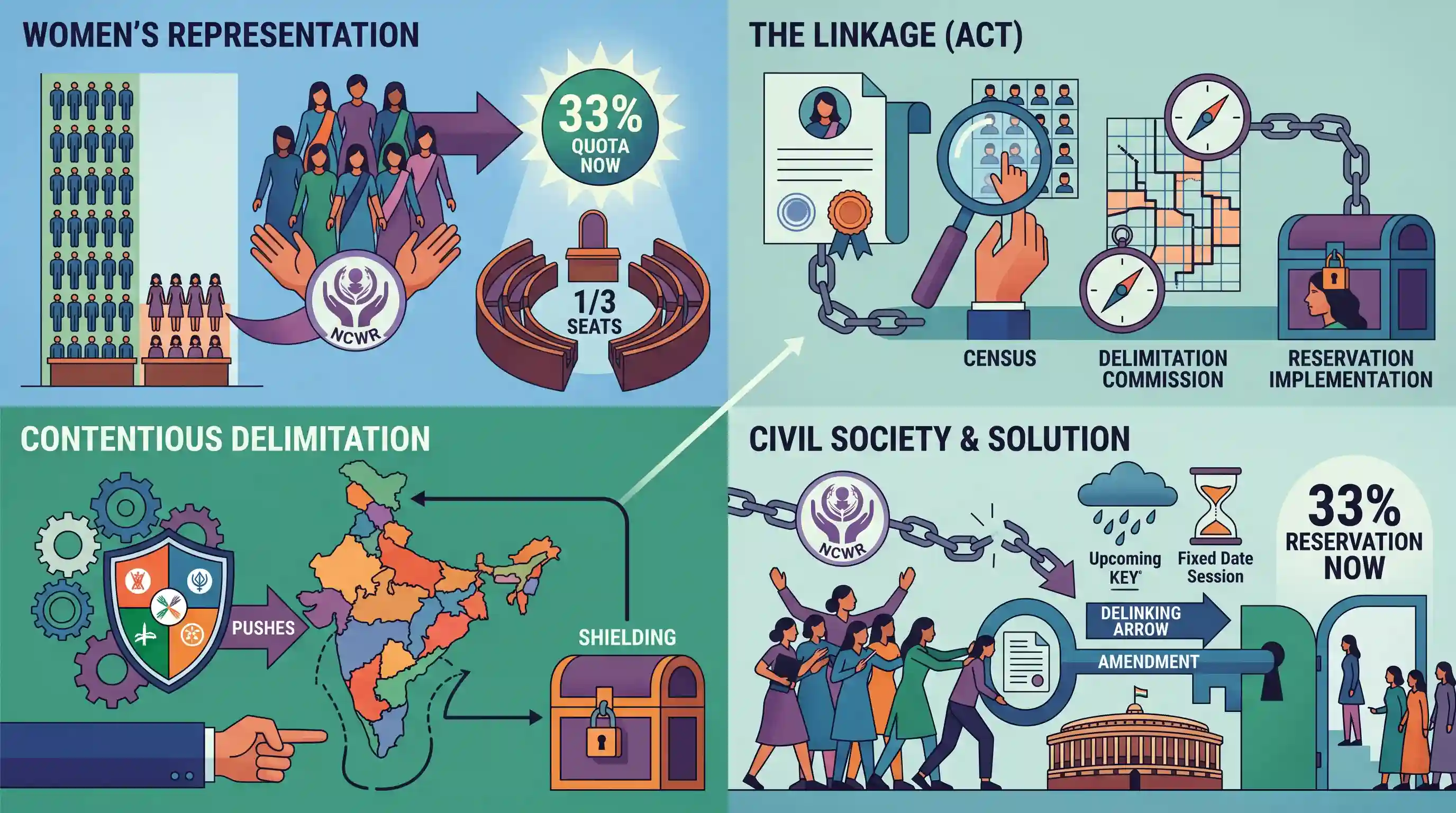
The National Coalition for Women's Reservation (NCWR), a coalition of women's organisations and civil society groups, has demanded the immediate, unconditional implementation of the 33% women's quota in Parliament and State Assemblies at their existing strength. Under the Constitution (106th Amendment) Act, 2023 (Nari Shakti Vandan Adhiniyam), the implementation of the reservation is linked to the completion of the next Census and subsequent delimitation. The coalition argues that this linkage serves as a political shield to push through the contentious delimitation exercise and is urging the government to introduce an amendment in the upcoming Monsoon Session of Parliament to delink the reservation from both processes.
Key Points
- The National Coalition for Women's Reservation (NCWR), a coalition of women's rights organisations and civil society groups, has demanded that the Union government introduce a Constitutional Amendment Bill in the upcoming Monsoon Session to delink the one-third (33%) women's reservation from the Census and delimitation processes.
- The Coalition demanded immediate, unconditional implementation of the 33% reservation in the Lok Sabha and State Legislative Assemblies based on the existing seat strength starting from the next round of elections.
- Under the Constitution (106th Amendment) Act, also known as the Nari Shakti Vandan Adhiniyam (passed in September 2023), the 33% quota will only take effect after the first Census conducted post-commencement of the Act and the subsequent delimitation exercise are completed.
- Activists and public signatories (including prominent academics, artists, and former civil servants) argue that the government is using the popular women's reservation as a political front to force the passage of the politically contentious delimitation and expansion of Lok Sabha seats.
- NCWR announced a nationwide campaign involving protests (such as daily demonstrations at Jantar Mantar during the Monsoon Session), national conferences with women MPs, and social media outreach to build public pressure for immediate implementation.
Important Terms
Constitution (106th Amendment) Act

A landmark constitutional amendment enacted in 2023 that mandates reserving one-third of seats for women in the Lok Sabha, State Legislative Assemblies, and the Delhi Legislative Assembly.
UPSC context
GS Paper II: Polity & Constitution, specifically regarding women’s representation, legislative reforms, and constitutional amendments.
Nari Shakti Vandan Adhiniyam
The popular name for India's 106th Constitutional Amendment Act, which provides 33 percent legislative reservation for women to ensure gender parity in key political institutions.
UPSC context
GS Paper II: Social Justice and Polity, testing women’s development, political participation, and gender-inclusive governance.
National Coalition for Women's Reservation (NCWR)
An active coalition of women's rights organisations, civil society groups, and citizens demanding the immediate and unconditional implementation of the legislative quota for women in India.
UPSC context
GS Paper II: Role of pressure groups, civil society organisations, and citizen-led advocacy in policy formulation.
Satark Nagrik Sangathan
An independent, Delhi-based citizens' advocacy group established in 2003 to promote transparency, public accountability, and active citizen participation in Indian governance.
UPSC context
GS Paper II: Governance, specifically Right to Information (RTI), accountability mechanisms, and civil society interventions.
State Legislative Assemblies
Unicameral or bicameral legislative bodies at the state level in India, where representatives are directly elected to legislate on subjects within State and Concurrent lists.
UPSC context
GS Paper II: Federal structure, separation of powers, and the functioning of state legislatures.
Prelims Trap
The Nari Shakti Vandan Adhiniyam mandates a 33% reservation for women in all chambers of India's bicameral Parliament.
The 106th Amendment only applies to the Lok Sabha, State Legislative Assemblies, and the Delhi Assembly. It does not apply to the Rajya Sabha or State Legislative Councils.
Static Concepts Connected
What are the constitutional provisions and history governing Delimitation in India?
- Constitutional Mandate: Articles 82 and 170 require seat reallocation after each census, executed by a Delimitation Commission appointed by the President.
- Judicial Immunity: Orders of the Delimitation Commission have the force of law and cannot be called into question before any court.
- The 2026 Freeze: The 84th Amendment (2001) froze seat reallocation based on the 1971 Census until the first census after 2026 to protect population control efforts.
How does the 106th Amendment differ from local body women's reservation?
- Enabling Articles: Local quotas rely on Articles 243D and 243T, while legislative quotas are introduced under Articles 330A, 332A, and 239AA.
- Immediate vs Deferred: Local reservations require no external triggers (like a future Census or Delimitation) and have been active since the 73rd/74th Amendments.
Cross-Topic Patterns
Federalism vs Demographic Divergence
Delimitation delays stem from fears that southern states with better demographic control will lose Lok Sabha seats to northern states with higher population growth.
Pressure Groups and Gender Justice
The NCWR mobilization demonstrates how non-party political formations use constitutional challenges to shape legislative timetables and target policy implementation gaps.

Expect a 2026 conceptual question comparing local body quotas (Art 243D) with the deferred triggers and exclusions of the 106th Amendment.
Linked PYQs · 3
Linked PYQs · 3
- 2023MainsGS2
Discuss the contribution of civil society groups for women's effective and meaningful participation and representation in state legislatures in India.
- 2024PrelimsGS1
How many Delimitation Commissions have been constituted by the Government of India till December 2023?
- 2012PrelimsGS1
With reference to the Delimitation Commission, consider the following statements: 1. The orders of the Delimitation Commission cannot be challenged in a Court of Law. 2. When the orders of the Delimitation Commission are laid before the Lok Sabha or State Legislative Assembly, they cannot effect any modifications in the orders. Which of the statements given above is/are correct?
