Women Empowerment and Legislative Accountability Reforms
Source:The Hindu ↗
Why It Matters
The article touches upon vital GS2 themes regarding political representation (Women's Reservation Bill) and the declining productivity of legislative assemblies. Proposals like 'no work, no pay' and a mandated minimum of 60 sittings are important critical evaluations of how to reform the legislative process and ensure the accountability of elected representatives.
Summary
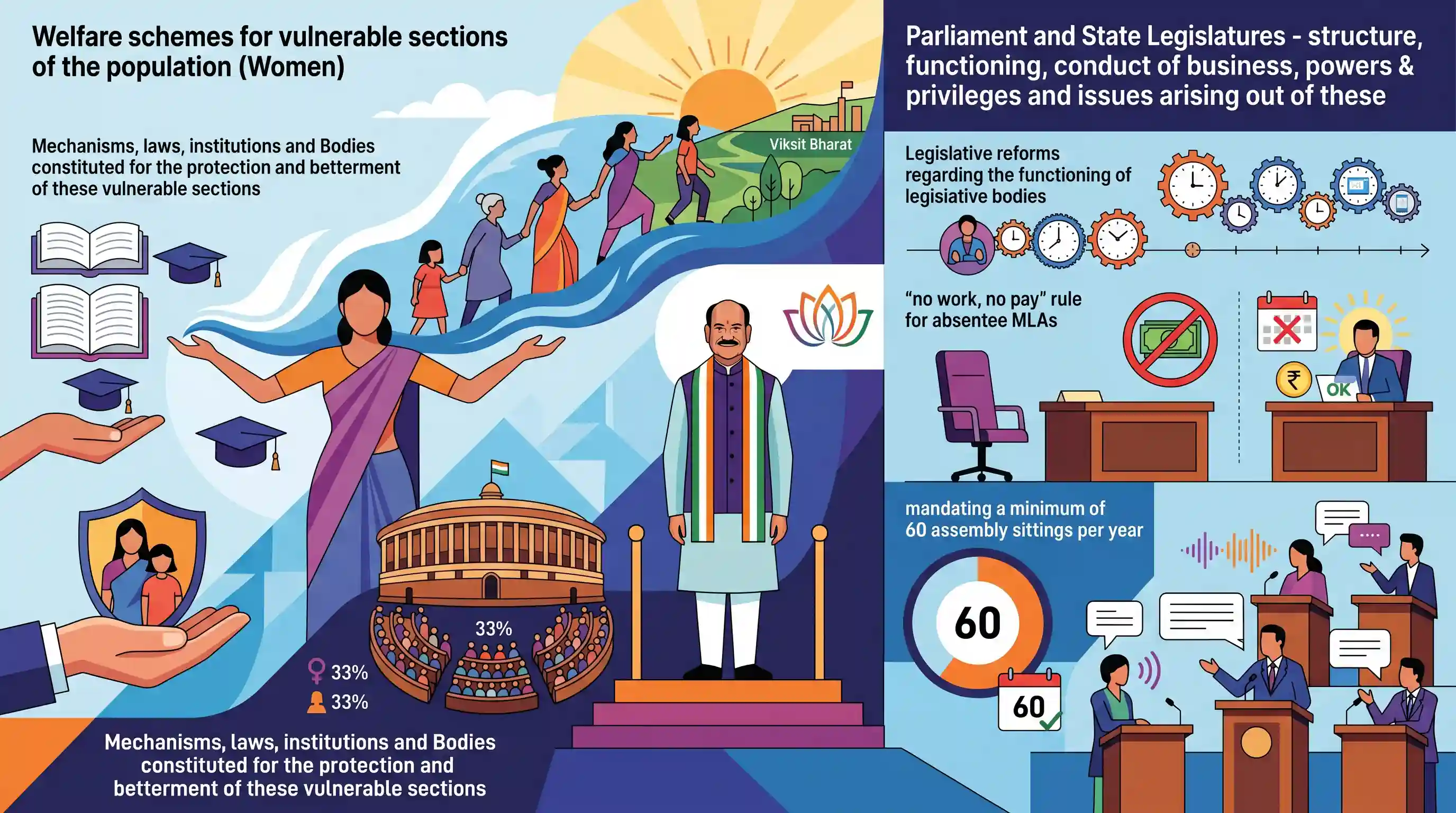
Lok Sabha Speaker Om Birla inaugurated the first National Conference of Parliamentary and Legislative Committees on Empowerment of Women in Tirupati. The event highlighted the transformative potential of the Nari Shakti Vandan Adhiniyam (granting 33% reservation to women in legislatures) and the push for 100% female literacy to realize a 'Viksit Bharat'. Concurrently, crucial reforms regarding the functioning of legislative bodies were proposed, notably introducing a 'no work, no pay' rule for absentee MLAs and mandating a minimum of 60 assembly sittings per year to ensure legislative accountability and effective debate.
Key Points
- The first National Conference of Parliamentary and Legislative Committees on Empowerment of Women was held in Tirupati, focusing on women shaping the 'Viksit Bharat' vision.
- Lok Sabha Speaker Om Birla emphasized the impact of the Nari Shakti Vandan Adhiniyam, which ensures 33% reservation for women in Lok Sabha and state legislatures.
- Andhra Pradesh Assembly Speaker proposed a 'no work, no pay' policy for legislators to curb absenteeism and frequent boycotts of assembly sessions.
- There was a strong demand to mandate a minimum of 60 sittings annually for legislative assemblies to ensure meaningful debate and amplify people's voices.
- The conference underscored the critical need to achieve 100% literacy among girls as a foundational step for women's empowerment.
Important Terms
Nari Shakti Vandan Adhiniyam

The 106th Constitutional Amendment Act, 2023, which reserves 33% of seats for women in the Lok Sabha, State Legislative Assemblies, and the Delhi Assembly for a 15-year period.
UPSC context
GS-II: Indian Constitution, Parliament, and State Legislatures; tests knowledge of significant amendments and political representation of vulnerable sections.
Viksit Bharat @2047
The government's long-term vision to transform India into a developed, self-reliant nation by 2047, focusing on four key pillars: youth, poor, women, and farmers.
UPSC context
GS-II/GS-III: Governance and Socio-economic Development; relevant for essays and policy-related questions on national development goals.
Parliamentary Committee on Empowerment of Women
A permanent joint parliamentary committee of 30 members (20 LS, 10 RS) that monitors government measures to secure women's status, dignity, and representation in legislative bodies.
UPSC context
GS-II: Parliament and State Legislatures — structure and functioning; crucial for understanding legislative oversight mechanisms.
Legislative Accountability
The obligation of elected representatives to perform duties like attending sessions and debating; includes proposals like "no work, no pay" and mandating minimum annual sitting days.
UPSC context
GS-II: Parliament and State Legislatures — conduct of business and issues of legislative effectiveness and discipline.
Tirupati Resolution
An outcome of the 2024 national conference proposing a gender lens across all ministries, institutionalized gender budgeting, and increased female participation in emerging technologies.
UPSC context
GS-II: Welfare schemes for women and institutional bodies; reflects recent inter-legislative consensus on gender policy.
Gender Responsive Budgeting
A strategy to achieve gender equality by integrating a gender perspective into the budgetary process and assessing the impact of fiscal policies on women versus men.
UPSC context
GS-II/GS-III: Social Justice and Economic Development; tests understanding of fiscal tools for inclusive growth.
Prelims Trap
"The Constitution of India mandates a minimum of 60 sittings per year for State Legislative Assemblies."
Article 174 only specifies that the gap between two sessions cannot exceed six months. Minimum sitting days are merely proposed reforms, not constitutional mandates.
Static Concepts Connected
What is the Committee on Empowerment of Women?
- Composition: It is a joint parliamentary committee comprising 30 members (20 from Lok Sabha and 10 from Rajya Sabha).
- Origin: First constituted in 1997 as a dedicated body to monitor women's welfare, status, and upliftment.
- Key Function: Reviews Union Government measures for women's equality and examines reports submitted by the National Commission for Women (NCW).
What are the rules regarding legislative absenteeism and sessions?
- Seat Vacancy: Under Articles 101(4) and 190(4), a seat can be declared vacant if a member is absent for 60 consecutive days without permission.
- Session Gap: Article 174 restricts the maximum gap between two legislative sessions to six months, with no minimum days specified.
- NCRWC Reform: The National Commission to Review the Working of the Constitution (NCRWC) recommended 50–90 mandatory sitting days for Assemblies to ensure accountability.
Cross-Topic Patterns
106th CAA + Delimitation Exercise
The 33% women's reservation is legally contingent upon the publication of the next census and subsequent delimitation, creating a direct link between electoral boundary mapping and gender justice.
Legislative absenteeism + Institutional decline
Proposals like 'no work, no pay' and minimum sittings directly feed into GS2 themes of declining parliamentary productivity, frequent disruptions, and the need for comprehensive legislative reforms.

Expect a 2026 Prelims multi-statement question fusing the 106th CAA's implementation clauses (delimitation) with constitutional session norms.
Linked PYQs · 5
Linked PYQs · 5
- 2023MainsGS2
Discuss the contribution of civil society groups for women's effective and meaningful participation and representation in state legislatures in India.
- 2019MainsGS2
“The reservation of seats for women in the institutions of local self-government has had a limited impact on the patriarchal character of the Indian Political Process.” Comment.
- 2019MainsGS2
Individual Parliamentarian's role as the national law maker is on a decline, which in turn, has adversely impacted the quality of debates and their outcome. Discuss.
- 2023MainsGS2
Discuss the role of Presiding Officers of state legislatures in maintaining order and impartiality in conducting legislative work and in facilitating best democratic practices.
- 2021MainsGS2
Do Department-related Parliamentary Standing Committees keep the administration on its toes and inspire reverence for parliamentary control? Evaluate the working of such committees with suitable examples.
