Women Reservation Delimitation and North South Federal Dynamics
Source:Indian Express ↗
Why It Matters
It addresses the critical intersection of gender representation, future delimitation, and federal equilibrium, making it vital for understanding the balance of power between Centre and States as well as regional equity in India's democracy.
Summary
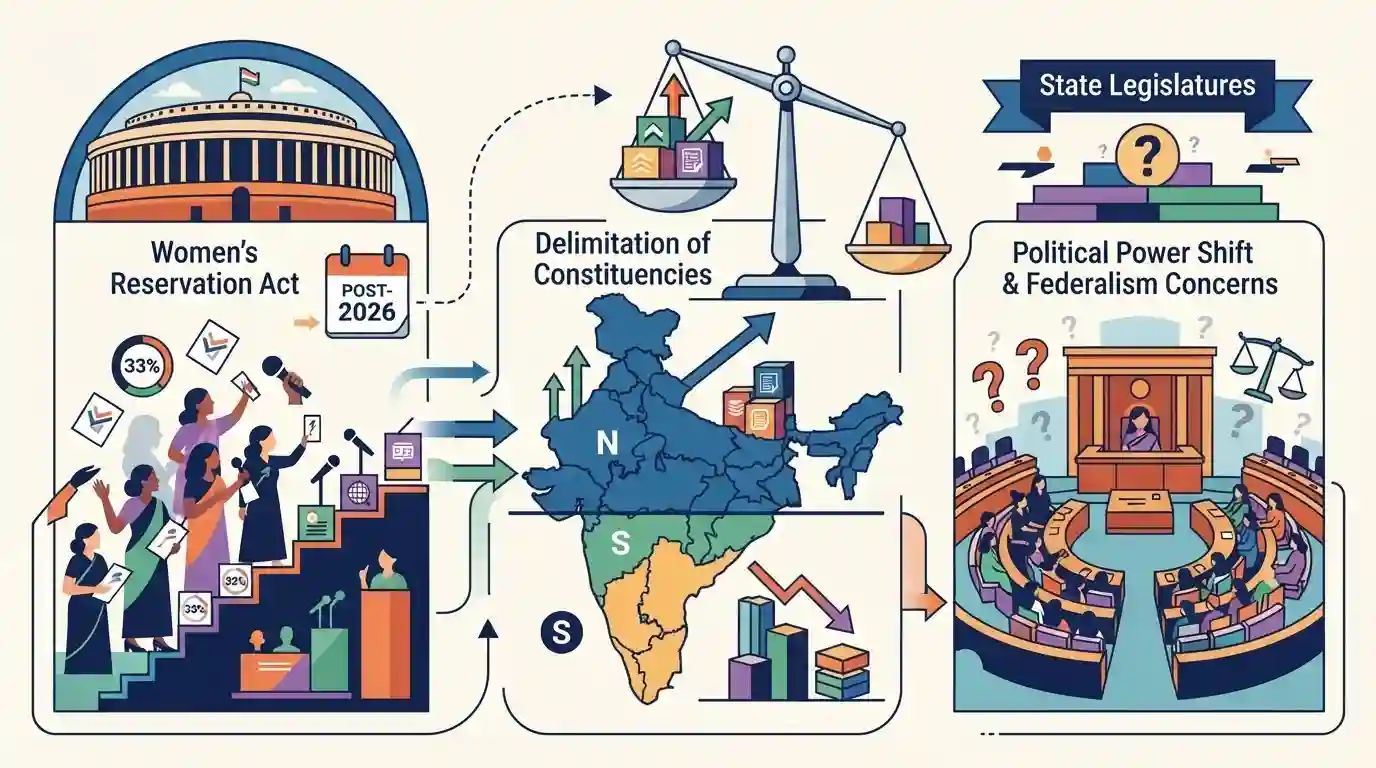
The article examines the complex intersection of the Women's Reservation Act, future delimitation of parliamentary constituencies, and India's North-South demographic divide. Because the operationalization of women's reservation is linked to post-2026 delimitation based on new census data, concerns have emerged regarding the shifting balance of political power between northern states with higher population growth and southern states that have managed population growth effectively.
Key Points
- The implementation of the Women's Reservation Act is constitutionally tied to the completion of the first census after 2026 and subsequent delimitation.
- Delimitation based on current population trends poses a major political and federal dilemma due to demographic disparities between Northern and Southern states.
- Southern states, which successfully implemented population control, fear losing their relative political weight and representation in Parliament compared to Northern states with higher population growth.
- Balancing women reservation with regional representation equity requires careful political consensus and institutional safeguards.
Important Terms
Nari Shakti Vandan Adhiniyam

A landmark constitutional amendment enacted in 2023 that mandates 33% reservation of seats for women in the Lok Sabha, state legislative assemblies, and the National Capital Territory of Delhi assembly.
UPSC context
Important for GS Paper II under Indian Polity (Constitutional Amendments, Women Empowerment, and Representation of Women in Politics).
Delimitation Commission
A statutory and quasi-judicial body constituted by the Government of India under an Act of Parliament to redraw the boundaries of parliamentary and assembly constituencies based on recent census data.
UPSC context
Crucial for GS Paper II (Federalism, Electoral System, and Delimitation challenges in Indian federal polity).
Static Concepts Connected
What are the constitutional provisions governing Delimitation and Lok Sabha seat allocation in India?
- Article 82: Article 82 provides for the readjustment of seat allocation after every census by a Delimitation Commission established by Parliament.
- Seat Freeze: The 42nd Amendment Act (1976) froze total Lok Sabha seats and state-wise allocations based on the 1971 census until the year 2000.
- 2001 Extension: The 84th Amendment Act (2001) extended this freeze on seat readjustment until the first census after 2026 (nominally 2031 census data).
- Judicial Bar: Delimitation Commission orders have the force of law and cannot be challenged in any court of law under Article 329.
Cross-Topic Patterns
Demographic Divergence vs. Cooperative Federalism
Demographic divergence between Northern and Southern states creates severe tensions between the principle of one-person-one-vote and the federal principle of protecting constituent states, impacting cooperative federalism.
Constitutional Freezes and Federal Equity
The 42nd and 84th Constitutional Amendments froze seat allocation to prevent penalizing states for population control, demonstrating how constitutional architecture mediates federal friction.

Delimitation + Women Reservation + Federalism will be tested via analytical statement-based questions in Prelims or Mains GS-2.
Linked PYQs · 2
Linked PYQs · 2
- 2024MainsGS2
What changes has the Union Government recently introduced in the domain of Centre-State relations ? Suggest measures to be adopted to build the trust between the Centre and the States and for strengthening federalism.
- 2023MainsGS2
Explain the significance of the 101st Constitutional Amendment Act. To what extent does it reflect the accommodative spirit of federalism?
