Women Reservation and Delimitation Challenges for Federalism
Source:Indian Express ↗
Why It Matters
It addresses critical structural intersections in Indian polity: gender representation through legislation, the mechanics of parliamentary delimitation, and cooperative/competitive federalism amid demographic imbalances between northern and southern states.
Summary
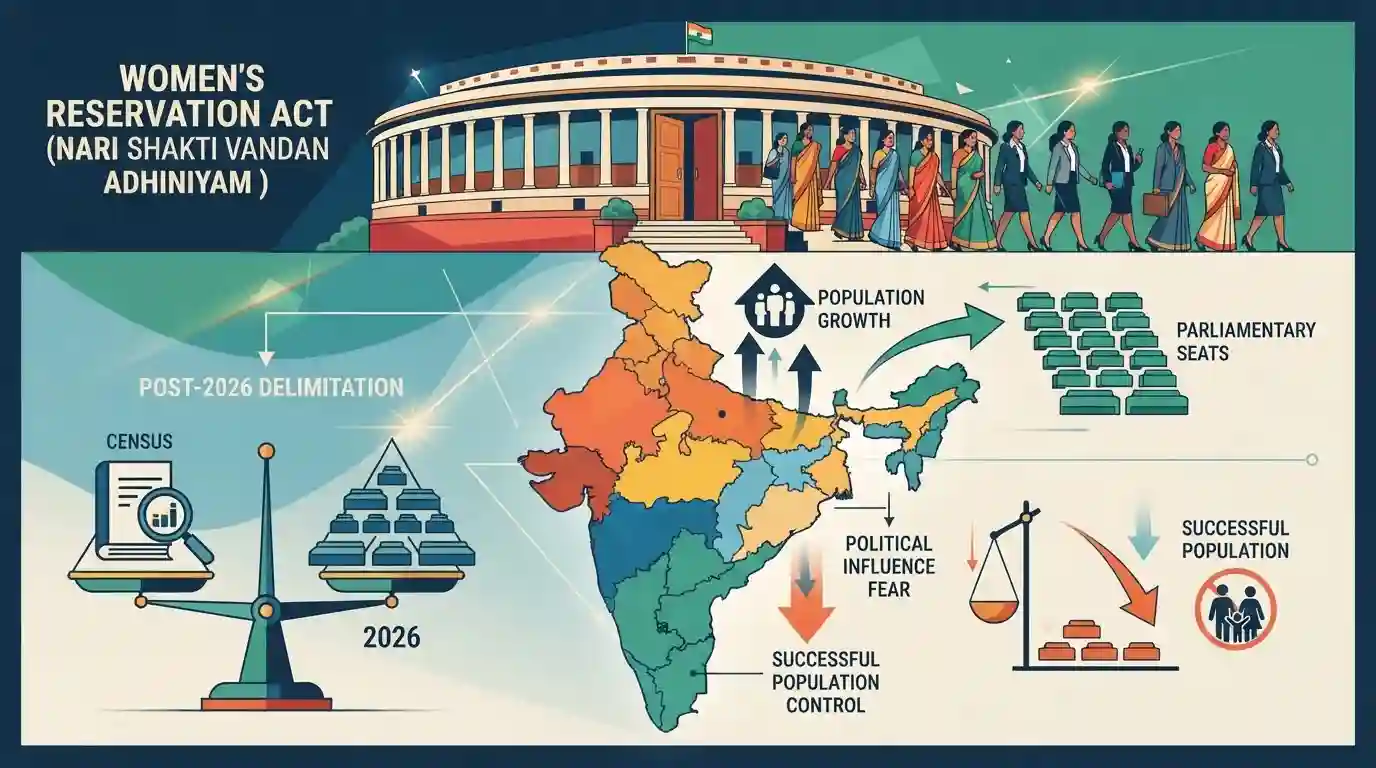
The article explores the intersection of the Women's Reservation Act, future parliamentary delimitation, and the emerging North-South political divide in India. While the Nari Shakti Vandan Adhiniyam seeks to enhance women's political representation, its operationalization is linked to post-2026 delimitation. This creates friction because southern states, which have been more successful in population control, fear a loss of parliamentary seats and political influence relative to northern states experiencing higher population growth.
Key Points
- The implementation of the Women's Reservation Act (Nari Shakti Vandan Adhiniyam) is legally tied to the next delimitation exercise based on the first census conducted after 2026.
- Delimitation poses a contentious federal challenge due to the demographic divergence between northern and southern states (population growth control vs. population expansion).
- Southern states that successfully implemented population stabilization face the prospect of a reduced share of Lok Sabha seats and political weight compared to northern states.
- Balancing women empowerment through political reservation with the federal concerns of regional representation remains a complex legislative hurdle.
Important Terms
Nari Shakti Vandan Adhiniyam

A landmark constitutional amendment enacted in 2023 that mandates a one-third reservation of seats for women in the Lok Sabha, state legislative assemblies, and the Delhi assembly.
UPSC context
UPSC Prelims/Mains (Polity): Tests understanding of women empowerment, legislative representation, and major constitutional amendments.
Constitutional Amendment Act
A formal change or addition to the Constitution of India made under Article 368, requiring specific legislative majorities to alter constitutional provisions.
UPSC context
UPSC Prelims/Mains (Polity): Tests the amending power of Parliament, federal balance, and procedural requirements under Article 368.
Parliament of India
The supreme legislative body of India comprising the President, the Lok Sabha, and the Rajya Sabha, responsible for law-making and national oversight.
UPSC context
UPSC Prelims/Mains (Polity): Core topic on the structure, functioning, powers, and privileges of the Union legislature.
Delimitation Commission
A high-powered statutory body appointed by the President of India to redraw territorial boundaries of Lok Sabha and Assembly constituencies based on recent population data.
UPSC context
UPSC Prelims/Mains (Polity & Federalism): Tests issues around federal structure, population control consequences, and inter-state representation balance.
Prelims Trap
The Nari Shakti Vandan Adhiniyam immediately reserves one-third of seats for women in the current Lok Sabha.
Aspirants often assume the 106th Constitutional Amendment Act is currently operational for women's reservation, whereas its enforcement is legally deferred until the first census post-2026 and subsequent delimitation.
Static Concepts Connected
What are the constitutional provisions and commissions governing Delimitation in India?
- Article 82: Constitutional basis under Article 82 provides for readjustment of seat allocation after every census by a Parliament-appointed Delimitation Commission.
- Constitutional Freezes: Constitutional freezes under the 42nd and 84th Amendment Acts suspended seat readjustment to protect states with successful population policies.
- Finality of Orders: Statutory authority of orders issued by the Delimitation Commission has the force of law and cannot be questioned in any court.
Cross-Topic Patterns
Delimitation Freeze vs Cooperative Federalism
The freeze on seat allocation since the 1971 census directly pits the principle of democratic representation against cooperative federalism and the concerns of southern states.
Nari Shakti Vandan & Federal Imbalances
Connecting gender empowerment through the 106th Amendment to post-2026 census data creates a complex multi-variable legislative and federal challenge for Parliament.

Delimitation + federal imbalance + women's reservation will be clubbed in a multi-statement mains or analytical prelims question.
Linked PYQs · 3
Linked PYQs · 3
- 2024MainsGS2
What changes has the Union Government recently introduced in the domain of Centre-State relations ? Suggest measures to be adopted to build the trust between the Centre and the States and for strengthening federalism.
- 2023MainsGS2
Discuss the contribution of civil society groups for women's effective and meaningful participation and representation in state legislatures in India.
- 2019MainsGS2
From the resolution of contentious issues regarding distribution of legislative powers by the courts, 'Principle of Federal Supremacy' and 'Harmonious Construction' have emerged. Explain.
