Women reservation intersects with delimitation and federal balance
Source:Indian Express ↗
ఇది ఎందుకు ముఖ్యం
It deals with core governance and constitutional issues, specifically how the convergence of women's reservation and delimitation impacts India's federal equilibrium and regional representation balance.
సారాంశం
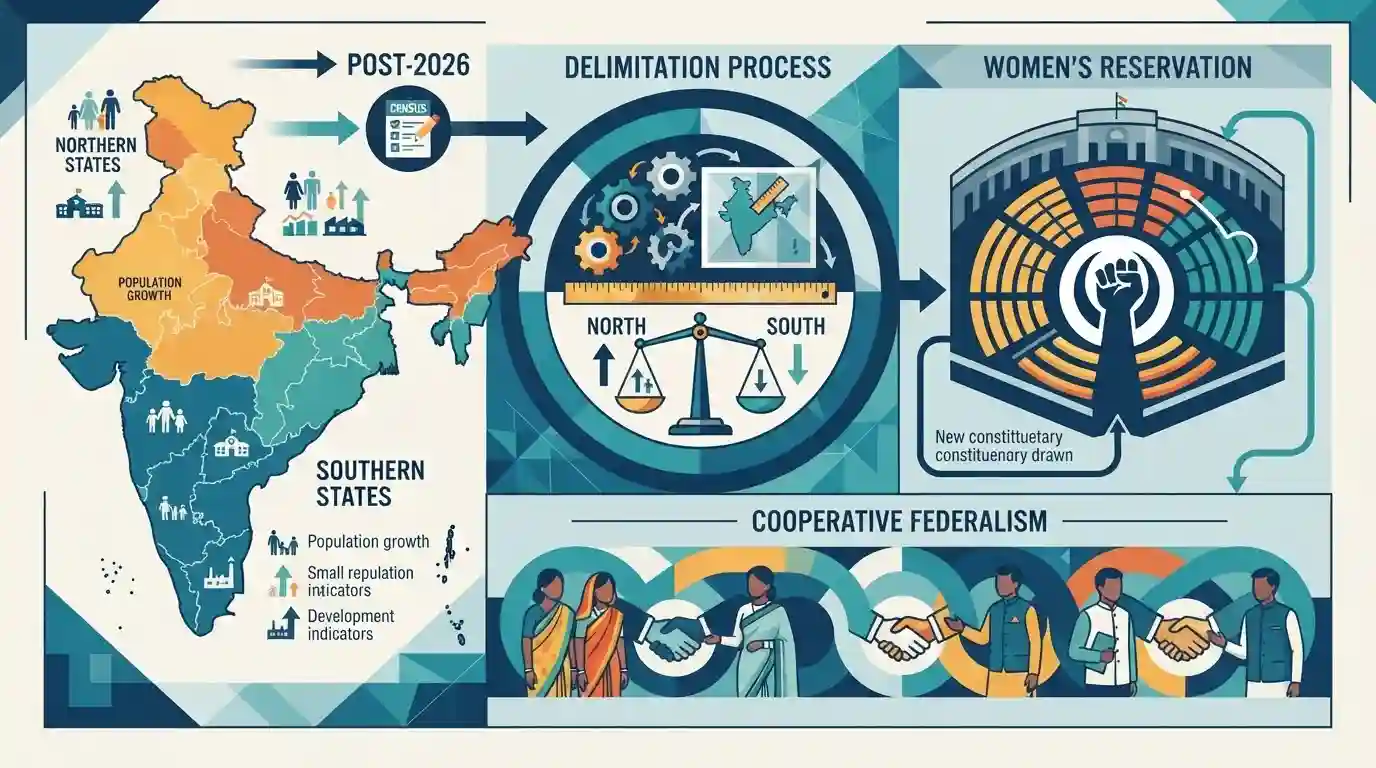
The article examines the intricate relationship between the Women’s Reservation Act and the upcoming delimitation of Lok Sabha constituencies. It highlights how linking women's reservation to post-2026 census delimitation intersects with concerns over the North-South political divide, population control disparities, and cooperative federalism in India.
ముఖ్య అంశాలు
- The implementation of the Women’s Reservation Act (Nari Shakti Vandan Adhiniyam) is linked constitutionally to the next delimitation exercise after the first Census post-2026.
- Delimitation based strictly on post-2026 population figures creates a structural tension regarding the North-South divide, as southern states that successfully controlled population growth fear losing parliamentary representation compared to northern states with higher growth rates.
- This interplay between gender representation, parliamentary reallocation, and federal balance presents unique policy and legislative challenges for cooperative federalism in India.
ముఖ్యమైన పదాలు
Nari Shakti Vandan Adhiniyam (Women's Reservation Act)

Constitution (106th Amendment) Act, 2023, providing 33% reservation for women in the Lok Sabha and State Legislative Assemblies, effective post-delimitation.
UPSC context
GS Paper II (Polity & Governance): Tests understanding of gender justice, constitutional amendments, and legislative representation.
Delimitation Act
The statutory process of redrawing boundaries of Lok Sabha and Assembly constituencies based on recent population census figures to ensure equal representation.
UPSC context
GS Paper II (Polity & Governance / Federalism): Evaluates federal dynamics, population-based representation, and North-South political disparities.
Lok Sabha
The lower house of India's bicameral Parliament, directly elected by citizens on the basis of adult suffrage, comprising representatives of constituencies.
UPSC context
GS Paper II (Indian Constitution & Polity): Central to questions on parliamentary democracy, legislative accountability, and seat allocation.
అనుసంధానమైన స్థిర భావనలు
What are the constitutional provisions and implications governing the Delimitation Commission of India?
- Statutory Body: Set up under Delimitation Act enacted by Parliament after every census.
- Finality of Orders: Orders have force of law and cannot be questioned in any court under Article 329.
- Seat Freeze: 42nd Amendment (1976) and 84th Amendment (2001) froze seat allocation based on the 1971 census until post-2026.
అంతర-అంశ నమూనాలు
Delimitation vs. Fiscal Federalism Penalties
Delimitation conflicts directly with fiscal federalism indicators like the 15th Finance Commission devolution criteria, which reward population control.
Gender Representation meets Federal Balancing
Linking gender equity mandates to contentious demographic exercises complicates the implementation of constitutional rights in a diverse federation.

Delimitation + 106th Amendment + North-South divide will feature as a multi-statement assertion/reasoning question in Prelims.
అనుసంధాన PYQలు · 2
అనుసంధాన PYQలు · 2
- 2024MainsGS2
What changes has the Union Government recently introduced in the domain of Centre-State relations ? Suggest measures to be adopted to build the trust between the Centre and the States and for strengthening federalism.
- 2023MainsGS2
Discuss the contribution of civil society groups for women's effective and meaningful participation and representation in state legislatures in India.
