Delimitation and Women Reservation Pose Federal Challenges
Source:Indian Express ↗
কেন এটি গুরুত্বপূর্ণ
This topic is crucial for GS2 as it sits at the intersection of women's political empowerment, federal equity, electoral reforms, and the upcoming delimitation exercise, which will shape India's federal and democratic structure for decades.
সারসংক্ষেপ
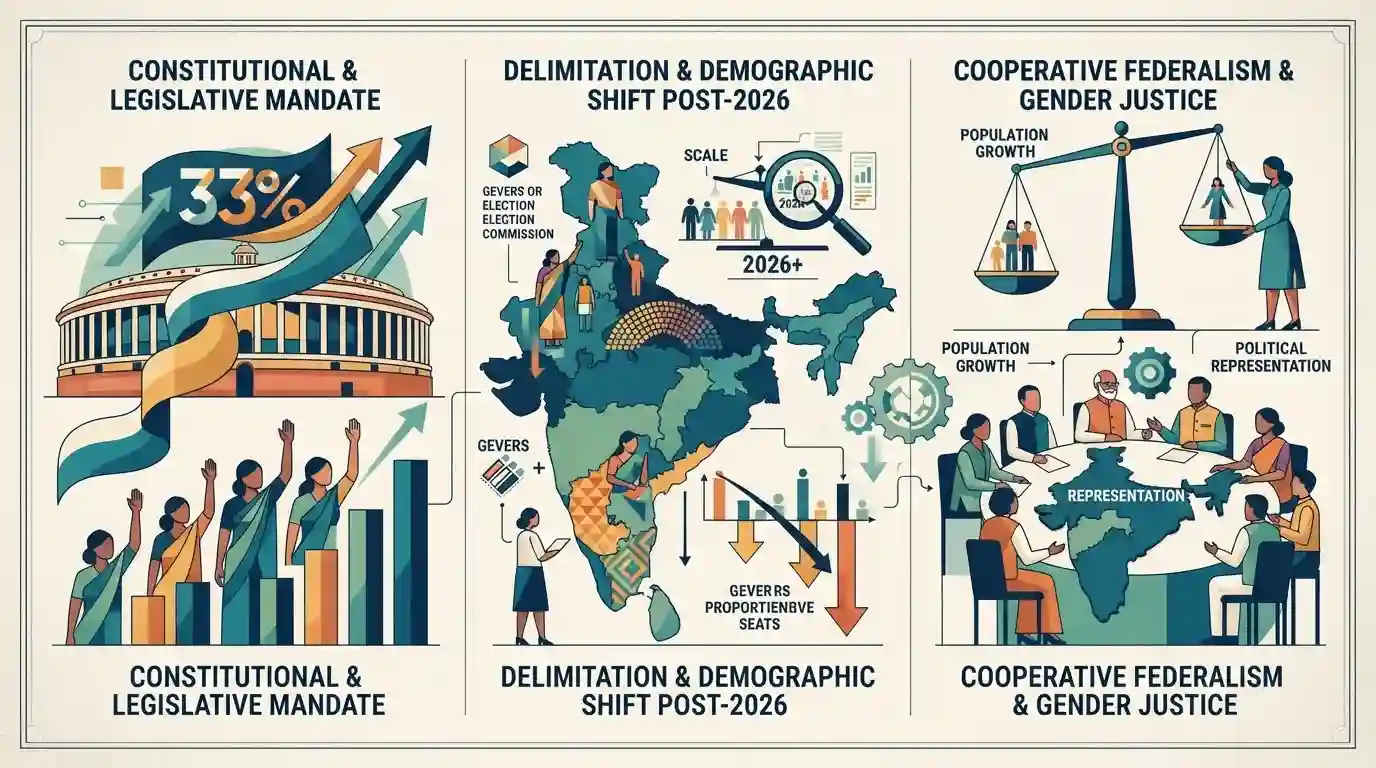
The article discusses the intricate political, constitutional, and demographic challenges surrounding the operationalization of the Women's Reservation Act (Nari Shakti Vandan Adhiniyam). Because the law's implementation is tied to the post-2026 delimitation exercise, it intersects directly with concerns over the North-South demographic divide, potential reduction of southern states' parliamentary seats, and principles of cooperative federalism.
মূল বিষয়
- The operationalization of the Women's Reservation Act (Nari Shakti Vandan Adhiniyam) is legally linked to the completion of the first census post-2026 and subsequent delimitation.
- Delimitation poses a major political challenge due to the demographic divergence between northern states (which experienced higher population growth) and southern states (which successfully controlled population).
- Redistribution of Lok Sabha seats based on fresh census data risks penalizing southern states by reducing their relative political representation in Parliament, raising concerns over federal equity.
- The interplay between women's reservation and delimitation creates a complex legislative puzzle regarding how constituencies are rotated and reserved without exacerbating the North-South political imbalance.
গুরুত্বপূর্ণ শব্দ
Nari Shakti Vandan Adhiniyam

The 106th Constitutional Amendment Act, 2023, which mandates one-third reservation for women in the Lok Sabha and state legislative assemblies, operationalized after post-2026 census delimitation.
UPSC context
UPSC GS Paper II: Polity & Governance - Women empowerment, gender justice, and constitutional amendments.
Delimitation Act
A statutory process of redrawing parliamentary and assembly constituency boundaries based on the latest census data to ensure equal representation across populations.
UPSC context
UPSC GS Paper II: Polity & Governance - Structure and functioning of Parliament, federal balance, and representation.
Parliament
India's bicameral supreme legislative body consisting of the President, Lok Sabha, and Rajya Sabha, responsible for enacting national laws and policies.
UPSC context
UPSC GS Paper II: Parliament and State Legislatures - Structure, functioning, conduct of business, and powers.
Lok Sabha
The lower house of India's bicameral Parliament, composed of representatives directly elected by the citizens of India from single-member territorial constituencies.
UPSC context
UPSC GS Paper II: Parliament - Composition, powers, and representation dynamics including seat allocation debates.
সংযুক্ত স্থির ধারণা
What are the constitutional provisions and finality associated with the Delimitation Commission in India?
- Constitutional Basis: Article 82 mandates Parliament to enact a Delimitation Act after every Census to readjust Lok Sabha and State Assembly seat allocations.
- Legal Finality: Established via an independent statutory Delimitation Commission whose orders have the force of law and cannot be questioned in any court.
- Seat Freeze: The 42nd Amendment (1976) froze seat allocations based on the 1971 census, subsequently extended by the 84th Amendment (2001) until the first census post-2026.
আন্তঃবিষয় প্যাটার্ন
Demographic Divergence & Fiscal-Political Federalism
Population growth divergence between northern and southern states directly threatens federal equity during post-2026 delimitation, creating friction between legislative representation and fiscal devolution (e.g., Finance Commission criteria).
Gender Empowerment vs. Territorial Representation Mechanics
The Nari Shakti Vandan Adhiniyam relies on post-2026 delimitation, linking gender justice mandates directly with the constitutional mechanics of Article 81 and Article 82 seat redistribution.

Post-2026 delimitation + North-South federal imbalance + 106th Amendment linkage will likely be tested via a multi-statement conceptual MCQ.
সংযুক্ত PYQ · 4
সংযুক্ত PYQ · 4
- 2025MainsGS2
Indian Constitution has conferred the amending power on the ordinary legislative institutions with a few procedural hurdles. In view of this statement, examine the procedural and substantive limitations on the amending power of the Parliament to change the Constitution.
- 2023MainsGS2
Discuss the contribution of civil society groups for women's effective and meaningful participation and representation in state legislatures in India.
- 2023MainsGS2
Explain the constitutional perspectives of Gender Justice with the help of relevant Constitutional Provisions and case laws.
- 2022MainsGS2
“While the national political parties in India favour centralisation, the regional parties are in favour of State autonomy.” Comment.
