Women Quota and Lok Sabha Delimitation Federal Challenges
Source:Indian Express ↗
ఇది ఎందుకు ముఖ్యం
It addresses critical structural intersections in Indian governance: gender equity in legislatures, federal stability, demographic imbalances, and the geopolitics of parliamentary seat allocation across regions.
సారాంశం
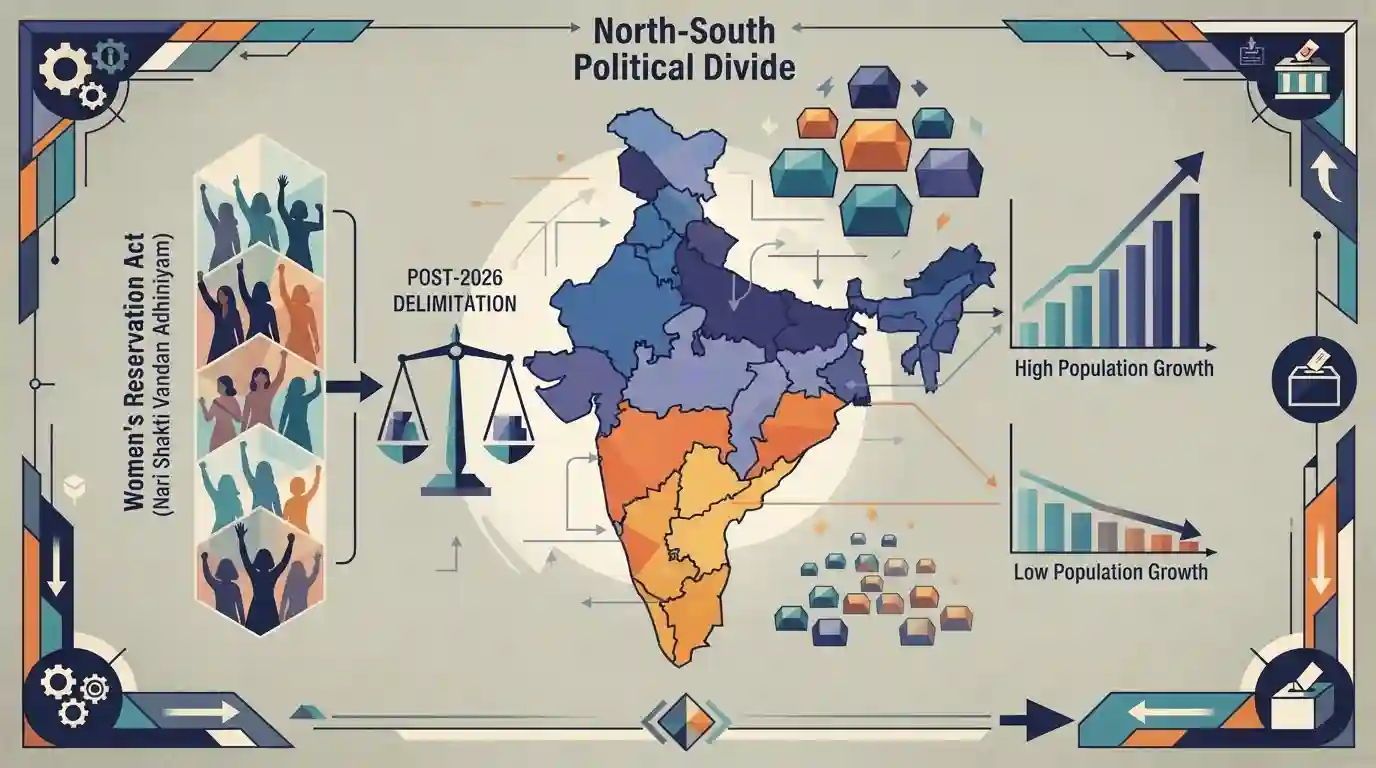
The article discusses the intricate linkages between the Women's Reservation Act (Nari Shakti Vandan Adhiniyam), future delimitation of Lok Sabha constituencies, and the looming North-South political divide. Because the reservation of seats for women is tied to post-2026 delimitation, disparities in population growth between Northern and Southern states threaten to skew regional representation, creating severe federal implications.
ముఖ్య అంశాలు
- The implementation of the Women's Reservation Act (Nari Shakti Vandan Adhiniyam) is legally linked to the completion of the first census post-2026 and subsequent delimitation.
- Delimitation poses a contentious federal challenge due to the demographic divergence between Northern states (higher population growth) and Southern states (successful population control).
- Recalibrating Lok Sabha seats based purely on population could penalize Southern states by reducing their relative political weight, compounding tensions over resource allocation and federalism.
- Balancing women's political empowerment with equitable regional representation remains a complex legislative and constitutional puzzle for India.
ముఖ్యమైన పదాలు
Nari Shakti Vandan Adhiniyam (Women's Reservation Act)

The 106th Constitutional Amendment Act reserving one-third of seats for women in the Lok Sabha and State Legislative Assemblies, linked to post-2026 delimitation.
UPSC context
GS Paper II (Polity and Governance): Tests understanding of gender justice, legislative empowerment, and constitutional amendments.
Delimitation Act
The statutory process of redrawing boundaries of Lok Sabha and Assembly constituencies based on population changes, governed by Articles 82 and 170.
UPSC context
GS Paper II (Polity & Federalism): Important for federal balance, representation parity, and inter-state equity.
Lok Sabha
The lower house of India's bicameral Parliament, representing citizens directly with members chosen by direct election on the basis of adult suffrage.
UPSC context
GS Paper II (Parliament and State Legislatures): Tests structure, functioning, and representation dynamics of the legislature.
అనుసంధానమైన స్థిర భావనలు
What is the constitutional mechanism and historical background of the Delimitation Commission in India?
- Statutory Basis: Established under the Delimitation Commission Act, it is appointed by the President of India and works in collaboration with the Election Commission of India.
- Finality of Orders: Orders issued by the Delimitation Commission have the force of law and cannot be challenged in any court of law.
- Constitutional Mandate: Article 82 mandates the readjustment of Lok Sabha seats after every census, but constitutional freezes (42nd and 84th amendments) delayed this post-2026.
అంతర-అంశ నమూనాలు
Demography, Delimitation, and Asymmetric Federalism
Successful family planning in Southern states could lead to a loss of parliamentary seats during delimitation, directly clashing with cooperative federalism and fiscal devolution norms.

Expect a statement-based question linking post-2026 delimitation, the 106th Amendment, and its federal implications on Southern representation.
అనుసంధాన PYQలు · 2
అనుసంధాన PYQలు · 2
- 2023MainsGS2
Discuss the contribution of civil society groups for women's effective and meaningful participation and representation in state legislatures in India.
- 2024MainsGS2
Examine the need for electoral reforms as suggested by various committees with particular reference to "one nation one election" principle.
