Delimitation and Women Quota Pose Federal Balance Challenges
Source:Indian Express ↗
Why It Matters
The linkage between the 106th Amendment (Women's Reservation) and delimitation brings forth a critical federal challenge regarding the North-South demographic divide. This intersection of gender justice, electoral representation, and cooperative federalism is a high-probability theme for GS Paper 2 Mains and Prelims.
Summary
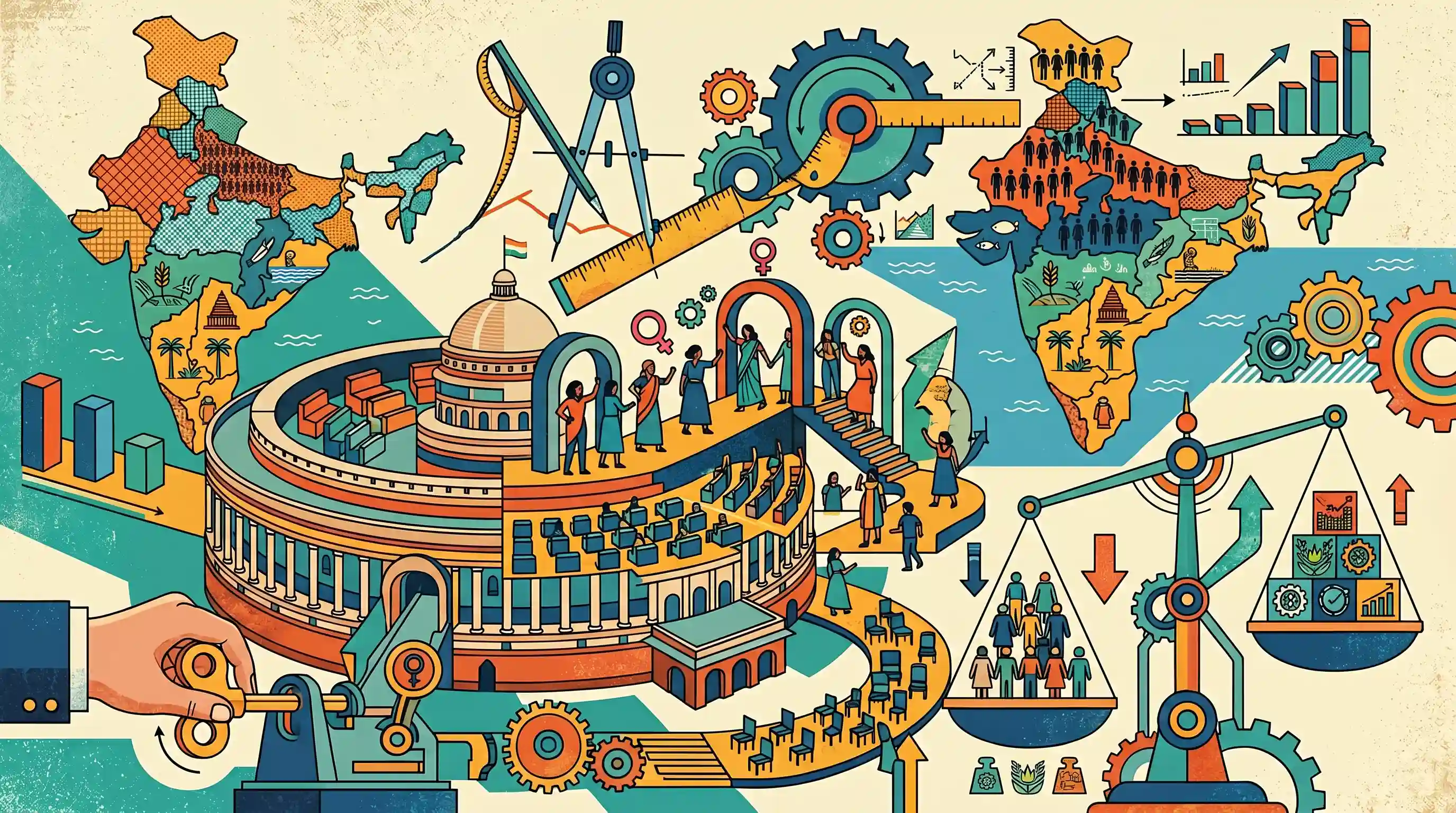
The article examines the complex interplay between the pending implementation of women's reservation in legislative bodies, the upcoming delimitation of constituencies, and the resulting impact on India's federal equilibrium. It highlights the tension between adhering to democratic representation based on population size—which favors Northern states—and protecting the political influence of Southern states that have successfully managed population growth. Expanding the Lok Sabha is discussed as a means to implement the Nari Shakti Vandan Adhiniyam without disrupting cooperative federalism.
Key Points
- The implementation of the 106th Constitutional Amendment Act (Nari Shakti Vandan Adhiniyam), which provides 33% reservation for women in Lok Sabha and State Assemblies, is tied to the upcoming delimitation exercise.
- Conducting delimitation strictly based on current population data threatens to shift political power disproportionately toward populous Northern states, raising concerns about federal equity.
- Southern states, which have successfully implemented population control measures, fear losing their proportional representation and political influence in Parliament.
- Expanding the total number of Lok Sabha seats—facilitated by the capacity of the new Parliament building—is considered a potential solution to ensure no state loses its current absolute number of seats while adjusting for population.
- Policymakers must navigate the complex trade-off between the democratic principle of 'one person, one vote' and the imperative to maintain 'federal equilibrium' to preserve cooperative federalism.
Important Terms
Nari Shakti Vandan Adhiniyam

The 106th Constitutional Amendment Act (2023) reserving one-third of seats for women in the Lok Sabha, State Legislative Assemblies, and the Delhi Assembly for 15 years.
UPSC context
GS Paper II: Significant constitutional provisions; tests knowledge of gender-based affirmative action and legislative reforms.
Delimitation Commission
An independent statutory body appointed by the President to redraw boundaries of parliamentary and assembly constituencies based on census data to ensure uniform representation.
UPSC context
GS Paper II: Constitutional and statutory bodies; essential for understanding electoral integrity and Articles 82/170.
Delimitation Act
Legislation enacted by Parliament under Article 82 after each census, providing the legal framework for redrawing electoral boundaries and allocating seats among states.
UPSC context
GS Paper II: Parliament and State Legislatures; tests understanding of the legal process governing democratic representation.
Federal Equilibrium
The political and representation balance between the Union and States, particularly ensuring that more populous northern states do not diminish the influence of southern states.
UPSC context
GS Paper II: Federal structure and regionalism; critical for analyzing tensions in cooperative federalism and demographic shifts.
Lok Sabha
The directly elected lower house of Parliament, where seat allocation is currently frozen at 1971 census levels until the first census after 2026.
UPSC context
GS Paper II: Structure of Parliament; fundamental for understanding representative democracy and seat distribution challenges.
Prelims Trap
"The 106th Amendment guarantees 33% reservation for women in all houses of Parliament and State Legislatures."
The 106th CAA applies ONLY to the Lok Sabha, State Legislative Assemblies, and the National Capital Territory of Delhi. It explicitly excludes the Rajya Sabha and State Legislative Councils.
Static Concepts Connected
What is the constitutional timeline freezing the number of Lok Sabha seats?
- 42nd Amendment (1976): Froze the allocation of Lok Sabha seats to states based on the 1971 Census to incentivize and reward state-level population control efforts.
- 84th Amendment (2001): Extended this freeze on the total number of state-wise seats until the publication of the first census conducted after the year 2026.
- 87th Amendment (2003): Permitted the territorial readjustment of constituencies within a state based on the 2001 Census without changing the total number of seats allocated.
What are the unique powers and features of the Delimitation Commission?
- Executive Appointment: Appointed by the President of India and works in close collaboration with the Election Commission of India.
- Finality of Orders: Its orders have the force of law and are strictly immune from being challenged in any court of law.
- No Legislative Modification: Copies of its orders are laid before the Lok Sabha and State Assemblies, but legislatures cannot effect any modifications to them.
Cross-Topic Patterns
Demographic penalties in fiscal devolution
The tension over population data in delimitation mirrors controversies in recent Finance Commissions regarding the shift to 2011 Census data, which Southern states argued penalized their successful demographic transitions in tax devolution.
Local vs. National Women's Reservation
Unlike Panchayats (73rd CAA) where 33% women's reservation was implemented outright, the 106th CAA makes it legally contingent on future census and delimitation exercises, establishing asymmetric commencement of rights.

A multi-statement Prelims question interlinking Article 334A, the 84th CAA seat freeze till 2026, and Delimitation powers is highly probable.
Linked PYQs · 3
Linked PYQs · 3
- 2024PrelimsGS1
How many Delimitation Commissions have been constituted by the Government of India till December 2023?
- 2019MainsGS2
“The reservation of seats for women in the institutions of local self-government has had a limited impact on the patriarchal character of the Indian Political Process.” Comment.
- 2023MainsGS2
Discuss the contribution of civil society groups for women's effective and meaningful participation and representation in state legislatures in India.
