Womens Reservation and Delimitation Federal Implications
Source:The Hindu ↗
Why It Matters
The intersection of delimitation and women's reservation touches upon core constitutional principles of democratic representation and federalism. It highlights the tension between proportional representation based on population and rewarding states for successful demographic management.
Summary
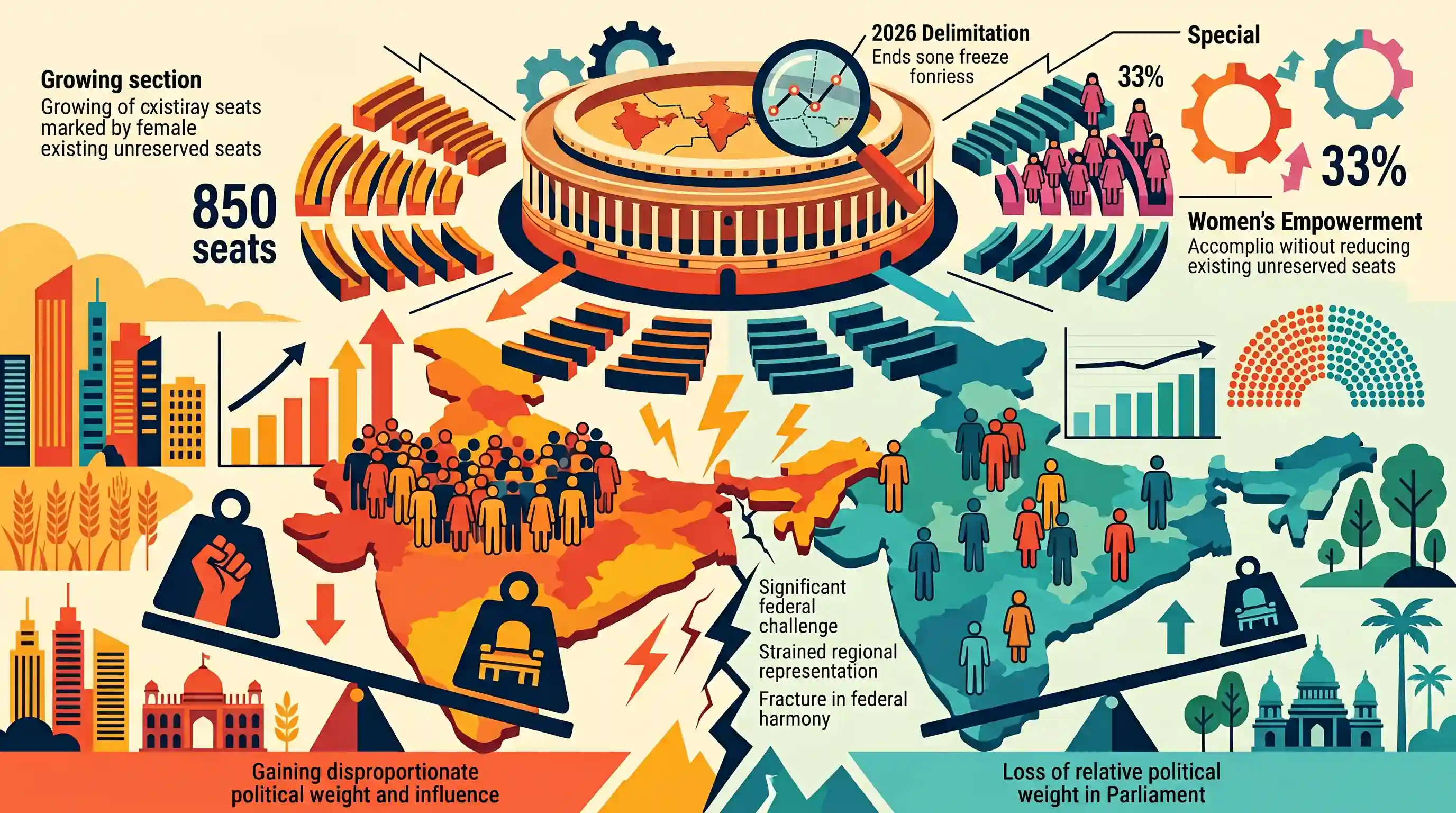
The article examines the combined implications of the Women's Reservation Bill and the upcoming 2026 Delimitation exercise on India's political landscape. The Delimitation process will end a 50-year freeze on parliamentary seat allocation, expanding the Lok Sabha to 850 seats based on updated demographic data. While this expansion clears the path for reserving 33% of the seats for women without reducing the absolute number of unreserved seats, it poses a significant federal challenge. Southern states that successfully stabilized their populations stand to lose relative political weight in Parliament, whereas Northern and Central states with higher population growth will gain disproportionate influence, potentially straining regional representation and federal harmony.
Key Points
- The Women's Reservation Bill guarantees 33% representation for women in the Lok Sabha and State Assemblies, removing earlier dependency on the delayed 2021 Census.
- The 2026 Delimitation process will lift the freeze on constituency reallocation that has been in place since 1976, increasing Lok Sabha seats from 543 to 850.
- Out of the newly expanded 850 Lok Sabha seats, one-third will be reserved for women, with reserved constituencies being rotated following each delimitation.
- The unfreezing of seats based on current populations will likely cause a political imbalance, heavily favoring Northern states like Uttar Pradesh and Bihar over Southern states that successfully curbed population growth.
Important Terms
Nari Shakti Vandan Adhiniyam

Formally the 106th Constitutional Amendment Act, 2023, it reserves one-third (33%) of seats for women in the Lok Sabha, State Assemblies, and Delhi Assembly for a 15-year period.
UPSC context
GS Paper 2 (Polity/Social Justice); tests understanding of gender-based affirmative action and its legislative implementation hurdles.
Delimitation Commission
A high-powered statutory body, typically headed by a retired Supreme Court judge, tasked with redrawing electoral constituency boundaries to ensure equal representation based on updated census data.
UPSC context
GS Paper 2 (Elections); critical for questions on representative democracy, seat reallocation, and the 'one person, one vote' principle.
84th Constitutional Amendment Act, 2002
Legislative measure that froze the number of Lok Sabha and State Assembly seats based on the 1971 Census until 2026 to encourage state-level population control efforts.
UPSC context
GS Paper 2 (Polity); tests knowledge of the historical evolution of seat freezes and the demographic divergence between states.
131st Constitutional Amendment Bill, 2026
A 2026 legislative proposal aiming to increase Lok Sabha strength from 543 to 850 seats and fast-track women's reservation by decoupling it from the next official census.
UPSC context
GS Paper 2 (Polity); essential for current affairs questions on the expansion of Parliament and its impact on regional representation.
Article 82
Constitutional provision mandating the readjustment of Lok Sabha seats after each census, which forms the legal basis for the Delimitation Commission's formation and functioning.
UPSC context
GS Paper 2 (Constitution); fundamental for explaining the constitutional mechanism behind electoral redrawing and parliamentary composition.
Federalism (Demographic Challenge)
In the context of delimitation, it refers to the tension between population-based representation and the political rights of states that successfully achieved population stabilization (the North-South divide).
UPSC context
GS Paper 2 (Federal Structure); a core theme for Mains regarding center-state relations and regional political equity.
Prelims Trap
"Orders of the Delimitation Commission are subject to judicial review by the Supreme Court to prevent gerrymandering."
Under Article 329(a) of the Constitution, orders of the Delimitation Commission hold the force of law and cannot be challenged in any court.
Static Concepts Connected
What are the powers and composition of the Delimitation Commission?
- Composition: Appointed by the President, it usually comprises a retired Supreme Court judge, the Chief Election Commissioner, and respective State Election Commissioners.
- Immunity from Courts: Its orders have the force of law and cannot be challenged in any court (Article 329a), preventing infinite delays in elections.
- No Legislative Override: Copies of orders are laid before the Lok Sabha and State Legislative Assemblies, but they cannot effect any modifications to them.
What are the key constitutional provisions inserted by the 106th Amendment Act?
- New Articles: Inserts Articles 330A, 332A, and 239AA(2)(b) granting 33% reservation for women in Lok Sabha, State Assemblies, and the Delhi Assembly.
- Horizontal Quota: Mandates that one-third of the total seats reserved for SCs and STs shall be reserved for women belonging to those groups.
- Sunset Clause: The reservation comes with a 15-year sunset clause, which can be extended by Parliament by law.
Cross-Topic Patterns
Delimitation vs. Finance Commission Demographics
The North-South political representation divide perfectly mirrors recent Finance Commission debates, where Southern states protested losing tax-devolution shares due to their successful demographic stabilization.
From PRIs to Parliament representation
While the 73rd and 74th Amendments (Article 243D) introduced 33% women's reservation at the Panchayat and Municipal levels in 1992, the 106th CAA finally elevates this structural empowerment to the Parliament.

Expect a tough multi-statement Prelims question in 2026 interlinking the 84th and 106th Amendments, Article 329, and federalism impacts.
Linked PYQs · 3
Linked PYQs · 3
- 2024PrelimsGS1
How many Delimitation Commissions have been constituted by the Government of India till December 2023?
- 2023MainsGS2
Discuss the contribution of civil society groups for women's effective and meaningful participation and representation in state legislatures in India.
- 2019MainsGS2
“The reservation of seats for women in the institutions of local self-government has had a limited impact on the patriarchal character of the Indian Political Process.” Comment.
