Women Reservation and Delimitation 2026 Constitutional Linkage
Source:The Hindu ↗
Why It Matters
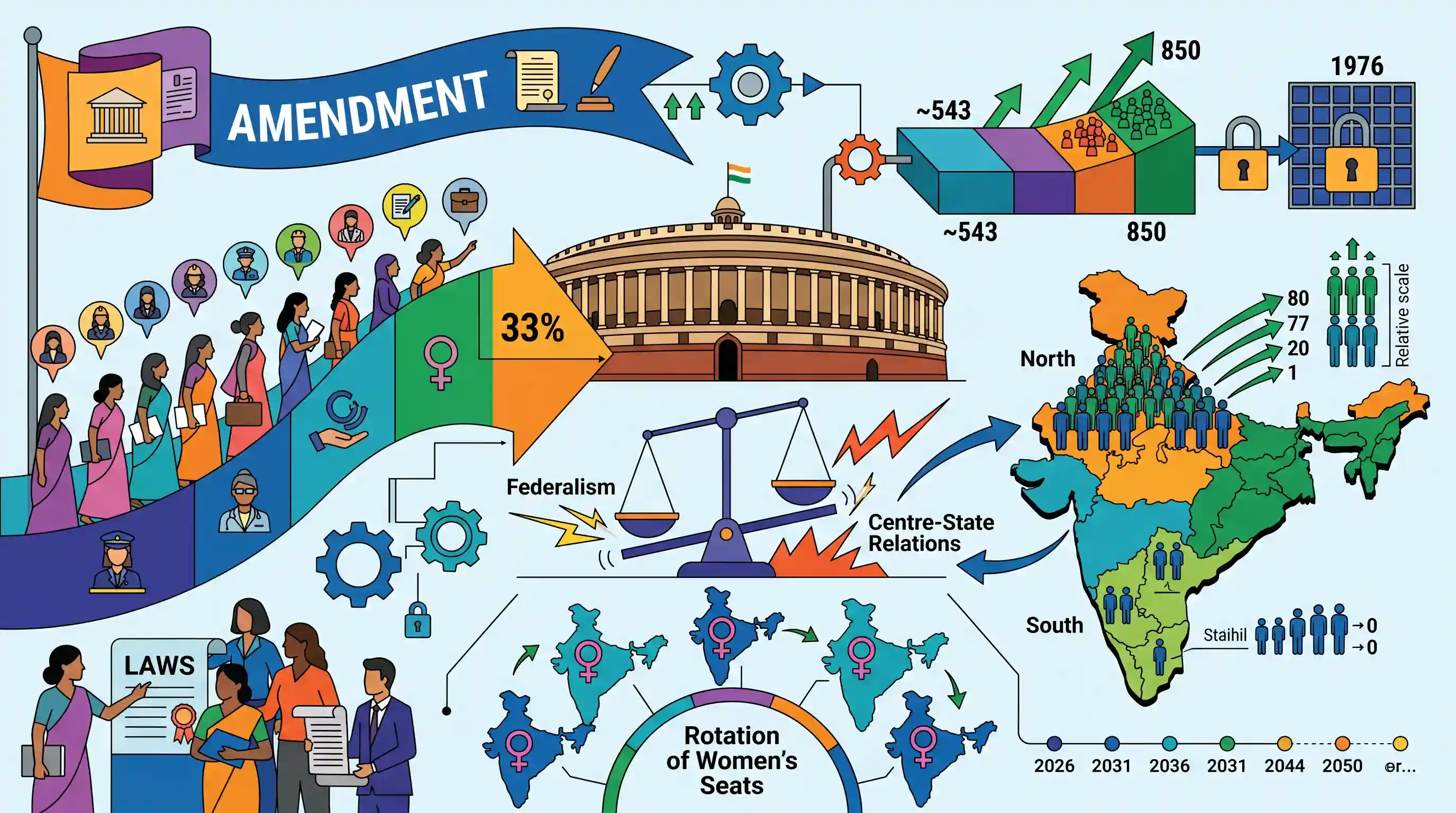
The intersection of women's reservation and delimitation highlights critical constitutional and federal dynamics. For UPSC aspirants, it is essential to understand how demographic changes influence political representation and how the lifting of the 1976 freeze on seat allocation might strain Centre-State relations, particularly the North-South demographic divide.
Summary
The article details the impending implementation of the Women's Reservation Bill (reserving 33% seats for women) in tandem with the 2026 delimitation exercise. It highlights the planned expansion of the Lok Sabha to approximately 850 seats and the associated unfreezing of state-wise seat allocations, which have been capped since 1976. This shift introduces significant federal challenges, as Southern states with lower population growth rates risk reduced political representation compared to rapidly growing Northern states. Additionally, the piece notes that women's reserved seats will undergo rotation after every future delimitation.
Key Points
- The 106th Constitutional Amendment (Nari Shakti Vandan Adhiniyam) mandates 33% reservation for women in the Lok Sabha and State Legislative Assemblies.
- The reservation will come into effect post the upcoming delimitation exercise, which is scheduled after the first census published post-2026 (targeting the 2029 General Elections).
- The 2026 delimitation will unfreeze the allocation of parliamentary seats among states, potentially expanding the Lok Sabha to around 850 seats based on updated population figures.
- Lifting the 1976 population freeze raises significant federal concerns, as Southern states that successfully controlled their populations fear losing political representation relative to populous Northern and Central states.
- Reserved constituencies for women will be rotated following each subsequent delimitation exercise to ensure broad and equitable gender representation over time.
Important Terms
Nari Shakti Vandan Adhiniyam

Official name for the 106th Constitutional Amendment Act reserving 33% seats for women in the Lok Sabha, State Assemblies, and Delhi Assembly for 15 years.
UPSC context
GS Paper II: Governance and Social Justice; tests understanding of gender-based political representation and new Articles 330A/332A.
Delimitation Commission
A high-power statutory body, chaired by a retired Supreme Court judge, tasked with redrawing electoral constituency boundaries based on the latest census to ensure equal representation.
UPSC context
GS Paper II: Federalism and Elections; tests knowledge of Articles 82/170 and the "one vote, one value" principle.
84th Constitutional Amendment Act
A 2001 amendment that extended the freeze on the total number of Lok Sabha and State Assembly seats (based on 1971 population) until after 2026.
UPSC context
GS Paper II: Federalism; relevant for the timeline of seat allocation and population control incentives.
42nd Constitutional Amendment Act
A 1976 amendment that first froze seat allocation in legislatures at 1971 levels to prevent states from losing political power due to population control efforts.
UPSC context
GS Paper II: Constitutional History; important for the origin of the current demographic-representation debate.
Delimitation Act
Legislation passed by Parliament under Article 82 that provides the legal authority to constitute a Delimitation Commission and set its operating rules.
UPSC context
GS Paper II: Parliament and State Legislatures; tests procedural understanding of redrawing electoral maps.
Prelims Trap
The 106th CAA mandates 33% reservation for women across all houses of Parliament, including the Rajya Sabha.
The 106th Amendment only applies to the Lok Sabha, State Legislative Assemblies, and NCT of Delhi. It explicitly does NOT apply to the Rajya Sabha or State Legislative Councils.
Static Concepts Connected
What are the constitutional powers and characteristics of the Delimitation Commission?
- Appointment: Appointed by the President of India, it works in collaboration with the Election Commission of India.
- Absolute Authority: Its orders have the force of law and cannot be challenged or questioned before any court.
- Legislative Role: Copies of its orders are laid before the Lok Sabha and State Assemblies, but legislatures cannot modify them.
Which Constitutional Amendments froze the state-wise allocation of Lok Sabha seats?
- 42nd CAA (1976): Froze the state-wise allocation of seats based on the 1971 census until the year 2000 to promote and incentivize family planning.
- 84th CAA (2001): Extended the freeze on the total number of Lok Sabha seats allocated to each state until the first Census published after 2026.
Cross-Topic Patterns
Federalism vs. Demographic Dividend
The 2026 delimitation unfreezing pits the population control success of Southern states against the demographic heft of Northern states, echoing Finance Commission devolution debates.
Intersectionality and Sub-quotas
The 106th CAA applies women's reservation within existing SC/ST quotas, linking constitutional representation directly to ongoing Supreme Court debates on sub-categorization and horizontal reservations.

Expect a multi-statement Prelims question testing the explicit exclusion of Rajya Sabha alongside the 84th CAA's 2026 freeze condition.
Linked PYQs · 5
Linked PYQs · 5
- 2023MainsGS2
Discuss the contribution of civil society groups for women's effective and meaningful participation and representation in state legislatures in India.
- 2019MainsGS2
“The reservation of seats for women in the institutions of local self-government has had a limited impact on the patriarchal character of the Indian Political Process.” Comment.
- 2012PrelimsGS1
With reference to the Delimitation Commission, consider the following statements: 1. The orders of the Delimitation Commission cannot be challenged in a Court of Law. 2. When the orders of the Delimitation Commission are laid before the Lok Sabha or State Legislative Assembly, they cannot effect any modifications in the orders. Which of the statements given above is/are correct?
- 2024PrelimsGS1
How many Delimitation Commissions have been constituted by the Government of India till December 2023?
- 2024MainsGS2
What changes has the Union Government recently introduced in the domain of Centre-State relations ? Suggest measures to be adopted to build the trust between the Centre and the States and for strengthening federalism.
