Morbidity-Mortality Paradox Highlights Gender Disparities in Health
Source:The Hindu ↗
Why It Matters
This topic is crucial for UPSC aspirants as it bridges public health policy and gender equity. It provides a nuanced understanding of how demographic trends (aging population) intersect with gender disparities, relevant for GS-1 (Society) and GS-2 (Social Justice/Health). It highlights the need for structural shifts in policy formulation to cater to the geriatric care needs of women beyond traditional maternal health schemes.
Summary
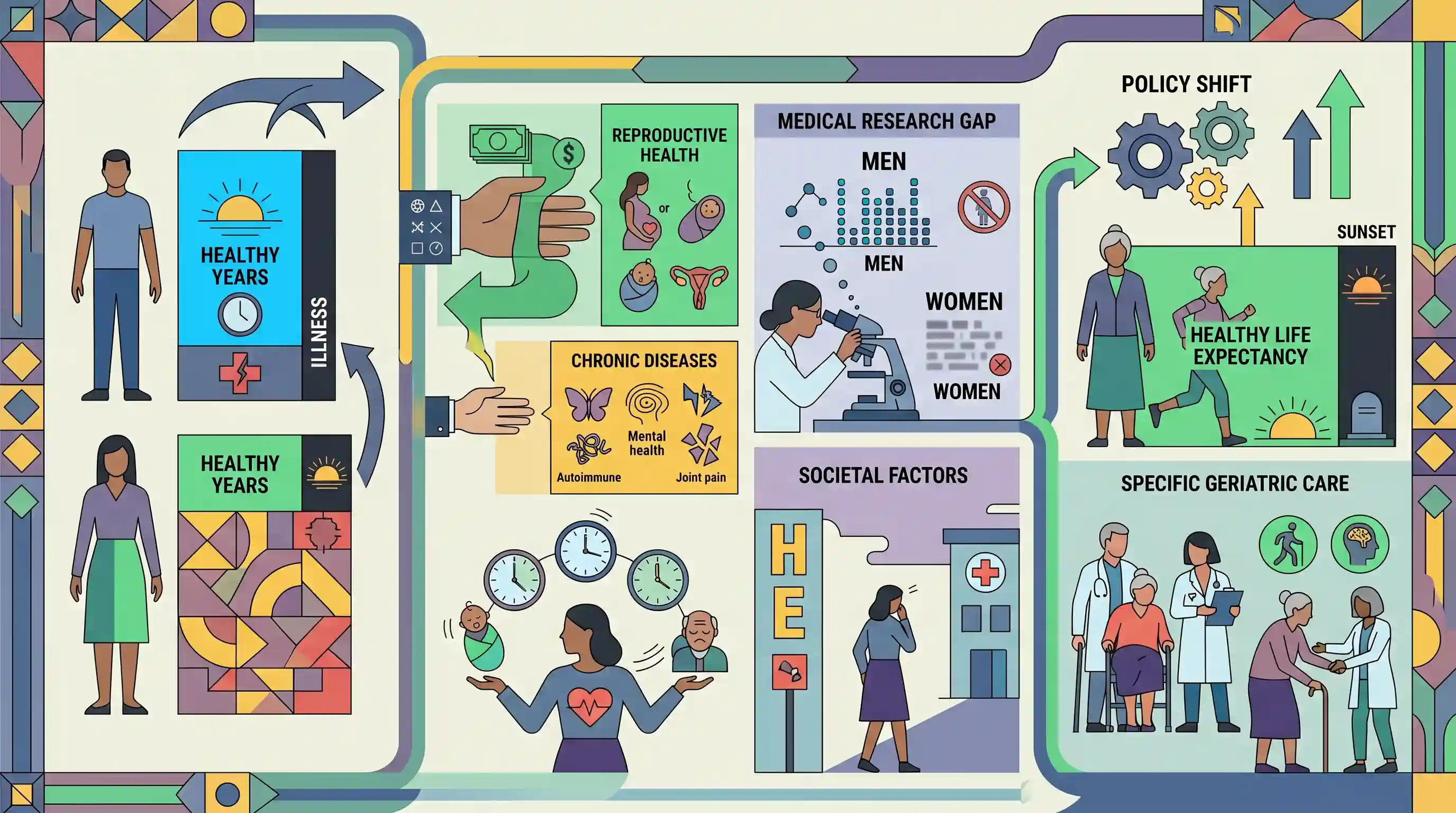
The article analyzes the 'morbidity-mortality paradox', highlighting that although women have a higher life expectancy than men, they spend significantly more years living with illnesses and disabilities. This health gap is driven by a healthcare focus skewed towards reproductive health, ignoring the chronic, non-fatal ailments like autoimmune and mental health disorders that disproportionately affect women. Furthermore, a historical lack of female representation in medical research, combined with societal factors like the unpaid caregiving burden and delayed healthcare-seeking, worsens outcomes. The article advocates for a policy shift toward extending healthy life expectancy (HALE) and improving geriatric care tailored to women.
Key Points
- The article highlights the 'health-survival paradox', revealing that while women generally outlive men, they spend a larger proportion of their lives in poor health or with disabilities (higher morbidity).
- It points out that healthcare systems predominantly focus on maternal and reproductive health, often neglecting chronic conditions like autoimmune diseases, musculoskeletal disorders, and mental health issues that heavily impact women.
- The historical under-representation of women in medical research and clinical trials has created a gender data gap, leading to delayed diagnoses and treatments that are less effective for female bodies.
- Societal and economic factors, such as the disproportionate burden of unpaid caregiving, lack of financial independence, and delayed health-seeking behaviors under patriarchal norms, exacerbate this health gap.
- The findings underscore the need for healthcare policies to shift focus from merely increasing 'life expectancy' to improving 'healthy life expectancy' (HALE), with a stronger emphasis on geriatric and gender-responsive care.
Important Terms
Morbidity-mortality Paradox

The phenomenon where women experience higher rates of illness and disability (morbidity) yet maintain longer life spans (mortality) than men globally.
UPSC context
GS Paper 2/Health: Critical for analyzing gender-specific health outcomes and social justice for vulnerable sections.
Healthy Life Expectancy (HALE)
A health indicator measuring the average number of years a person is expected to live in "full health," excluding years lived with disability or illness.
UPSC context
GS Paper 2/Health: Essential for assessing the quality of life versus simple longevity in public health policy.
National Health Mission (NHM)
India's flagship initiative (subsuming NRHM and NUHM) aimed at ensuring universal, equitable, and affordable healthcare through interventions in maternal, child, and chronic disease management.
UPSC context
GS Paper 2/Governance: Tests knowledge of public health delivery systems and central-state health cooperation.
World Health Organization (WHO)
A specialized United Nations agency established in 1948 that coordinates international health responses, sets global health standards, and supports national health systems.
UPSC context
GS Paper 2/International Institutions: Relevant for understanding global health governance and India's international obligations.
Geriatric Care
Specialized medical and social care focused on the unique health needs and disabilities of the elderly population, typically those aged 60 and above.
UPSC context
GS Paper 2/Social Justice: Key for evaluating welfare schemes for the elderly and managing demographic transitions.
Gender Health Gap
Systemic disparities between men and women regarding healthcare access, clinical research representation, and disease outcomes, often influenced by biological and socio-cultural factors.
UPSC context
GS Paper 2/Women's Issues: Tests ability to analyze social determinants of health and gender inequality in governance.
Prelims Trap
Higher female life expectancy in India implies a proportionately higher Healthy Life Expectancy (HALE) for women compared to men.
This is the 'morbidity-mortality paradox'. Women live longer but spend significantly more of those extra years suffering from chronic diseases and disabilities, decreasing their overall proportion of healthy years.
Static Concepts Connected
What is the difference between Life Expectancy and Healthy Life Expectancy (HALE)?
- Life Expectancy: The average number of years a newborn is expected to live if current age-specific mortality rates continue to apply throughout their lifetime.
- HALE: A WHO metric measuring the average number of years a person can expect to live in 'full health', discounting years lived with disease or disability.
What does the 'feminisation of ageing' mean in demography?
- Core definition: A demographic shift where the elderly population becomes predominantly female, driven by women's naturally higher life expectancy compared to men.
- Policy implications: Requires specialized geriatric care and social security, as elderly women face compounded vulnerabilities like high morbidity, higher rates of widowhood, and poverty.
Cross-Topic Patterns
Unpaid care economy and health outcomes
Time poverty from disproportionate unpaid caregiving (GS1) limits women's healthcare access and financial independence (GS3), directly exacerbating chronic morbidity and delayed diagnoses.
Gender data gaps in medical AI
The historical exclusion of women from clinical trials creates biased datasets. Training AI diagnostic tools on this data risks perpetuating treatments that are biologically less effective for females.

Expect a GS-2 Mains question linking the 'feminisation of ageing' with the urgent need to shift India's health metrics from LEB to HALE.
Linked PYQs · 2
Linked PYQs · 2
- 2020MainsGS2
In order to enhance the prospects of social development, sound and adequate health care policies are needed particularly in the fields of geriatric and maternal health care. Discuss.
- 2024MainsGS1
Distinguish between gender equality, gender equity and women's empowerment. Why is it important to take gender concerns into account in programme design and implementation?
