Role of Women Led MSMEs in Viksit Bharat
Source:Indian Express ↗
Why It Matters
This topic lies at the intersection of GS1 (Role of Women), GS2 (SHGs and Micro-finance), and GS3 (Economic Growth and MSMEs). Addressing the gender gap in entrepreneurship is critical for tackling India's low female labor force participation rate and realizing the developmental goals of Viksit Bharat 2047.
Summary
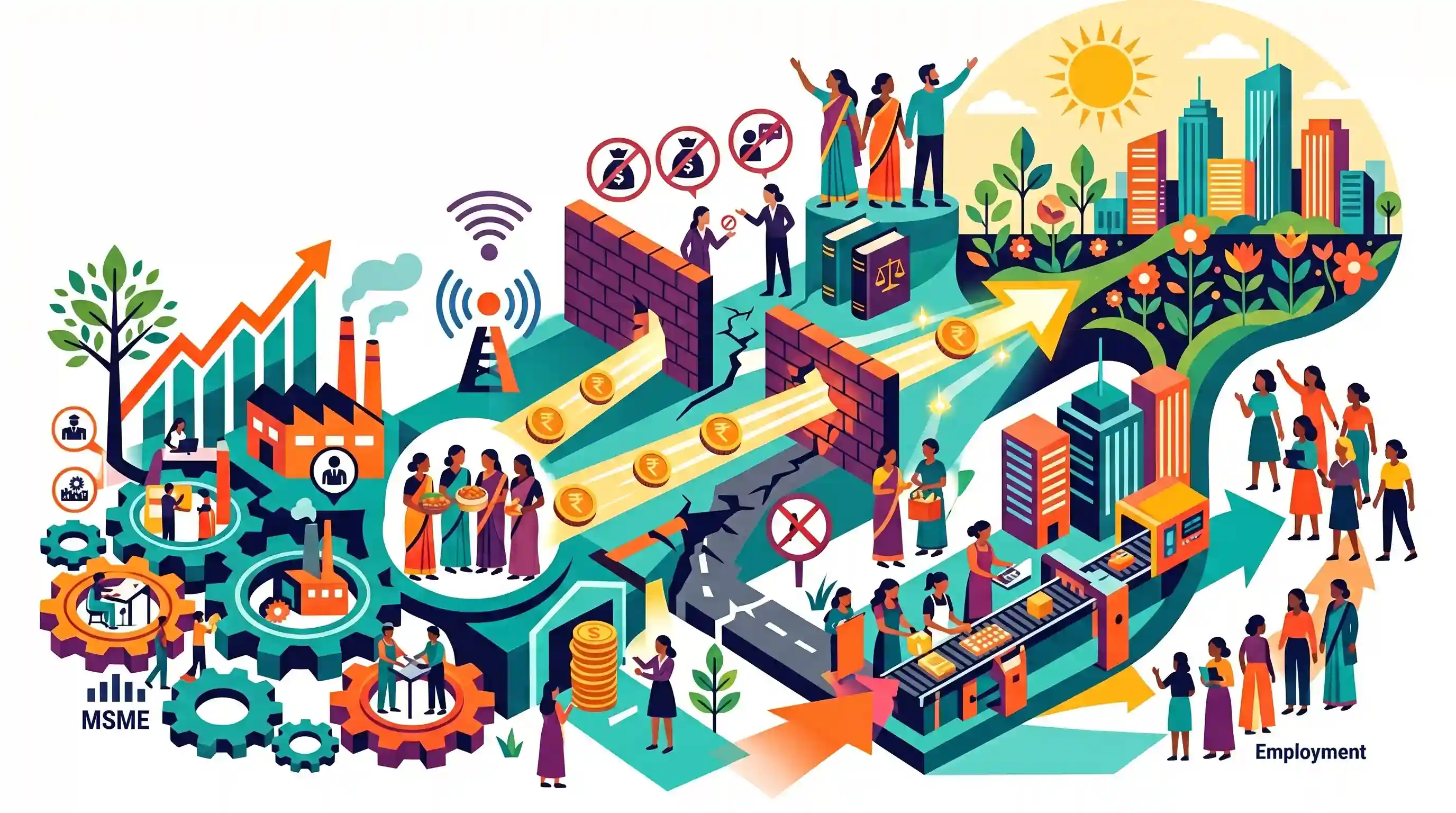
The article emphasizes the indispensable role of women-led Micro, Small, and Medium Enterprises (MSMEs) in achieving 'Viksit Bharat' by 2047. While the MSME sector is the backbone of the Indian economy regarding employment and output, women entrepreneurs still face disproportionate hurdles such as lack of credit, collateral issues, and social constraints. By enhancing access to micro-finance, leveraging SHG networks, and implementing targeted government policies, India can unlock the immense potential of its 'Nari Shakti.' Scaling women-owned businesses will not only drive direct economic growth but also trigger a multiplier effect by boosting female employment and advancing inclusive development.
Key Points
- The MSME sector is a crucial driver of economic growth; promoting women-led enterprises within this sector can significantly boost GDP and employment.
- Women entrepreneurs face systemic challenges, including limited access to formal credit, collateral requirements, and entrenched socio-cultural barriers.
- Women-led enterprises tend to hire more women, creating a positive multiplier effect on the female labor force participation rate (FLFPR) and inclusive growth.
- Access to microfinance and the robust network of Self Help Groups (SHGs) play a critical role in nurturing grassroots female entrepreneurship.
- Bridging the gender gap in business ownership and easing the compliance and credit burden for women is a fundamental prerequisite for realizing the vision of 'Viksit Bharat' by 2047.
Important Terms
Viksit Bharat 2047

The government’s vision to transform India into a developed nation by the centenary of its independence. It targets a $30-40 trillion economy, high per capita income, and inclusive growth.
UPSC context
GS Paper III (Economic Development); tests long-term planning, sustainable growth, and sectoral targets for India's future.
MSMEs
Small-scale businesses classified by investment and turnover. Often called the 'backbone' of the economy, they contribute nearly 30% to GDP and are the second-largest employment generator after agriculture.
UPSC context
GS Paper III (Indian Economy); tests knowledge of industrial policy, classification, and roles in inclusive growth.
Self Help Groups (SHGs)
Informal, community-based groups (predominantly women) that pool savings to provide mutual credit. They facilitate financial inclusion, poverty alleviation, and grassroots women's empowerment through collective entrepreneurship.
UPSC context
GS Paper II (Social Justice) and Paper III (Rural Development); tests community-led development and financial inclusion strategies.
Mudra Yojana
A scheme providing collateral-free loans (up to ₹20 lakh) to micro-enterprises under Shishu, Kishor, and Tarun categories. It aims to 'fund the unfunded' and formalize the informal sector.
UPSC context
GS Paper III (Financial Inclusion); tests familiarity with credit access and government support for the informal economy.
Stand Up India
A credit scheme facilitating bank loans (₹10 lakh to ₹1 crore) for SC, ST, and women entrepreneurs to start 'greenfield' (first-time) ventures in manufacturing, services, or trading.
UPSC context
GS Paper II (Governance) and Paper III (Economy); tests targeted credit interventions and women's economic empowerment.
Udyam Registration
The official Aadhaar-based, paperless portal for MSME registration. It provides a permanent identity and serves as a gateway for enterprises to access government subsidies and benefits.
UPSC context
GS Paper III (Ease of Doing Business); tests knowledge of digital governance and sector formalization.
Prelims Trap
"Stand-Up India scheme provides loans to women entrepreneurs specifically for upgrading and expanding their existing MSME units."
Stand-Up India specifically facilitates bank loans between ₹10 lakh and ₹1 crore only for setting up greenfield (first-time) enterprises, not for existing businesses.
Static Concepts Connected
What is the current composite classification criteria for MSMEs in India?
- Micro Enterprise: Investment in Plant and Machinery or Equipment up to ₹1 crore and Annual Turnover up to ₹5 crore.
- Small Enterprise: Investment up to ₹10 crore and Annual Turnover up to ₹50 crore.
- Medium Enterprise: Investment up to ₹50 crore and Annual Turnover up to ₹250 crore.
What are the core features of the SHG-Bank Linkage Programme (SBLP)?
- NABARD Origins: Launched by NABARD in 1992, it integrates the unbanked rural poor into the formal financial sector by linking SHGs with bank branches.
- Collateral-free Lending: Loans are provided without physical collateral. The lending is based on peer-pressure, internal group discipline, and social capital.
- Savings First Model: SHGs first lend internally using members' savings. Once a track record is built, banks extend a larger term loan to the group as a single entity.
Cross-Topic Patterns
FLFPR and the MSME Multiplier
Women-led MSMEs hire proportionately more women. Expanding this sector directly addresses the stagnation in India's Female Labor Force Participation Rate (FLFPR) and tackles rural disguised unemployment.
DPI enabling Cash-Flow Lending
Lack of physical collateral restricts women's credit. The integration of Udyam registration with Account Aggregators allows banks to shift from collateral-based to cash-flow-based lending for female entrepreneurs.

Mains 2026 will likely test the transition of women from SHG micro-credit reliance to formal MSME leadership as a driver of FLFPR.
Linked PYQs · 4
Linked PYQs · 4
- 2023MainsGS3
Faster economic growth requires increased share of the manufacturing sector in GDP, particularly of MSMEs. Comment on the present policies of the Government in this regard.
- 2021MainsGS2
Can the vicious cycle of gender inequality, poverty and malnutrition be broken through microfinancing of women SHGs? Explain with examples.
- 2020MainsGS2
Micro-Finance as an anti-poverty vaccine, is aimed at asset creation and income security of the rural poor in India". Evaluate the role of the Self Help Groups in achieving the twin objectives along with empowering women in rural India.
- 2024MainsGS1
Distinguish between gender equality, gender equity and women's empowerment. Why is it important to take gender concerns into account in programme design and implementation?
