Decentralised Renewable Energy and Women Empowerment for Rural Growth
Source:The Hindu ↗
Why It Matters
This topic sits squarely at the intersection of GS2 (Women Empowerment & SHGs) and GS3 (Renewable Energy & Inclusive Growth). It offers a highly effective multi-dimensional perspective for Mains answers, showing how climate action and energy transition can be leveraged to achieve social justice and rural development.
Summary
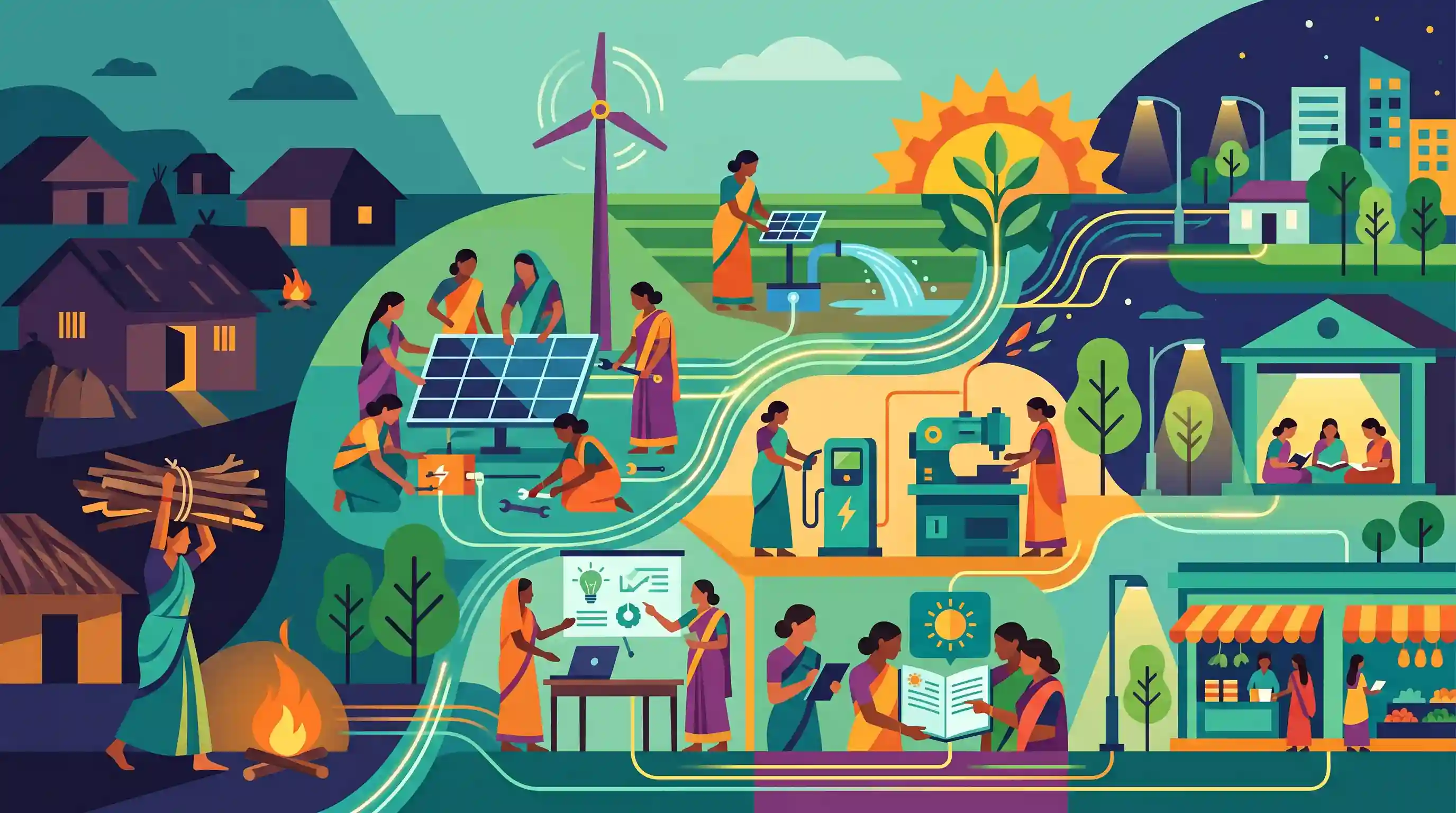
The article explores the critical intersection of India's renewable energy transition and gender empowerment. It highlights that Decentralised Renewable Energy (DRE) is essential for achieving last-mile energy connectivity and fostering rural economic activities. By empowering women to lead these DRE initiatives—such as managing solar microgrids or engaging in green entrepreneurship—the country can address energy poverty while simultaneously closing the gender gap in economic participation. This shift embodies a move from treating women as passive beneficiaries to active leaders in India's climate and energy goals.
Key Points
- Decentralised Renewable Energy (DRE) systems are crucial for bridging the last-mile energy access gap and supporting productive use of energy in rural India.
- Integrating women into the DRE sector shifts their role from mere energy consumers to active stakeholders, entrepreneurs, and managers of green infrastructure.
- Women-led DRE models address dual socio-economic challenges by simultaneously tackling rural energy poverty and enhancing female economic participation.
- Leveraging existing networks like Self Help Groups (SHGs) can effectively scale up women-led energy transitions and promote localized, inclusive economic growth.
Important Terms
Decentralised Renewable Energy (DRE)

Energy generated near its point of use from renewable sources like solar, biomass, or small hydro, reducing reliance on the centralized national grid.
UPSC context
GS Paper 3: Energy and Infrastructure. Crucial for achieving net-zero targets and ensuring energy security in remote rural areas.
Solar Microgrids
Small, localized electricity networks powered by solar panels and batteries that can operate independently or alongside the main grid to provide 24/7 power to communities.
UPSC context
GS Paper 3: Infrastructure. Tested as a solution for reliable rural electrification and climate resilience in disaster-prone regions.
Energy Poverty
The lack of access to affordable, reliable, and sustainable modern energy services (electricity and clean cooking fuels), which hinders human development and economic growth.
UPSC context
GS Paper 1: Social Issues; GS Paper 3: Energy. A multidimensional challenge impacting health, education, and gender equality in India.
Self Help Groups (SHGs)
Informal collectives of 10–20 members (primarily women) who pool savings to provide internal loans and initiate micro-enterprises, fostering grassroots financial inclusion.
UPSC context
GS Paper 2: Social Justice; GS Paper 3: Inclusive Growth. Key to the NRLM framework and women-led development models.
Last-mile Transition
The challenge of extending essential services—such as electricity, healthcare, or digital connectivity—to the most remote, geographically isolated, or socio-economically marginalized populations.
UPSC context
GS Paper 2: Governance; GS Paper 3: Infrastructure. Tests knowledge of inclusive policy implementation and universal service delivery.
Green Entrepreneurship
Entrepreneurs who create business models prioritizing environmental sustainability and resource efficiency, often generating 'green jobs' in sectors like renewable energy or waste management.
UPSC context
GS Paper 3: Economic Development and Environment. Essential for marrying economic growth with India's climate commitments (Sustainable Development).
Prelims Trap
DRE initiatives in India focus primarily on providing clean cooking fuel to rural households.
Aspirants often confuse DRE with PMUY (Ujjwala). DRE actually focuses on localized electricity generation (microgrids) and the Productive Use of Renewable Energy (PURE) for enterprises, not just fuel.
Static Concepts Connected
What characterizes Decentralised Renewable Energy (DRE) systems?
- Point of Generation: Power is produced close to the demand source (e.g., solar microgrids, biogas), drastically reducing transmission and distribution (T&D) losses inherent in centralized grids.
- Productive Use: DRE drives the 'Productive Use of Renewable Energy' (PURE) by powering rural micro-enterprises (chillers, looms, dryers), transforming households into economic units.
How do Self Help Groups (SHGs) facilitate rural asset ownership?
- Financial Intermediation: Through the SHG-Bank Linkage Programme, women pool savings to access collateral-free institutional credit, enabling them to purchase capital-intensive DRE assets.
- Operational Management: Grassroots social capital allows SHGs to jointly own, operate, and collect user-fees for local green infrastructure like solar microgrids and agricultural pumps.
Cross-Topic Patterns
PM KUSUM + SHG micro-entrepreneurship
PM KUSUM exemplifies DRE by solarizing agriculture. Linking such schemes with SHGs bridges GS3 clean energy targets with GS2 gender inclusion and rural livelihoods.
Ecofeminism + Climate Mitigation
Women disproportionately suffer from energy poverty. Managing DRE microgrids shifts their narrative from passive welfare recipients (consumers) to active managers of climate-resilient green infrastructure.

Expect a GS3 Mains question integrating Decentralised Renewable Energy (DRE) with GS2 women's empowerment via SHGs, beyond Ujjwala.
Linked PYQs · 4
Linked PYQs · 4
- 2020MainsGS3
Describe the benefits of deriving electric energy from sunlight in contrast to the conventional energy generation. What are the initiatives offered by our Government for this purpose?
- 2022MainsGS3
Do you think India will meet 50 percent of its energy needs from renewable energy by 2030 ? Justify your answer. How will the shift of subsidies from fossil fuels to renewables help achieve the above objective ? Explain.
- 2020MainsGS2
Micro-Finance as an anti-poverty vaccine, is aimed at asset creation and income security of the rural poor in India". Evaluate the role of the Self Help Groups in achieving the twin objectives along with empowering women in rural India.
- 2021MainsGS2
Can the vicious cycle of gender inequality, poverty and malnutrition be broken through microfinancing of women SHGs? Explain with examples.
