Supreme Court examines declining political representation of women
Source:The Hindu ↗
Why It Matters
The article highlights the practical challenges and constitutional debates surrounding women's political representation in India. It is highly relevant for GS-2 topics related to constitutional amendments (106th, 73rd, 74th), the delimitation process, and the role of the judiciary in interpreting Article 15(3) for affirmative action.
Summary
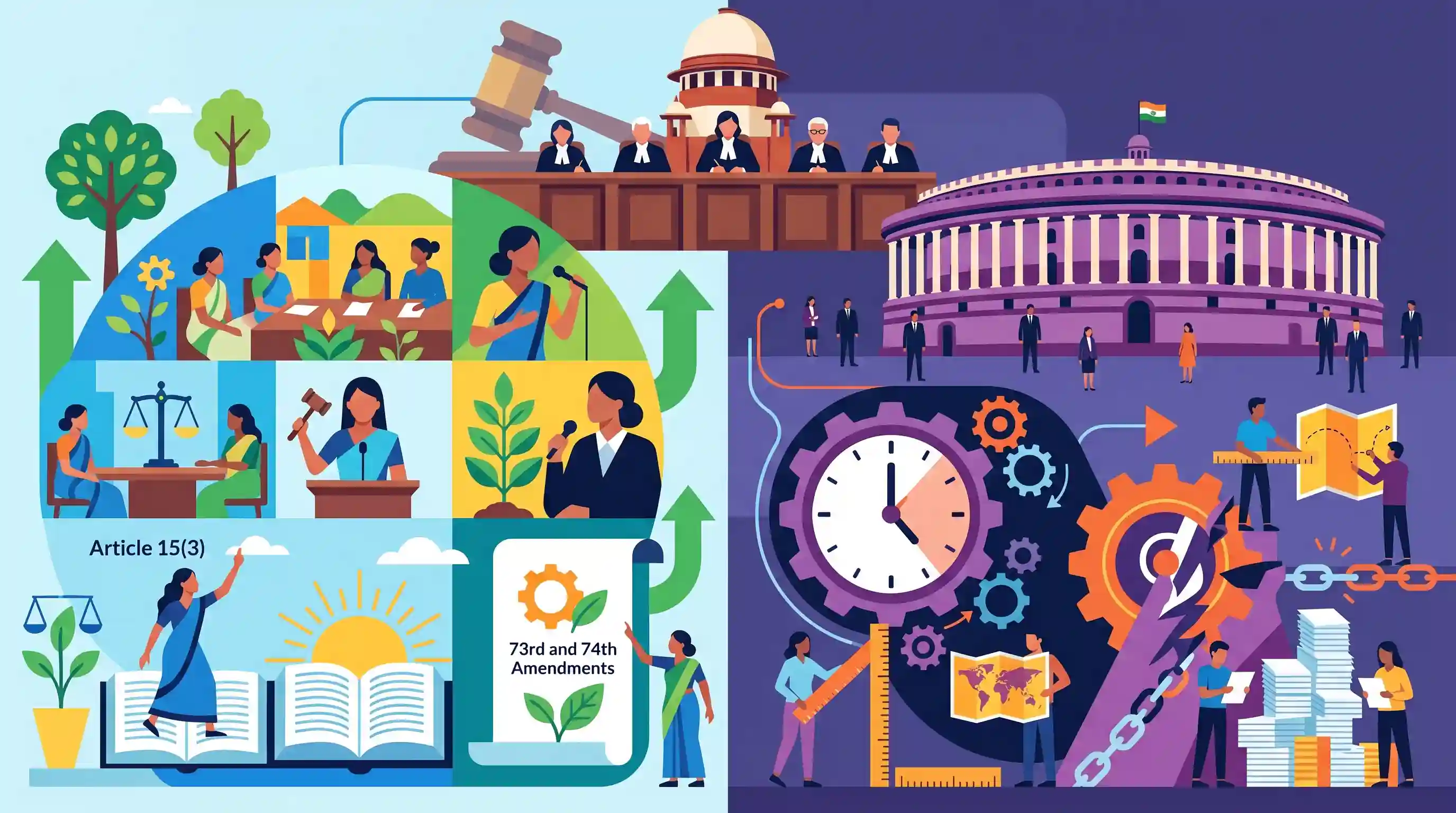
The Supreme Court labeled women as India's "largest minority," highlighting their persistently low and receding representation in Parliament compared to the broader population. During a hearing on the delayed implementation of the Nari Shakti Vandan Adhiniyam—which promises 33% reservation for women—the bench examined the government's defense that the rollout depends on pending census and delimitation exercises. The Justices contrasted the stagnation at the national level with the success of the 73rd and 74th Constitutional Amendments in local self-governance, and underscored the mandate of Article 15(3) to formulate affirmative action policies for women's political empowerment.
Key Points
- The Supreme Court termed women as the "largest minority" in India, expressing concern over their receding representation in Parliament.
- The observation was made during a hearing on the delayed implementation of the Nari Shakti Vandan Adhiniyam (106th Constitutional Amendment), which mandates 33% reservation for women in legislative bodies.
- The government stated that the women's reservation cannot be implemented until the next census and subsequent delimitation exercises are completed.
- The bench highlighted the success of the 73rd and 74th Constitutional Amendments, which effectively increased women's representation in local self-government, contrasting it with the national level.
- The Court invoked Article 15(3) of the Constitution, emphasizing the State's duty to make special, affirmative provisions to ensure substantive equality for women.
Important Terms
Nari Shakti Vandan Adhiniyam (106th Amendment Act)

A 2023 law (106th Amendment) reserving 33% of seats for women in the Lok Sabha, State Legislative Assemblies, and the Delhi Legislative Assembly for 15 years.
UPSC context
GS Paper II: Important for questions on legislative measures for gender parity and major constitutional amendments.
Article 15(3) of the Constitution
A constitutional provision enabling the State to make special provisions (affirmative action) for women and children, overriding general non-discrimination clauses.
UPSC context
GS Paper II: Fundamental Rights; key to understanding the constitutional basis for gender-based protective discrimination.
Delimitation Exercise
The process of redrawing boundaries of Lok Sabha and State Assembly constituencies based on recent census data to ensure equal representation (one person, one vote).
UPSC context
GS Paper II: Electoral reforms; critical for understanding the implementation timeline of the 106th Amendment.
73rd and 74th Constitutional Amendment Acts
1992 acts that institutionalized rural (Panchayats) and urban (Municipalities) local bodies, mandating a minimum of one-third reservation for women in local governance.
UPSC context
GS Paper II: Local Self-Governance; tests understanding of democratic decentralization and grassroots women's leadership.
Political Justice
A core ideal of the Preamble ensuring all citizens have equal access to political power and decision-making processes, regardless of gender or social status.
UPSC context
GS Paper II: Preamble and Basic Structure; relevant to judicial interpretations of democratic equality.
Prelims Trap
"The 106th Constitutional Amendment Act provides 33% reservation for women in both the Lok Sabha and Rajya Sabha."
The reservation strictly applies to the Lok Sabha, State Legislative Assemblies, and the Delhi Assembly. It does NOT apply to the Rajya Sabha or State Legislative Councils.
Static Concepts Connected
What is the constitutional framework governing the Delimitation Commission?
- Article 82: Empowers Parliament to enact a Delimitation Act after every census to readjust territorial constituencies.
- Judicial Immunity: Delimitation Commission orders have the force of law and cannot be questioned in any court.
- 84th Amendment Act: Froze the total number of Lok Sabha seats allocated to states based on the 1971 Census until after 2026.
Which constitutional articles mandate affirmative action for women's political representation?
- Article 15(3): Enables the State to make special, affirmative provisions for women, serving as the foundational bedrock for gender-based quotas.
- Articles 243D & 243T: Mandate a minimum of one-third reservation for women in Panchayats and Municipalities, respectively.
- Articles 330A & 332A: Inserted by the 106th Amendment to reserve 33% seats for women in the Lok Sabha and State Assemblies.
Cross-Topic Patterns
Delimitation & Federal Friction
Linking women's reservation to the post-2026 census triggers a clash with southern states, who fear losing proportional representation due to their successful population control.
Substantive Equality Jurisprudence
The SC’s reliance on Article 15(3) reinforces the shift from 'formal equality' to 'substantive equality,' a theme frequently explored in UPSC Mains GS2 and Essay papers.

Expect a 2026 Prelims question mixing the 106th Amendment's Rajya Sabha exclusion, SC/ST sub-quotas, and Article 334A's delimitation rule.
Linked PYQs · 4
Linked PYQs · 4
- 2024PrelimsGS1
Consider the following statements regarding 'Nari Shakti Vandan Adhiniyam' : 1. Provisions will come into effect from the 18th Lok Sabha. 2. This will be in force for 15 years after becoming an Act. 3. There are provisions for the reservation of seats for Scheduled Castes Women within the quota reserved for the Scheduled Castes. Which of the statements given above are correct?
- 2023MainsGS2
Discuss the contribution of civil society groups for women's effective and meaningful participation and representation in state legislatures in India.
- 2019MainsGS2
“The reservation of seats for women in the institutions of local self-government has had a limited impact on the patriarchal character of the Indian Political Process.” Comment.
- 2024MainsGS1
Despite comprehensive policies for equity and social justice, underprivileged sections are not yet getting the full benefits of affirmative action envisaged by the Constitution. Comment.
