Ammonia Gas Leak at Tamil Nadu Seafood Factory Kills Migrant Workers
Source:Indian Express ↗
Why It Matters
This tragic incident serves as a critical case study for GS3 Disaster Management (chemical disasters, NDRF response) and GS2/GS3 Social Justice and Economy (vulnerability of migrant female workers, occupational safety codes, and labour rights in the unorganized/processing sector).
Summary
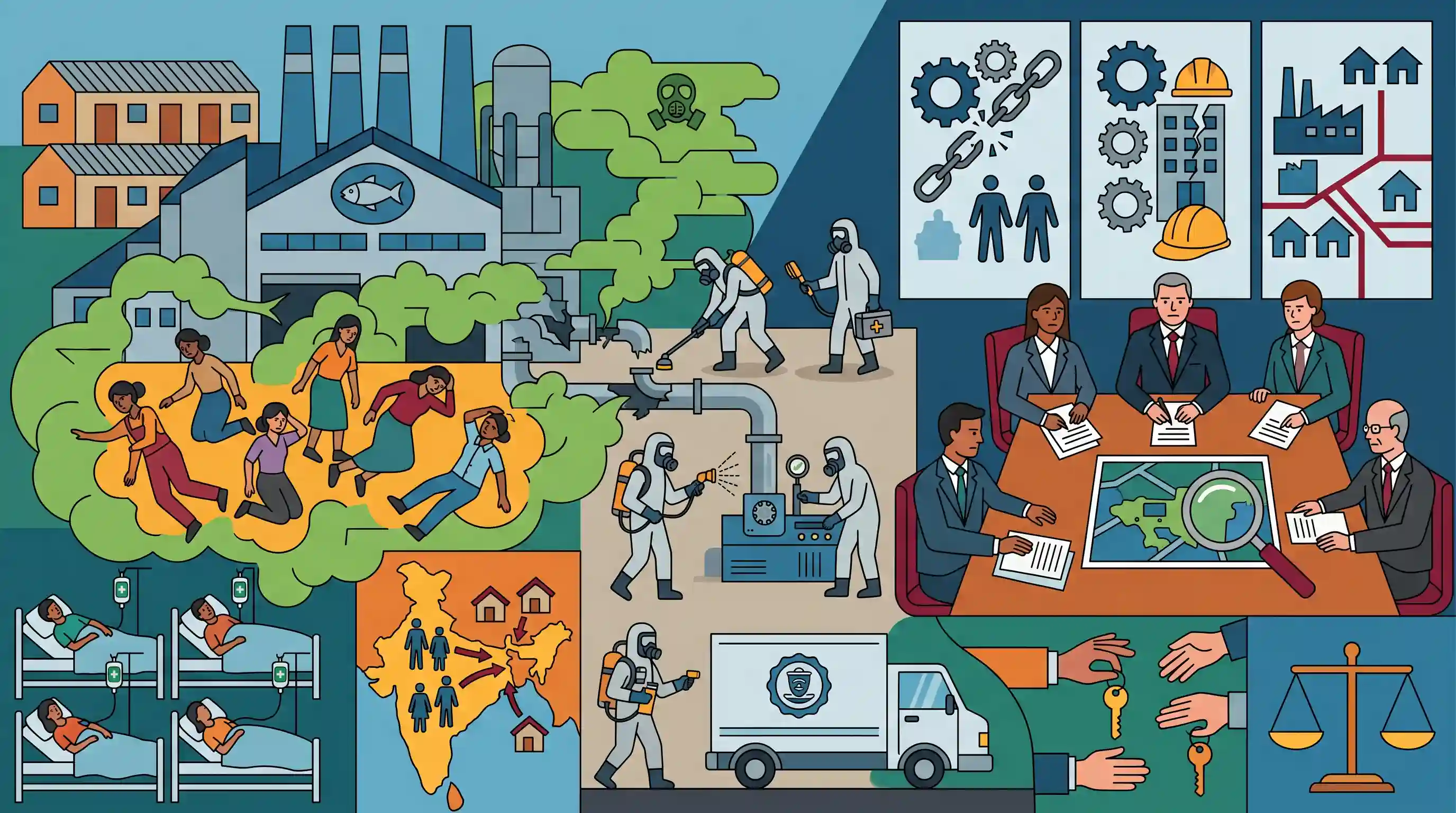
An ammonia gas leak at a seafood processing plant in Tiruvallur, Tamil Nadu, claimed the lives of seven female migrant workers and left dozens hospitalized. The victims, primarily from eastern Indian states, were residing in quarters within the factory premises, exposing them to the lethal chemical hazard. The deployment of an NDRF CBRN team and the formation of a state investigative panel underscore the severity of the industrial disaster, which raises urgent concerns regarding occupational safety, industrial zoning laws, and the systemic vulnerability of internal migrant laborers.
Key Points
- Seven female migrant workers from Assam, Odisha, and Jharkhand died following an ammonia gas leak at a seafood processing factory in Tiruvallur, Tamil Nadu.
- The workers were living in residential quarters located inside the factory premises, directly exposing them to the toxic chemical gas during the leak.
- The National Disaster Response Force (NDRF) deployed a specialized Chemical, Biological, Radiological, and Nuclear (CBRN) team to handle the emergency and secure the site.
- The Tamil Nadu government has constituted a probe panel comprising officials from industrial safety, public health, and pollution control boards to investigate the disaster.
- The incident highlights critical gaps in occupational safety standards, particularly concerning the housing of vulnerable internal migrant laborers in hazardous industrial zones.
Important Terms
National Disaster Response Force (NDRF)

A specialized Indian response force established under the Disaster Management Act, 2005. It provides rapid assistance during natural and man-made disasters, including chemical leaks and industrial accidents.
UPSC context
GS Paper III (Disaster Management); tests knowledge of institutional frameworks for disaster response and mitigation.
Tamil Nadu Pollution Control Board (TNPCB)
A state-level regulatory body established under the Water (Prevention and Control of Pollution) Act, 1974. It monitors industrial emissions and ensures compliance with environmental safety standards.
UPSC context
GS Paper III (Environment & Pollution); relevant for environmental governance and industrial regulation topics.
Directorate of Industrial Safety and Health (DISH)
A state authority responsible for enforcing the Factories Act, 1948. It monitors occupational health, safety, and welfare of workers in registered industrial units.
UPSC context
GS Paper II (Social Justice/Labour Welfare); tests understanding of occupational safety laws and industrial oversight.
CBRN (Chemical, Biological, Radiological and Nuclear)
An acronym for Chemical, Biological, Radiological, and Nuclear hazards. NDRF maintains specialized units equipped with advanced technology to manage these specific, high-risk non-conventional emergencies.
UPSC context
GS Paper III (Disaster Management); specific to man-made and industrial disaster response strategies.
Factories Act, 1948
The primary law governing working conditions in Indian factories. It mandates safety measures, health standards, and welfare provisions for industrial laborers.
UPSC context
GS Paper II (Governance/Laws); central to discussions on industrial safety and labor rights.
Ammonia Gas Leak
A toxic, colorless gas with a pungent smell, commonly used as a refrigerant in cold storage. Exposure causes severe respiratory distress and chemical burns.
UPSC context
GS Paper III (Environment/Disaster Management); a case-study example of chemical industrial hazards.
Prelims Trap
"The Disaster Management Act 2005 provides the statutory mechanism for mandatory compensation to victims of chemical disasters."
Statutory compensation and immediate relief for victims of hazardous industrial chemical accidents are mandated under the Public Liability Insurance Act, 1991, not the DM Act.
Static Concepts Connected
What are the environmental and health hazards of industrial Ammonia (NH3)?
- Human Toxicity: Causes severe skin burns, eye damage, and acute respiratory distress upon inhalation.
- Secondary Pollutant: Reacts with NOx and SOx in the atmosphere to form dangerous secondary PM2.5 particulate matter.
- Eutrophication: Deposition in water bodies leads to algal blooms, acidification, and oxygen depletion, threatening aquatic ecosystems.
What is the legal framework for chemical disaster management in India?
- EPA 1986 Rules: The Manufacture, Storage and Import of Hazardous Chemical Rules (under EPA 1986) govern industrial compliance and safety thresholds.
- PLI Act 1991: Mandates that industries handling hazardous substances provide immediate, no-fault financial relief to accident victims.
- DM Act 2005: NDMA guidelines dictate hazard zonation, off-site emergency planning, and the deployment of specialized NDRF CBRN units.
Cross-Topic Patterns
Feminization of internal migration
The presence of young women from Assam and Odisha in Tamil Nadu highlights how distress migration for low-wage informal sector jobs worsens gendered occupational vulnerabilities.
Urban zoning vs. Labour housing
Housing labourers within hazardous factory premises blatantly violates NDMA zonation guidelines, a deadly structural failure echoing past disasters like the Vizag styrene leak and Delhi factory fires.

Expect a 2026 Prelims question mixing Ammonia's environmental impacts (PM2.5 precursor) with chemical disaster legal frameworks.
Linked PYQs · 3
Linked PYQs · 3
- 2020MainsGS3
Discuss the recent measures initiated in disaster management by the Government of India departing from the earlier reactive approach.
- 2019MainsGS3
Vulnerability is an essential element for defining disaster impacts and its threat to people. How and in what ways can vulnerability to disasters be characterized? Discuss different types of vulnerability with reference to disasters.
- 2015MainsGS1
Discuss the changes in the trends of labour migration within and outside India in the last four decades.
