Digital Transformation and Women Entrepreneurship in MSMEs
Source:The Hindu ↗
Why It Matters
Provides a concrete example of how digital technologies and women's business consortiums (social capital) can intersect to boost the MSME sector, serving as an excellent case study for answers on digitalization, women's empowerment, and MSME growth.
Summary
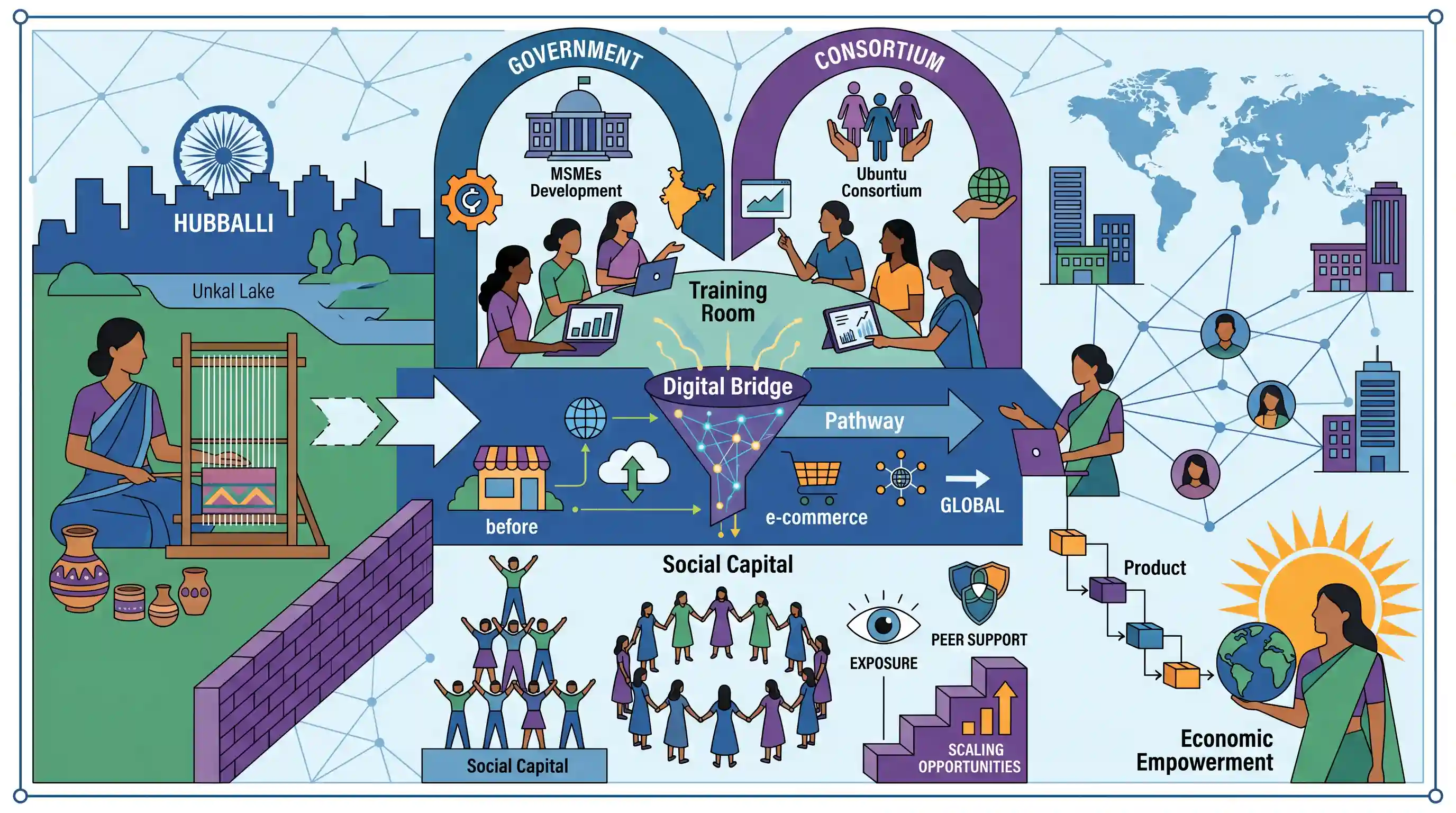
The article discusses a training programme in Hubballi, Karnataka, aimed at encouraging women entrepreneurs to adopt digital transformation to expand their businesses. Organized by the MSMEs Development and Facilitation Office and the Ubuntu Consortium of Women Entrepreneurs Association, the initiative highlights how digitization removes geographical barriers and connects local capabilities to global markets. It also underscores the importance of women's business networks in providing exposure, peer support, and scaling opportunities for MSMEs in tier II cities.
Key Points
- A training programme for women entrepreneurs in Hubballi focused on 'Business Beyond Boundaries Through Digital Transformation'.
- Digitalization was highlighted as an essential bridge connecting local entrepreneurial capabilities with global market opportunities, eliminating geographical limitations.
- The Ubuntu Consortium has grown significantly (from 8 to 65 associations), demonstrating the power of women's organizational networks and social capital in fostering peer support and business growth.
- Experts emphasized that MSMEs, particularly those led by women in tier II cities, need to embrace technological diversification and innovation to scale their operations.
Important Terms
MSME Development and Facilitation Office (MSME-DFO)

Field-level wings of the Union Ministry of MSME that provide technical, managerial, and economic consultancy to small businesses and assist in implementing central development schemes.
UPSC context
GS Paper 3 (Economy); vital for understanding institutional frameworks supporting MSMEs and ease of doing business.
Ubuntu Consortium of Women Entrepreneurs Association
A Karnataka-based non-profit consortium of various women’s associations providing mentorship, networking, and digital on-boarding to help women entrepreneurs scale and reach global markets.
UPSC context
GS Paper 1 (Social Issues) and GS Paper 3 (Economy); relevant for topics on women empowerment and entrepreneurship models.
North Karnataka Small Scale Industries Association (NKSSIA)
One of the largest regional industrial bodies in North Karnataka, established in 1962 to represent small-scale manufacturing units and advocate for their policy and infrastructure needs.
UPSC context
GS Paper 3 (Economy); illustrates the role of regional trade associations in driving balanced industrial and regional development.
Social Capital
The collective value derived from networks, trust, and relationships within a group that facilitates cooperation and resource-sharing, essential for women-led micro-enterprises.
UPSC context
GS Paper 2 (Social Justice); critical for analyzing the success of Self-Help Groups (SHGs) and community-driven development.
Digital Transformation
The strategic integration of digital technologies—such as cloud computing, AI, and e-commerce—into business operations to improve efficiency, customer reach, and competitiveness.
UPSC context
GS Paper 3 (Economy/S&T); essential for discussing Industry 4.0 and its impact on the formalization and growth of Indian MSMEs.
Prelims Trap
The Public Procurement Policy mandates CPSEs to procure 25% of their annual requirements exclusively from women-owned MSMEs.
The 25% procurement mandate applies to all Micro and Small Enterprises (MSEs). Within this, there is a specific sub-target of only 3% reserved for women-owned MSEs.
Static Concepts Connected
What is the Udyam Assist Platform (UAP) for MSMEs?
- Target Base: Formalizes Informal Micro Enterprises (IMEs) that do not have, or are exempted from, GST registration.
- Financial Inclusion: Enables IMEs to receive a registration certificate, unlocking their access to Priority Sector Lending (PSL) from banks.
What are the key government policy incentives for women-led MSMEs?
- Public Procurement: Central Ministries and CPSEs are mandated to procure at least 3% of their annual purchases from women-owned MSEs.
- Credit Support: An enhanced 85% credit guarantee coverage is provided for women entrepreneurs under the Credit Guarantee Fund Trust for Micro and Small Enterprises (CGTMSE).
Cross-Topic Patterns
SHG networks to formal MSMEs
Programs like Lakhpati Didi and regional consortiums leverage women's social capital, transitioning them from basic micro-credit models into formal, digitally-integrated MSMEs.
ONDC and Tier-II digital inclusion
Digital transformation programs for women MSMEs directly feed into India's push to democratize e-commerce via ONDC, breaking geographic market monopolies.

Expect a 2026 Prelims question testing the distinction between Udyam and Udyam Assist, paired with the 3% women-MSE procurement mandate.
Linked PYQs · 4
Linked PYQs · 4
- 2025MainsGS2
Women's social capital complements in advancing empowerment and gender equity. Explain.
- 2021MainsGS2
Can the vicious cycle of gender inequality, poverty and malnutrition be broken through microfinancing of women SHGs? Explain with examples.
- 2023MainsGS3
Faster economic growth requires increased share of the manufacturing sector in GDP, particularly of MSMEs. Comment on the present policies of the Government in this regard.
- 2023MainsGS3
What is the status of digitalization in the Indian economy? Examine the problems faced in this regard and suggest improvements.
