Barmer Drowning Incident Highlights Safety Risks in Farm Reservoirs
Source:times-of-india ↗
Why It Matters
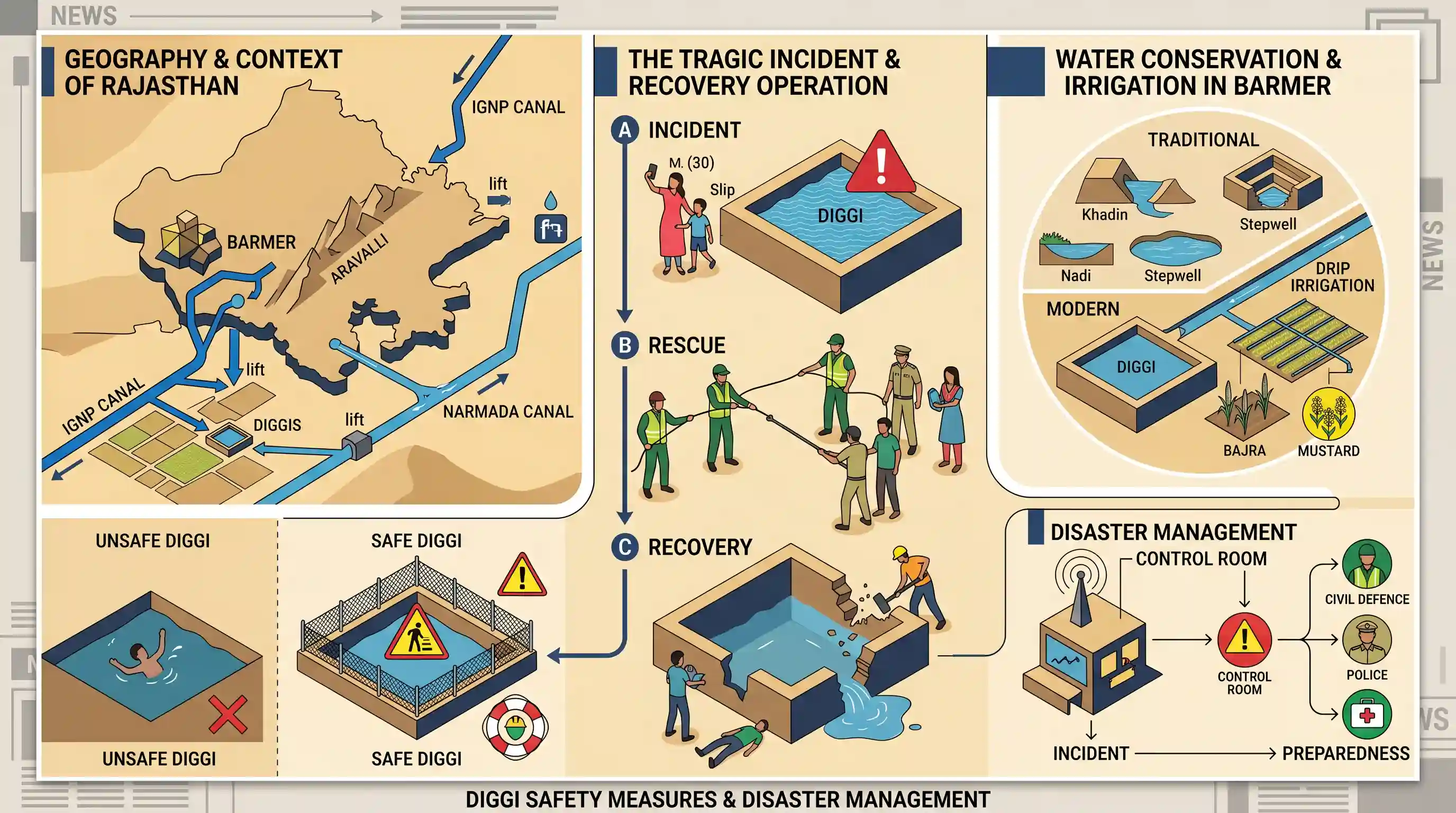
The incident underscores the ubiquity of 'diggis' (farm water reservoirs) in the water-scarce terrain of Barmer, which is fed by key initiatives like the Narmada Canal Project. It connects to RPSC's core focus areas, including traditional and modern water harvesting techniques (such as Khadins and Diggis), district-wise irrigation coverage, and local emergency response systems.
Summary
A tragic incident occurred in Banon Ki Beri Doodh village, Barmer district, where a 30-year-old woman and her 7-year-old son drowned in a newly constructed farm water reservoir ('diggi') while attempting to take selfies. The rescue and recovery operation was conducted by local police, residents, and Civil Defence teams, who had to drain the reservoir by demolishing a wall. The event brings attention to water storage structures ('diggis') in arid Rajasthan, their roles in farming, and the safety measures required to prevent drowning accidents.
Key Points
- A 30-year-old woman (Jiyo Devi) and her 7-year-old son (Hitesh) drowned in a newly constructed farm water reservoir ('diggi') in Banon Ki Beri Doodh village, Barmer district, Rajasthan, while taking a selfie.
- The child slipped into the reservoir, prompting his mother to jump in to rescue him, but both drowned due to the depth of the water and inability to swim.
- The bodies were recovered in a joint three-hour operation by the local police, residents, and Civil Defence personnel, requiring a JCB machine to demolish one wall of the 'diggi' to drain the water.
- In Rajasthan's arid districts (like Barmer, Jaisalmer, Sri Ganganagar), 'diggis' (farm ponds/reservoirs) are crucial modern rainwater and canal-water storage structures, often subsidized by the state government for agriculture.
- The incident highlights safety vulnerabilities associated with open water conservation structures in rural areas, highlighting the need for fencing, warning signs, and local disaster preparedness.
Important Terms
Narmada Canal Project

A 532 km contour canal transferring water from Sardar Sarovar Dam to Jalore and Barmer in Rajasthan, notable for mandating highly efficient micro-irrigation systems like sprinklers.
UPSC context
GS Paper 1 (Geography: Water Resources) & GS Paper 3 (Agriculture). Tests inter-state water sharing and modern irrigation systems.
Diggi (Water Reservoir)
A micro-farm water harvesting and storage structure built in arid and canal-command areas of Rajasthan to store water for pressurized micro-irrigation.
UPSC context
GS Paper 1 (Geography: Traditional & Modern Water Conservation) & GS Paper 3 (Agriculture). Tests localized, drought-resilient farming techniques.
Rajasthan Diggi Subsidy Scheme
A state welfare scheme providing 75% to 85% financial subsidy (up to ₹3.4 lakh) to farmers for constructing lined agricultural water storage tanks.
UPSC context
GS Paper 2 (Government Schemes) & GS Paper 3 (Agricultural Subsidies). Tests policy interventions promoting water-use efficiency in agriculture.
Civil Defence Act, 1968
An Indian legislative framework, amended in 2009, that institutionalized civil protection measures and expanded volunteer-led civil defence roles to cover disaster management and rescue operations.
UPSC context
GS Paper 3 (Disaster Management). Tests legal frameworks, community-level disaster preparedness, and volunteer coordination in crisis response.
Prelims Trap
Jhalaras are traditional community stepwells that directly harvest rainwater from their own vast natural catchment areas.
Jhalaras do not possess their own natural catchment; they are architectural stepwells designed specifically to collect subterranean seepage from upstream reservoirs.
Static Concepts Connected
How do traditional Rajasthani water structures (Khadin, Tanka, Jhalara) structurally differ?
- Khadins (Dhoras): Earthen embankments built across low-lying agricultural slopes to capture runoff, saturating the soil for winter Rabi cultivation.
- Tankas: Paved underground rainwater storage cisterns, traditionally lined with polished lime to keep collected household drinking water cool and clean.
- Jhalaras: Stepwell-like structures built to collect subterranean seepage from adjacent upstream water bodies rather than direct surface runoff.
What is a 'Diggi' and how does it support modern agriculture?
- Definition: An on-farm, lined water reservoir designed to store canal or rainwater allocations in arid agricultural command zones.
- Irrigation Synergy: Serves as a reliable source to run pressurized micro-irrigation systems like drip and sprinkler networks on demand.
- Policy Linkage: State subsidies require mandatory micro-irrigation installation to ensure water-saving compliance rather than flood irrigation.
Cross-Topic Patterns
Farm storage + PMKSY micro-irrigation
Integrating farm-level storage (diggis) with mandatory drip/sprinkler systems aligns with PMKSY goals, optimizing water-use efficiency in water-stressed arid regions.
Rural assets + Disaster risk mitigation
Rapid growth of state-subsidized farm ponds creates localized drowning hazards, necessitating national safety and fencing guidelines under community disaster management.

Match-the-following questions pairing traditional water harvesting systems (Khadin, Jhalara, Tanka) with their mechanisms are highly likely.
Linked PYQs · 3
Linked PYQs · 3
- 2024RPSC_PRELIMSGS1
In which district of Rajasthan 'Khadin' is a popular method of water conservation?
- 2025RPSC_PRELIMSGS1
In which district of Rajasthan is the ‘Khadin’ water conservation method prevalent?
- 2018RPSC_PRELIMSGS1
Match the following: List-I – List-II (Major Irrigation Project) (Districts benefited by irrigation facilities) A. Siddhmukh Project (i) Jalore and Barmer B. Narmada Project (ii) Jalore, Pali and Jodhpur C. Jawai Project (iii) Udaipur and Pratapgarh D. Jakham Project (iv) Hanumangarh and Churu Code:
