WMO El Nino Forecast and Global Extreme Weather Risks
Source:The Hindu ↗
Why It Matters
El Nino is a core climatology concept frequently tested in UPSC Prelims and Mains (GS1). Understanding its far-reaching implications on the Indian monsoon, global agriculture, extreme weather events (heatwaves/droughts), and the multiplier effect of climate change is critical for answering questions on physical geography, environmental impacts, and disaster management.
Summary
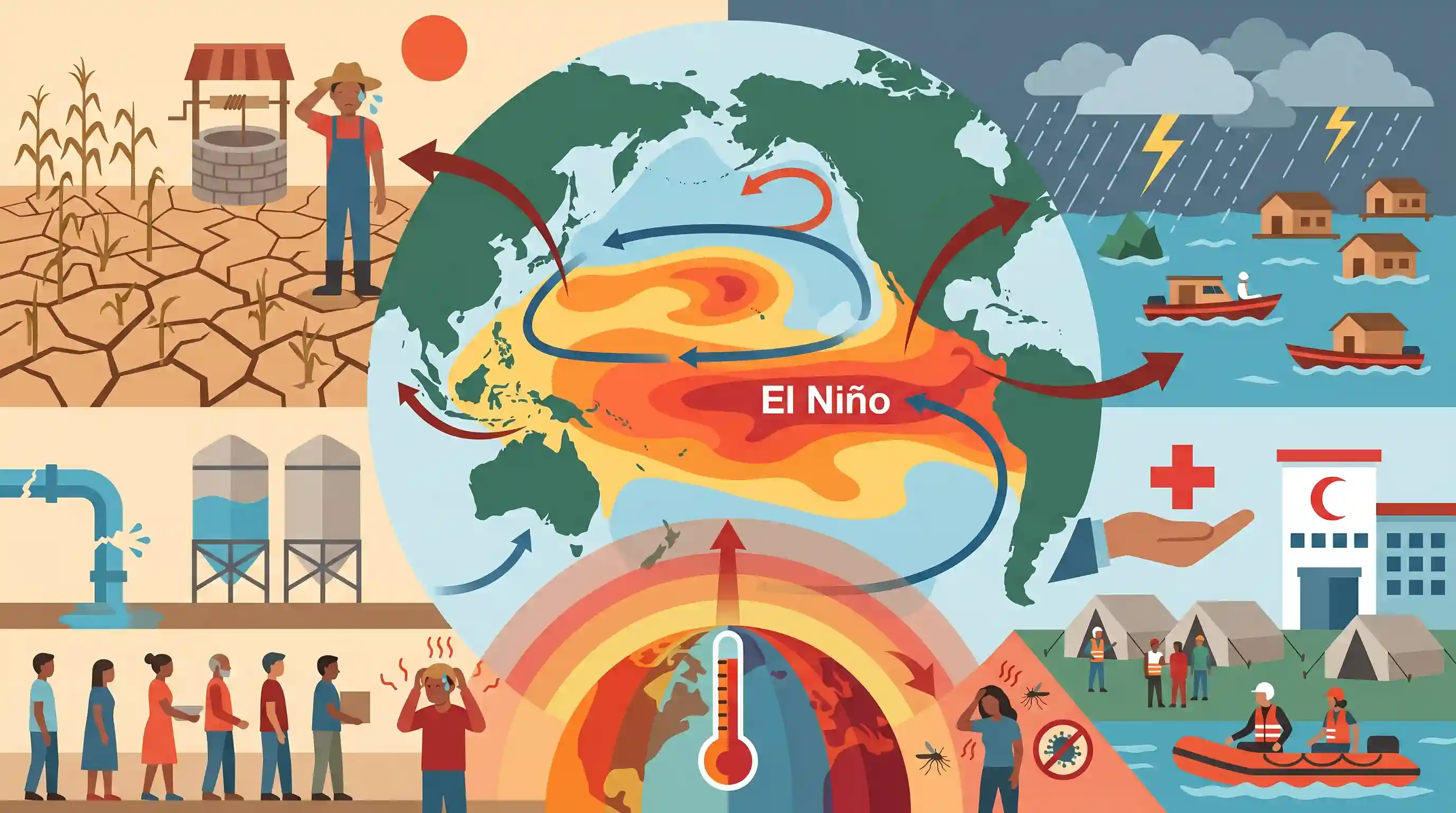
The World Meteorological Organization (WMO) has issued a severe warning regarding the development of a moderate to strong El Nino event in 2026. Driven by rising sea surface temperatures in the central and eastern Pacific, the phenomenon is expected to significantly increase global temperatures and trigger extreme weather globally. El Nino's onset typically causes severe droughts in regions like Southern Asia, Australia, and Indonesia, while causing heavy rainfall and potential flooding in areas like the Horn of Africa and the Americas. The UN warns that the compounded effects of El Nino and ongoing climate change will intensify deadly heatwaves, increase the spread of vector-borne diseases, and strain global food and water systems—potentially devastating agriculture in regions already facing input shortages.
Key Points
- The WMO forecasts a moderate to strong El Nino event in 2026, driven by unusually warm subsurface temperatures in the central and eastern Pacific Ocean.
- The phenomenon is expected to exacerbate extreme weather globally, causing droughts in Southern Asia, Australia, and Indonesia, while increasing rainfall in parts of the Americas and the Horn of Africa.
- Extreme heat associated with El Nino heightens the risk of heat-related illnesses, vector-borne diseases, and severe strain on global food and water systems.
- Anticipated hotter, drier conditions across Asia threaten to severely damage crops, compounding existing food supply challenges worsened by high fertilizer and fuel costs.
- While climate change does not necessarily increase the frequency of El Nino, it acts as a threat multiplier, making associated impacts like heatwaves and heavy rainfall significantly more severe.
Important Terms
El Niño

A climate phenomenon involving the periodic warming of sea surface temperatures in the central and eastern equatorial Pacific Ocean, disrupting global atmospheric circulation.
UPSC context
GS Paper I (Geography): Essential for understanding Indian Monsoon variability, droughts, and oceanic-atmospheric interactions.
World Meteorological Organization (WMO)
A specialized agency of the United Nations responsible for international cooperation on atmospheric science, climatology, hydrology, and the coordination of global weather alerts.
UPSC context
GS Paper II (International Institutions): Focuses on the role of global bodies in climate governance and disaster early warning.
Heatwaves
A period of abnormally high temperatures, defined by the IMD when temperatures exceed 40°C in plains or 30°C in hilly regions for consecutive days.
UPSC context
GS Paper III (Disaster Management): Tests knowledge of IMD/NDMA criteria and city-level Heat Action Plans (HAPs).
Food Security
The state where all people have physical and economic access to sufficient, safe, and nutritious food, defined by availability, accessibility, utilization, and stability.
UPSC context
GS Paper III (Agriculture/Economy): Evaluates impacts of climate shocks on crop yields and national buffer stock management.
Vector-borne diseases
Human illnesses caused by parasites, viruses, and bacteria transmitted by organisms like mosquitoes, ticks, and fleas (e.g., Malaria, Dengue).
UPSC context
GS Paper III (Public Health/Environment): Relates to the National Vector Borne Disease Control Programme and climate-induced health risks.
Disaster Management
The systematic process of using administrative decisions and operational skills to implement policies and strategies to lessen the impacts of hazards.
UPSC context
GS Paper III (Internal Security/DM): Focuses on the Disaster Management Act, 2005 and institutional preparedness for extreme weather.
Prelims Trap
"Climate change is increasing the frequency of El Nino events globally."
Climate change acts as a threat multiplier intensifying El Nino's impacts (heatwaves, floods), but it does not necessarily increase the frequency of the events themselves.
Static Concepts Connected
What is the primary mechanism of the El Niño phenomenon?
- Trade winds: Weakened easterly trade winds fail to push warm equatorial surface waters toward the western Pacific.
- Upwelling suppression: The accumulation of warm water suppresses the normal upwelling of cold, nutrient-rich water off South America.
- Walker Circulation: It shifts atmospheric circulation, causing high pressure (droughts) in Asia/Australia and low pressure (rain) in the Americas.
How does the Indian Ocean Dipole (IOD) interact with El Niño?
- Positive IOD: A warmer western Indian Ocean brings rain to India, which can neutralize El Niño's drought effect.
- Negative IOD: A cooler western Indian Ocean exacerbates the monsoon deficit and dry conditions typically caused by El Niño.
Cross-Topic Patterns
ENSO & Agrarian Inflation
El Nino-induced monsoon deficits disrupt Kharif yields, linking geography directly to volatile food inflation and prompting sudden government export bans or RBI rate adjustments.
Climate anomalies & Vector-borne diseases
Warmer temperatures and erratic rainfall expand mosquito breeding grounds, integrating climatology with GS-II public health and disease management themes.

A 2026 Prelims question will likely test El Niño's spatial rainfall anomalies (Horn of Africa vs. Australia) alongside the IOD's impact.
Linked PYQs · 3
Linked PYQs · 3
- 2017PrelimsGS1
With reference to 'Indian Ocean Dipole (IOD)' sometimes mentioned in the news while forecasting Indian monsoon, which of the following statements is/are correct? 1. IOD phenomenon is characterised by a difference in sea surface temperature between tropical Western Indian Ocean and tropical Eastern Pacific Ocean. 2. An IOD phenomenon can influence an El Nino's impact on the monsoon. Select the correct answer using the code given below:
- 2014MainsGS1
Most of the unusual climatic happenings are explained as an outcome of the El-Nino effect. Do you agree?
- 2024MainsGS3
Flooding in urban areas is an emerging climate-induced disaster. Discuss the causes of this disaster. Mention the features of two such major floods in the last two decades in India. Describe the policies and frameworks in India that aim at tackling such floods.
