Opposition raises concerns over US trade pact agricultural impact
Source:The Hindu ↗
Why It Matters
The article highlights the intersection of international trade agreements and domestic agricultural policy. It is crucial for UPSC aspirants to understand how FTAs and non-trade barrier negotiations can impact sensitive areas like GM crop regulations, domestic procurement, MSP, and the livelihoods of farmers.
Summary
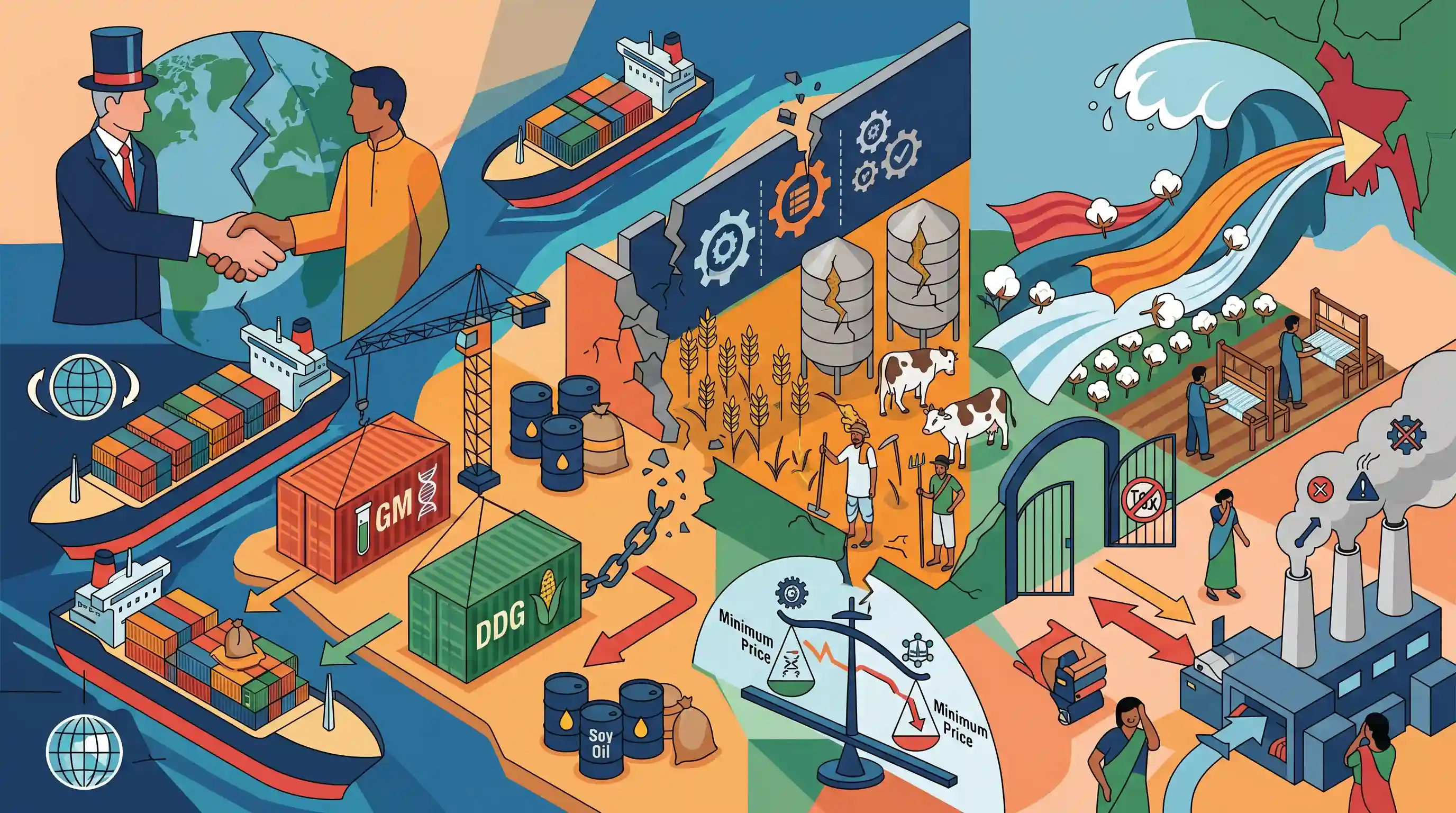
Congress leader Rahul Gandhi criticized the ongoing India-U.S. trade negotiations, citing severe potential repercussions for the Indian agricultural and textile sectors. Key issues highlighted include the potential import of Dried Distillers' Grains (DDG) from GM American corn and GM soy oil, threatening local dairy and soy farmers. Furthermore, the push to eliminate non-trade barriers risks undermining India's regulatory frameworks against GM crops, its Minimum Support Price (MSP) mechanisms, and domestic procurement systems. Additionally, the pact's provision granting zero-tariff access to Bangladesh could adversely impact domestic cotton farmers and textile exporters.
Key Points
- Congress leader Rahul Gandhi criticized the India-U.S. trade deal, asserting it compromises the interests of Indian farmers by opening domestic markets to American agricultural products.
- Key concerns involve the import of Dried Distillers' Grains (DDG) from GM American corn and GM soy oil, which could adversely affect the domestic dairy sector and soy farmers in central and western India.
- The deal allegedly seeks the removal of 'non-trade barriers', threatening India's cautious stance on Genetically Modified (GM) crops, its procurement systems, and Minimum Support Prices (MSP).
- An interim agreement allowing zero-tariff access to Bangladesh raises fears of negative impacts on domestic cotton farmers and the textile export industry.
Important Terms
India-U.S. Interim Trade Agreement

A 2026 preliminary trade framework reducing tariffs on specific goods (agriculture, energy) as a step toward a comprehensive Bilateral Trade Agreement (BTA).
UPSC context
GS II (IR) and GS III (Economy); tests bilateral trade diplomacy and impacts on domestic economic sectors.
Dried Distillers’ Grains (DDGs)
A high-protein animal feed byproduct of corn ethanol production; imports are controversial due to potential contamination with genetically modified (GM) corn.
UPSC context
GS III (Agriculture); relevant for livestock management, biofuel policy, and biosafety regulations.
Non-Tariff Barriers (NTBs)
Regulatory measures—such as technical standards, sanitary requirements, or licensing—that restrict trade without using direct customs duties (tariffs).
UPSC context
GS III (Economy); tests the ability to distinguish between protectionist measures and legitimate safety regulations in trade.
Genetically Modified (GM) Crops
Plants whose genetic material has been altered to enhance traits like pest resistance. In India, commercial cultivation is largely restricted to Bt cotton.
UPSC context
GS III (S&T/Agriculture); focuses on biosafety, GEAC regulations, and impact on seed sovereignty.
Minimum Support Price (MSP)
A guaranteed floor price at which the government purchases crops from farmers to provide price stability and ensure food security.
UPSC context
GS III (Agriculture); core topic for farm distress, subsidies, and WTO trade compliance.
Rules of Origin
The criteria used to determine the national source of a product to establish eligibility for preferential treatment under trade agreements.
UPSC context
GS III (Economy); tests knowledge of trade circumvention and how FTAs define eligible exports.
Prelims Trap
India enforces a blanket ban on the import of all Genetically Modified (GM) crops and their derivatives.
While commercial cultivation is restricted to Bt Cotton, India legally imports certain GM derivatives (like GM soy oil and crushed soy) subject to strict GEAC and FSSAI approvals.
Static Concepts Connected
What is the statutory framework governing GM crop imports in India?
- Apex Body: The Genetic Engineering Appraisal Committee (GEAC) under the Ministry of Environment, Forest and Climate Change.
- Statutory Backing: It derives its powers from the Rules for the Manufacture, Use, Import, Export and Storage of Hazardous Microorganisms/Genetically Engineered Organisms or Cells, under the Environment (Protection) Act, 1986.
- Mandate: GEAC evaluates and approves the commercial release, import, and large-scale use of GM crops and their processed derivatives.
How does the WTO Agreement on Agriculture (AoA) address Non-Tariff Barriers (NTBs)?
- Tariffication: It mandates that member nations convert all NTBs (like import quotas and minimum import prices) into equivalent tariff levels to ensure transparent market access.
- Tariff Reduction: The resulting tariffs from this conversion process must be bound and gradually reduced over a specified implementation period.
- Safeguard Mechanism: It allows temporary tariff hikes (Special Safeguard Provisions) to protect domestic farmers against sudden import surges or price depressions of tariffied agricultural products.
Cross-Topic Patterns
Geoeconomics of Textile Supply Chains
The US-Bangladesh cotton deal displaces Indian yarn exports, demonstrating how advanced economies use FTAs geostrategically to reshape regional manufacturing and redirect supply chains away from traditional suppliers.
Free Trade vs. Domestic Food Security
Western pressure to dismantle non-tariff barriers directly conflicts with India's MSP and PDS frameworks, a recurring friction point mirrored in WTO's 'Peace Clause' and public stockholding debates.

Expect a 2026 multi-statement Prelims question pairing GEAC's import mandate for GM derivatives with WTO's AoA (tariffication).
Linked PYQs · 4
Linked PYQs · 4
- 2018PrelimsGS1
With reference to the Genetically Modified mustard (GM mustard) developed in India, consider the following statements: 1. GM mustard has the genes of a soil bacterium that give the plant the property of pest-resistance to a wide variety of pests. 2. GM mustard has the genes that allow the plant cross-pollination and hybridization. 3. GM mustard has been developed jointly by the IARI and Punjab Agricultural University. Which of the statements given above is/are correct?
- 2015PrelimsGS1
The Genetic Engineering Appraisal Committee is constituted under the
- 2018MainsGS3
What do you mean by Minimum Support Price (MSP)? How will MSP rescue the farmers from the low income trap?
- 2023MainsGS3
What are the direct and indirect subsidies provided to farm sector in India? Discuss the issues raised by the World Trade Organization (WTO) in relation to agricultural subsidies.
