NEET-UG Protest Case Withdrawals: Administrative Relief for Students
Source:the-statesman ↗
Why It Matters
Highlights state-level governance responses to student agitations and the administrative mechanism of withdrawing public protest-related criminal cases to safeguard students' futures.
Summary
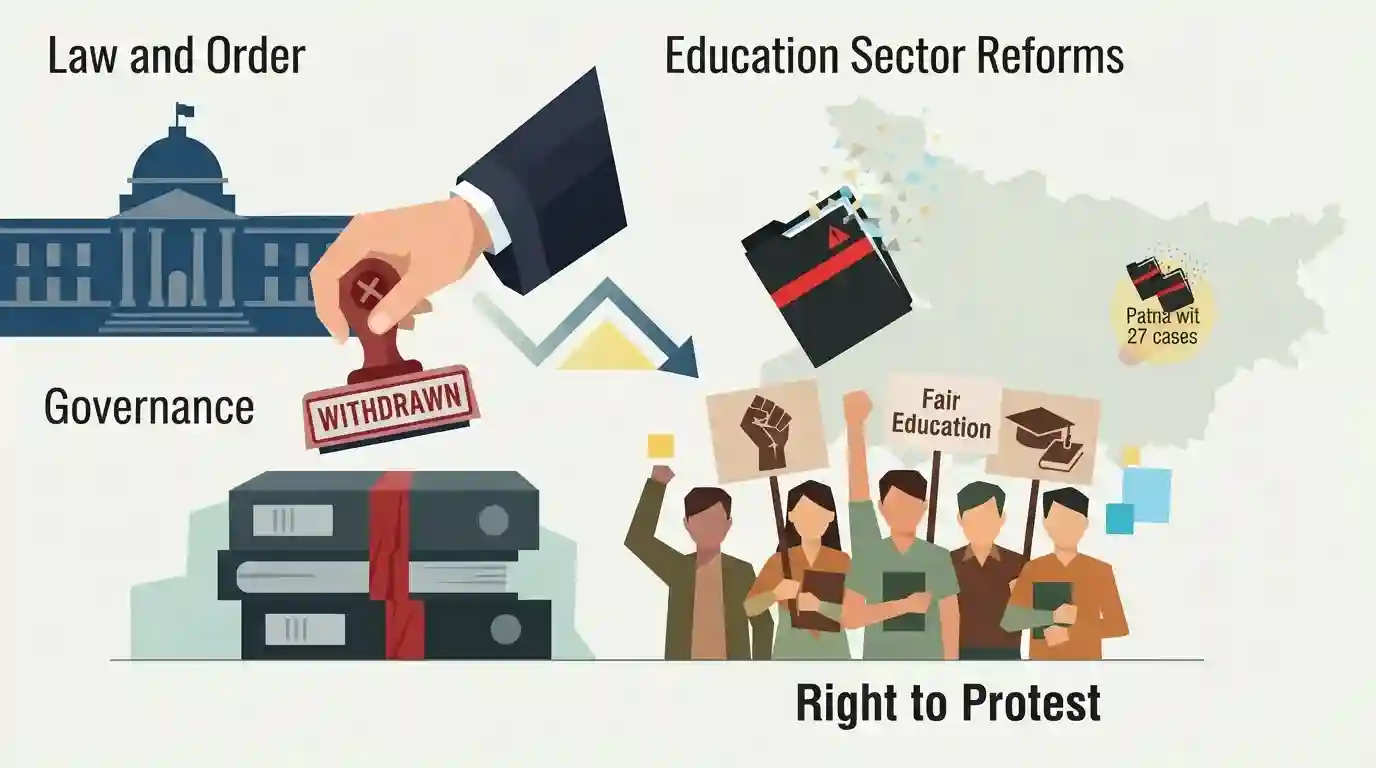
The Bihar administration has initiated the withdrawal of 64 criminal cases registered during the widespread protests against alleged irregularities in the NEET-UG examination. According to reports, 27 of these cases are being withdrawn in Patna alone. This administrative decision aims to provide relief to the students and youths who agitated against the examination discrepancies, preventing potential harm to their future educational and career prospects due to pending police records.
Key Points
- The Bihar government has initiated the process to withdraw 64 cases filed against individuals involved in the NEET-UG protests.
- Out of the total cases, 27 are specifically being withdrawn in the capital city of Patna.
- The cases were registered in connection with widespread agitations by students over alleged irregularities and paper leaks in the medical entrance examination.
- The move is seen as an administrative relief measure to ensure the careers of protesting students are not jeopardized by criminal records.
Important Terms
NEET-UG

The National Eligibility cum Entrance Test (Undergraduate) is a centralized, all-India entrance examination for admissions into medical and dental programs. It is managed by the NTA and has recently faced severe scrutiny over systemic irregularities and paper leaks.
UPSC context
GS-2 (Education/Governance). Highlights the critical need for fair, transparent, and robust national-level assessment frameworks to secure youth prospects.
National Testing Agency (NTA)
An autonomous testing organization under the Ministry of Education, established in 2017. It is tasked with conducting transparent, international-standard national-level entrance exams, such as NEET and JEE, to ensure uniform assessment practices across India.
UPSC context
GS-2 (Statutory and Regulatory Bodies). Highly relevant for questions on institutional accountability, public trust, and urgent administrative reforms.
Withdrawal of Prosecution
The legal mechanism under Section 360 of the BNSS (formerly Section 321 CrPC) allowing a Public Prosecutor to withdraw criminal charges against an accused with the trial court's consent, often to serve broader public interest or policy goals.
UPSC context
GS-2 (Judiciary/Executive Powers). Evaluates the doctrine of separation of powers, judicial oversight, and preventing executive misuse in criminal justice.
Right to Protest
A core democratic entitlement implicitly protected under Article 19(1)(a) (freedom of speech) and 19(1)(b) (peaceful assembly) of the Constitution, allowing citizens to publicly voice grievances against state actions or systemic failures.
UPSC context
GS-2 (Indian Constitution - Fundamental Rights). Tests the dynamic balance between civil liberties, reasonable restrictions, and maintaining public order.
Prelims Trap
The State Government has absolute, unilateral executive power to withdraw criminal cases registered against protesters.
Withdrawal of prosecution is not an executive fiat. Under the law (BNSS/CrPC), the Public Prosecutor applies for it, but it strictly requires the consent of the Court.
Static Concepts Connected
What is the legal procedure for the State to withdraw criminal cases?
- Legal Provision: Governed by Section 360 of the Bharatiya Nagarik Suraksha Sanhita (BNSS), which replaced Section 321 of the CrPC.
- Role of PP: The Public Prosecutor or Assistant Public Prosecutor in charge of a case must formally apply for the withdrawal.
- Judicial Consent: Withdrawal cannot be done unilaterally by the government; it strictly requires the consent of the presiding Court.
How is the 'Right to Protest' protected and restricted under the Constitution?
- Constitutional Basis: It derives implicitly from Article 19(1)(a) (freedom of speech) and Article 19(1)(b) (peaceful assembly without arms).
- Reasonable Restrictions: It is subject to reasonable restrictions under Article 19(2) and 19(3), primarily on grounds of public order, sovereignty, and integrity of India.
- Judicial Limits: The Supreme Court has clarified that the right to protest does not include the right to destroy public property or to hold cities ransom.
Cross-Topic Patterns
Exam leaks & Public Examinations Act
NEET-UG protests tie into the Public Examinations (Prevention of Unfair Means) Act, 2024, highlighting the shift toward fixing systemic administrative failures rather than punishing individual student agitators.
Demographic Dividend vs Youth Unrest
Persistent recruitment and exam failures create governance deficits, risking the conversion of India's demographic dividend into widespread youth unrest and public order challenges.

Expect a Prelims question on the Public Prosecutor's role and judicial consent required for withdrawing criminal cases under BNSS/CrPC.
Linked PYQs · 2
Linked PYQs · 2
- 2023BPSC_PRELIMSGS1
The elected Government of Bihar formed by Shri Krishna Singh resigned in February 1938 for which reason?
- 2018BPSC_PRELIMSGS1
The elected Government of Bihar resigned in February 1938 for which reason?
