Kerala Renewable Energy Storage Regulations and Prosumer Impact
Source:The Hindu ↗
Why It Matters
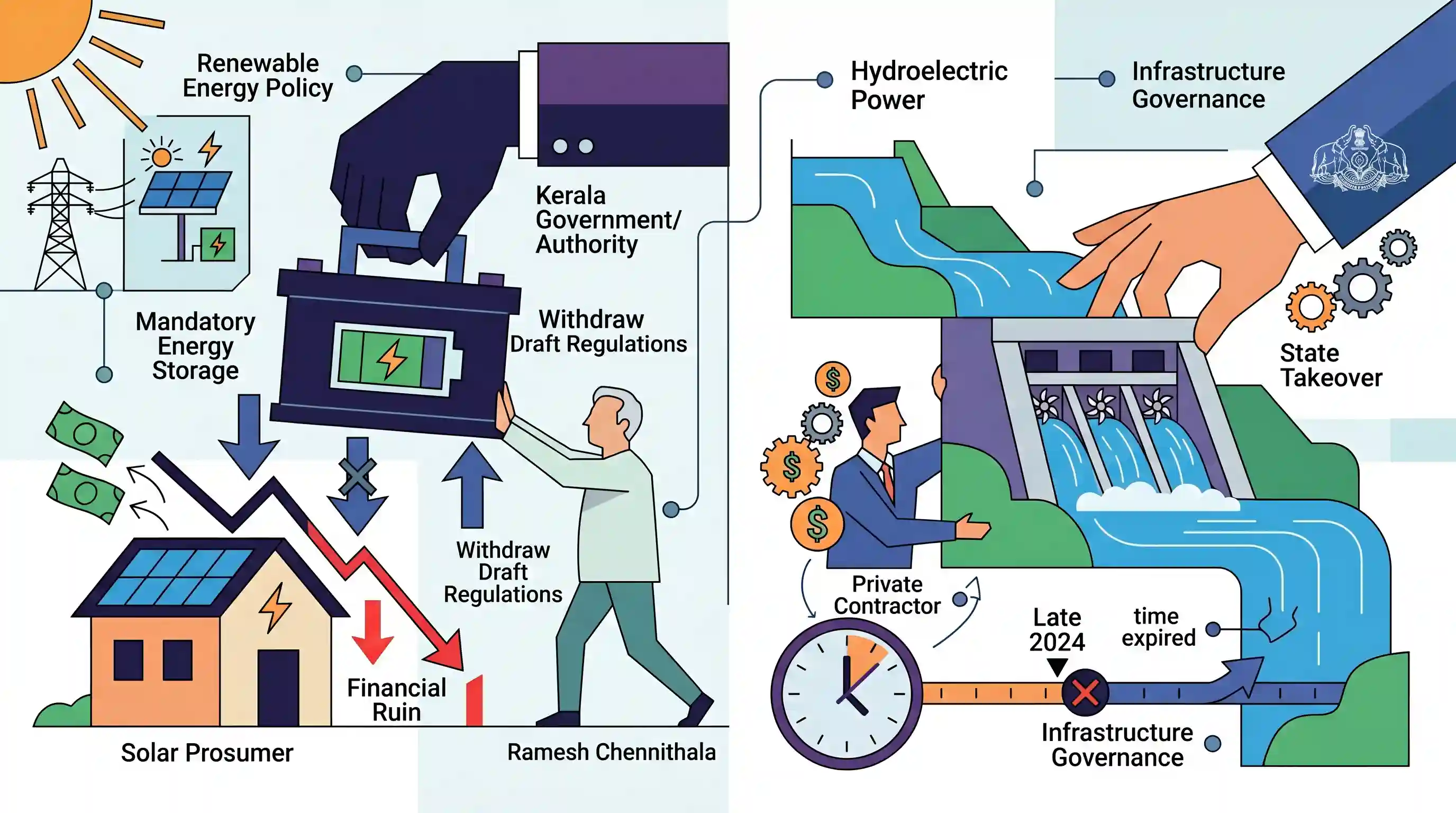
Highlights the regulatory and economic challenges of integrating decentralized renewable energy into the grid, particularly the cost implications of mandating energy storage for prosumers. Also demonstrates the administrative challenges in managing public-private energy infrastructure contracts.
Summary
Senior Congress leader Ramesh Chennithala has urged the Kerala government to withdraw draft regulations that make battery storage mandatory for renewable energy plants above a certain capacity, arguing it would financially ruin solar prosumers. Additionally, he demanded that the state take over the 12 MW Maniyar small hydro project, as the private contractor's operational term expired in late 2024 but the facility has yet to be transferred back to the State.
Key Points
- Draft regulations by the Kerala State Electricity Regulatory Commission propose mandatory battery storage for renewable energy plants above a certain capacity.
- Critics argue that mandatory energy storage will impose significant financial burdens on solar prosumers, potentially triggering an energy crisis by discouraging adoption.
- The Kerala government is facing demands to reclaim the 12 MW Maniyar small hydro project from a private company after its contract expired in December 2024.
Important Terms
Kerala State Electricity Regulatory Commission (KSERC)

A statutory body established under the Electricity Act, 2003, responsible for regulating electricity tariffs, licensing, and promoting renewable energy within the state.
UPSC context
GS Paper 2: Statutory and regulatory bodies; GS Paper 3: Infrastructure and Energy policy at the sub-national level.
Kerala State Electricity Board (KSEB)
The state-owned utility responsible for the generation, transmission, and distribution of electricity in Kerala, acting as the primary implementer of state power policies.
UPSC context
GS Paper 3: Infrastructure and Power sector governance; tests understanding of public sector undertakings (PSUs) in utilities.
Solar Prosumer
An individual or entity that both produces and consumes energy (typically solar), often exporting surplus power to the grid through various metering mechanisms.
UPSC context
GS Paper 3: Renewable energy and Environmental conservation; focuses on decentralized energy generation and the "prosumer" economy.
Battery Energy Storage System (BESS)
Technology that stores energy (e.g., in lithium-ion batteries) to balance supply and demand, essential for managing the intermittent nature of renewable sources like solar power.
UPSC context
GS Paper 3: Science & Technology and Energy; critical for grid stability and India’s 2030 renewable energy targets.
Build-Own-Operate-Transfer (BOOT) Model
An infrastructure project delivery model where a private entity receives a concession to finance, design, construct, and operate a facility before transferring it to the government.
UPSC context
GS Paper 3: Investment models and Infrastructure; tests understanding of Public-Private Partnerships (PPP) and asset ownership cycles.
Net Metering
A billing mechanism that credits solar energy system owners for the electricity they add to the grid, allowing them to offset their consumption costs.
UPSC context
GS Paper 3: Energy policy; specifically the financial and technical frameworks supporting residential renewable energy adoption.
Carborundum Universal Ltd (CUMI)
A Murugappa Group private company that operated the Maniyar Small Hydroelectric Project under a 30-year BOOT agreement, now central to a state-private asset transfer dispute.
UPSC context
GS Paper 3: Infrastructure; case study in contractual obligations and state takeover of private infrastructure projects.
Duck Curve
A graph representing the timing imbalance between peak demand and renewable energy production, where high midday solar generation leads to a sharp demand drop for conventional power.
UPSC context
GS Paper 3: Energy Security; technical challenge in grid management as renewable penetration increases.
Prelims Trap
Regulations and storage mandates for rooftop solar prosumers are solely determined by the Central Electricity Authority or CERC.
State Electricity Regulatory Commissions (SERCs) govern distribution-level grid integration and net-metering rules, meaning state-specific battery mandates can exist independently of Central schemes.
Static Concepts Connected
Why is Energy Storage critical for Renewable Energy integration?
- Intermittency management: Solar and wind generation fluctuate; storage smooths power output and prevents grid frequency collapse.
- Peak load shifting: Stores excess daytime solar power to meet peak evening demand, mitigating the 'Duck Curve' problem.
- Ancillary services: Provides rapid response voltage support and frequency regulation for distribution networks.
How are Small Hydro Projects (SHP) classified and governed in India?
- Capacity threshold: Hydropower projects up to 25 MW capacity are officially classified as Small Hydro Projects.
- Administrative control: Unlike large hydro (Ministry of Power), SHPs fall under the Ministry of New and Renewable Energy (MNRE).
- Environmental clearance: SHPs generally enjoy exemptions or relaxed norms for Environmental Impact Assessments compared to large dams.
Cross-Topic Patterns
Rooftop Solar vs. Battery Storage Economics
Mandating BESS for prosumers conflicts with the decentralized push of PM Surya Ghar Muft Bijli Yojana, highlighting the emerging need for Battery Energy Storage System (BESS) Viability Gap Funding (VGF).
Small Hydro & Pumped Storage alternatives
As electrochemical BESS remains costly for prosumers, states are exploring mechanical alternatives like Pumped Storage Projects (PSPs) and upgrading legacy small hydro assets to stabilize grids.

Questions on India's 'Duck Curve', BESS viability, and State vs. Centre jurisdiction in RE regulation are highly likely in GS3 2026.
Linked PYQs · 4
Linked PYQs · 4
- 2024PrelimsGS1
Consider the following: 1. Battery storage 2. Biomass generators 3. Fuel cells 4. Rooftop solar photovoltaic units How many of the above are considered "Distributed Energy Resources"?
- 2024PrelimsGS1
Recently, the term "pumped-storage hydropower" is actually and appropriately discussed in the context of which one of the following?
- 2025PrelimsGS1
Consider the following statements about 'PM Surya Ghar Muft Bijli Yojana': I. It targets installation of one crore solar rooftop panels in the residential sector. II. The Ministry of New and Renewable Energy aims to impart training on installation, operation, maintenance and repairs of solar rooftop systems at grassroot levels. III. It aims to create more than three lakhs skilled manpower through fresh skilling, and up-skilling, under scheme component of capacity building. Which of the statements given above are correct?
- 2020MainsGS3
Describe the benefits of deriving electric energy from sunlight in contrast to the conventional energy generation. What are the initiatives offered by our Government for this purpose?
