US Airstrikes on Iranian Nuclear Facilities and War Powers
Source:The Hindu ↗
Why It Matters
The US-Iran conflict directly impacts global energy security and supply chains, which is a core concern for India's foreign policy and economic stability. Understanding the collapse of the JCPOA and military dynamics (bunker busters vs. deep nuclear facilities) is critical for GS2 (IR) and GS3 (Security/Science), while the US debate on war powers provides comparative polity insights.
Summary
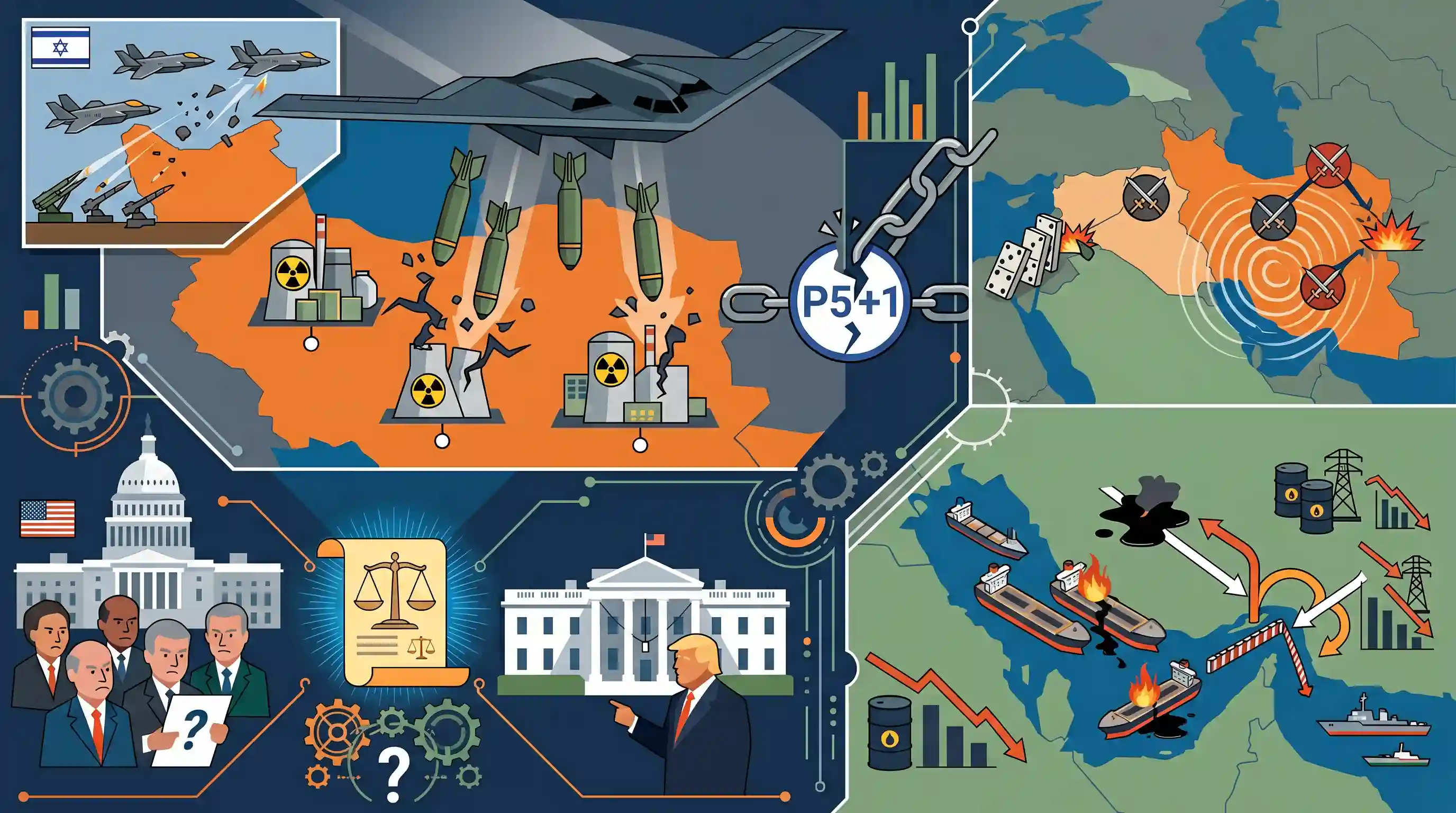
The article details significant US airstrikes ordered by President Donald Trump against Iran's key nuclear facilities (Fordo, Natanz, and Isfahan) in 2025. Utilizing B-2 stealth bombers and GBU-57 bunker-buster bombs, the strikes capitalized on previous Israeli attacks that degraded Iran's air defenses, intending to decisively halt Iran's uranium enrichment capabilities. The military intervention effectively ends any remnants of the 2015 JCPOA framework. However, the unilateral action has triggered constitutional debates in the US regarding the President's authority to wage war without congressional approval. The escalation also poses severe risks to regional stability in the Middle East and threatens global energy security, particularly concerning potential disruptions in the Strait of Hormuz.
Key Points
- The US launched direct airstrikes using B-2 stealth bombers and GBU-57 bunker-buster bombs against Iran's nuclear enrichment facilities at Fordo, Natanz, and Isfahan.
- The strikes capitalized on Iran's weakened air defenses, which had been previously targeted by Israel, effectively crippling Iran's capacity to produce Highly Enriched Uranium (HEU).
- The unilateral military action by President Trump sparked domestic controversy over the US Constitution's War Powers Resolution, as it was conducted without congressional authorization.
- The geopolitical escalation risks severe retaliatory actions by Iran, potentially threatening vital global energy transit routes like the Strait of Hormuz.
- The event marks the ultimate collapse of diplomatic efforts stemming from the 2015 JCPOA nuclear deal, which the US withdrew from in 2018.
Important Terms
Joint Comprehensive Plan of Action (JCPOA)

A 2015 multilateral agreement where Iran agreed to curb its nuclear program and allow international inspections in exchange for the lifting of economic sanctions by world powers (P5+1).
UPSC context
GS Paper II: International Relations; groupings/agreements affecting India's interests and West Asia geopolitics.
International Atomic Energy Agency (IAEA)
The UN's nuclear watchdog that verifies member states' compliance with non-proliferation treaties, ensuring nuclear materials are used solely for peaceful purposes through rigorous monitoring and inspections.
UPSC context
GS Paper II: Important International institutions; global governance of nuclear energy and security.
War Powers Resolution (1973)
A 1973 US law intended to check the President's power to commit the US to armed conflict without congressional consent, requiring notification within 48 hours of hostilities.
UPSC context
GS Paper II: Comparative Polity; executive-legislative checks and balances in major democratic systems.
Strait of Hormuz
A critical maritime chokepoint between the Persian Gulf and Gulf of Oman, carrying approximately 20% of global oil consumption and vital for India's energy security.
UPSC context
GS Paper I/III: Geography and Energy Security; strategic maritime corridors and global trade disruptions.
Uranium Enrichment
The process of increasing the concentration of the fissile isotope Uranium-235. Low enrichment (3-5%) serves power plants, while high enrichment (90%) is required for nuclear weapons.
UPSC context
GS Paper III: Science and Technology; nuclear technology applications and non-proliferation challenges.
Prelims Trap
"Uranium enriched to 20% U-235 is classified as weapons-grade material ready for nuclear warheads."
20% enrichment is merely the threshold for Highly Enriched Uranium (HEU). True weapons-grade uranium requires approximately 90% enrichment of the U-235 isotope.
Static Concepts Connected
What is the geographical and strategic significance of the Strait of Hormuz?
- Location: It is a critical maritime chokepoint connecting the Persian Gulf to the Gulf of Oman and the wider Arabian Sea.
- Bordering nations: It is geographically bounded by Iran to the north and Oman (the Musandam Peninsula) to the south.
- Economic chokepoint: It facilitates the transit of roughly 20% of the world's traded petroleum, making it a linchpin for global energy security.
How is uranium classified based on its U-235 isotopic enrichment levels?
- Natural Uranium: Mined uranium contains only about 0.7% of the fissile U-235 isotope, requiring processing for most reactors.
- LEU: Low Enriched Uranium (3-5% U-235) is the standard fuel used in civilian commercial nuclear power plants.
- HEU: Highly Enriched Uranium (>20% U-235) is utilized in specialized research reactors and naval nuclear propulsion systems.
- Weapons-grade: Uranium must be enriched to approximately 90% U-235 to be viable for constructing a nuclear weapon.
Cross-Topic Patterns
Energy Security + Macroeconomic stability
Escalation in the Strait of Hormuz threatens India's oil imports, directly impacting the Current Account Deficit (CAD) and imported inflation, linking Middle East geopolitics to domestic macroeconomic stability.
Comparative Polity: US vs Indian War Powers
The US President's unilateral strike capability (triggering War Powers debates) contrasts sharply with India's parliamentary system, where executive declarations of war remain subject to strict legislative accountability.

Expect a 2026 Prelims question linking Iranian nuclear sites (Natanz, Fordo) with Middle East maritime chokepoints (Strait of Hormuz).
Linked PYQs · 5
Linked PYQs · 5
- 2018PrelimsGS1
In the Indian context, what is the implication of ratifying the 'Additional Protocol' with the 'International Atomic Energy Agency (IAEA)'?
- 2020PrelimsGS1
In India, why are some nuclear reactors kept under "IAEA Safeguards" while others are not?
- 2025MainsGS2
"Energy security constitutes the dominant kingpin of India's foreign policy, and is linked with India's overarching influence in Middle Eastern countries.” How would you integrate energy security with India's foreign policy trajectories in the coming years?
- 2022MainsGS2
How will I2U2 (India, Israel, UAE and USA) grouping transform India's position in global politics?
- 2025MainsGS2
Compare and contrast the President's power to pardon in India and in the USA. Are there any limits to it in both the countries? What are 'preemptive pardons'?
