Punjab Farmer Success Shows Potential of Integrated Farming
Source:Indian Express ↗
Why It Matters
This article serves as an outstanding real-world case study for Mains GS3 questions on 'Integrated Farming Systems' and 'Economics of Animal Rearing'. It illustrates how a closed-loop system (fodder to livestock, manure to fields) combined with value-added breeding of indigenous animals (Beetal goats, Neeli Ravi & Murrah buffaloes) can resolve rural distress, eliminate debt-dependence, and offer viable high-income local opportunities to reverse youth out-migration.
Summary
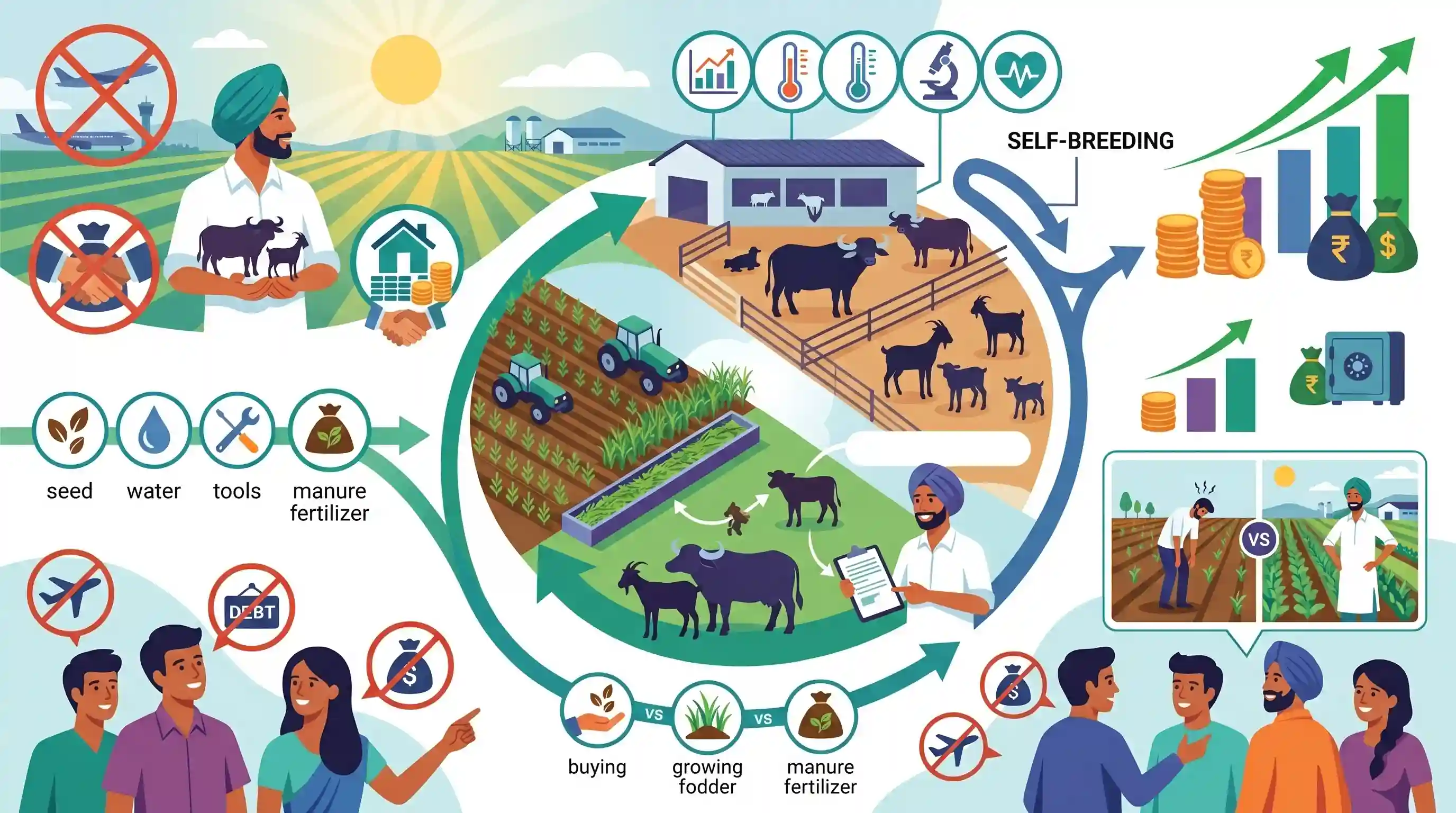
The article highlights the success story of Gurdeep Singh, a young Punjab farmer who rejected foreign migration to establish a thriving, debt-free integrated farming and livestock breeding enterprise in Bathinda. Starting in 2014 with two family buffaloes and one Beetal goat, he scientifically expanded his livestock to over 20 Neeli Ravi and Murrah buffaloes and 50 Beetal goats alongside crop cultivation. By growing his own fodder and self-breeding animals, he minimized production costs, demonstrating how integrated farming systems (IFS) and livestock rearing can serve as highly profitable, resilient, and liquid alternatives to traditional crop-only farming, ultimately serving as a model to stem youth migration and rural debt.
Key Points
- Case Study of Sustainable Agro-Entrepreneurship: Gurdeep Singh, a 35-year-old BA graduate from Punjab, transitioned from a private typing job to build a debt-free integrated farming enterprise worth over Rs 1 crore starting with just two family buffaloes and a single Beetal goat.
- Integrated Farming System (IFS) Model: On 11 acres (8 owned, 3 leased), he integrates crop cultivation (short-duration paddy, wheat, summer moong) with dedicated fodder crops (maize for silage and green fodder). Self-producing the feed dramatically lowers input costs and insulates the business from market shocks.
- Livestock Dynamics & Scientific Breeding: He manages 21-22 Neeli Ravi and Murrah buffaloes along with ~50 pure-bred Beetal goats. Instead of purchasing replacements, he breeds his own stock, selling 2-3 buffaloes annually (at ~Rs 1.5 lakh each) and over 50 goat kids, bringing in a reliable secondary revenue stream of Rs 6-7 lakh.
- Economic Viability and Safety Net: The venture generates an annual turnover of Rs 36-37 lakh with a net income of around Rs 25 lakh, completely debt-free. Singh treats livestock as a highly liquid financial safety net that appreciates in value and provides daily income, unlike depreciating farm machinery.
- Alternative to Out-Migration: In a state like Punjab where youth heavily aspire to migrate abroad, this case demonstrates that indigenous, scientific, and low-cost allied agricultural sectors can deliver highly competitive, dollar-equivalent incomes at home.
Prelims Trap
The Beetal goat is a pastoral-only breed unsuitable for intensive stall-feeding systems.
Beetal is highly prized precisely for its adaptability to intensive stall-feeding, making it perfect for small-scale integrated farming without large grazing lands.
Static Concepts Connected
What is an Integrated Farming System (IFS) and what are its core advantages?
- Resource Recycling: Waste from one component (like manure) serves as fertilizer or feed for another, drastically reducing overall input costs.
- Risk Mitigation: Diversifies income streams across crops and livestock, safeguarding smallholders from climate shocks or seasonal market crashes.
- Continuous Cashflow: Generates daily or weekly revenue (such as milk and meat) unlike the seasonal, delayed payments of monoculture cropping.
What are the distinguishing traits and native tracts of major North Indian indigenous breeds?
- Neeli Ravi: Riverine dairy buffalo of Punjab; recognized by 'Panch Kalyani' (five white markings) and distinct walled eyes.
- Beetal Goat: Dual-purpose Punjab breed; has long drooping ears and a Roman nose; highly suited for stall-fed intensive farming.
- Murrah Buffalo: Premier dairy breed native to Haryana; known for its deep black body and tightly curved spiral horns.
Cross-Topic Patterns
IFS as a climate adaptation tool
Integrating livestock with crops reduces chemical fertilizer reliance via manure recycling and lowers greenhouse gas intensity through optimized, home-grown silage feeding.
Indigenous livestock vs. youth out-migration
High-yield allied agricultural sectors provide stable, liquid cash flows, countering rural indebtedness and offering a viable domestic economic alternative to desperate youth out-migration.

Match-the-following questions pairing indigenous livestock breeds (Neeli Ravi, Beetal, Murrah) with their native tracts are highly likely.
Linked PYQs · 4
Linked PYQs · 4
- 2015MainsGS3
Livestock rearing has a big potential for providing non-farm employment and income in rural areas. Discuss suggesting suitable measures to promote this sector in India.
- 2022MainsGS3
What is Integrated Farming System ? How is it helpful to small and marginal farmers in India?
- 2019MainsGS3
How far is Integrated Farming System (IFS) helpful in sustaining agricultural production?
- 2025PrelimsGS1
Consider the following statements about the Rashtriya Gokul Mission : I. It is important for the upliftment of rural poor as majority of low producing indigenous animals are with small and marginal farmers and landless labourers. II. It was initiated to promote indigenous cattle and buffalo rearing and conservation in a scientific and holistic manner. Which of the statements given above is/are correct?
