China seeks to reshape Asian order following US China truce
Source:The Hindu ↗
ఇది ఎందుకు ముఖ్యం
Crucial for understanding shifting geopolitical alignments, US-China-India dynamics, and the evolution of the Asian security and economic order.
సారాంశం
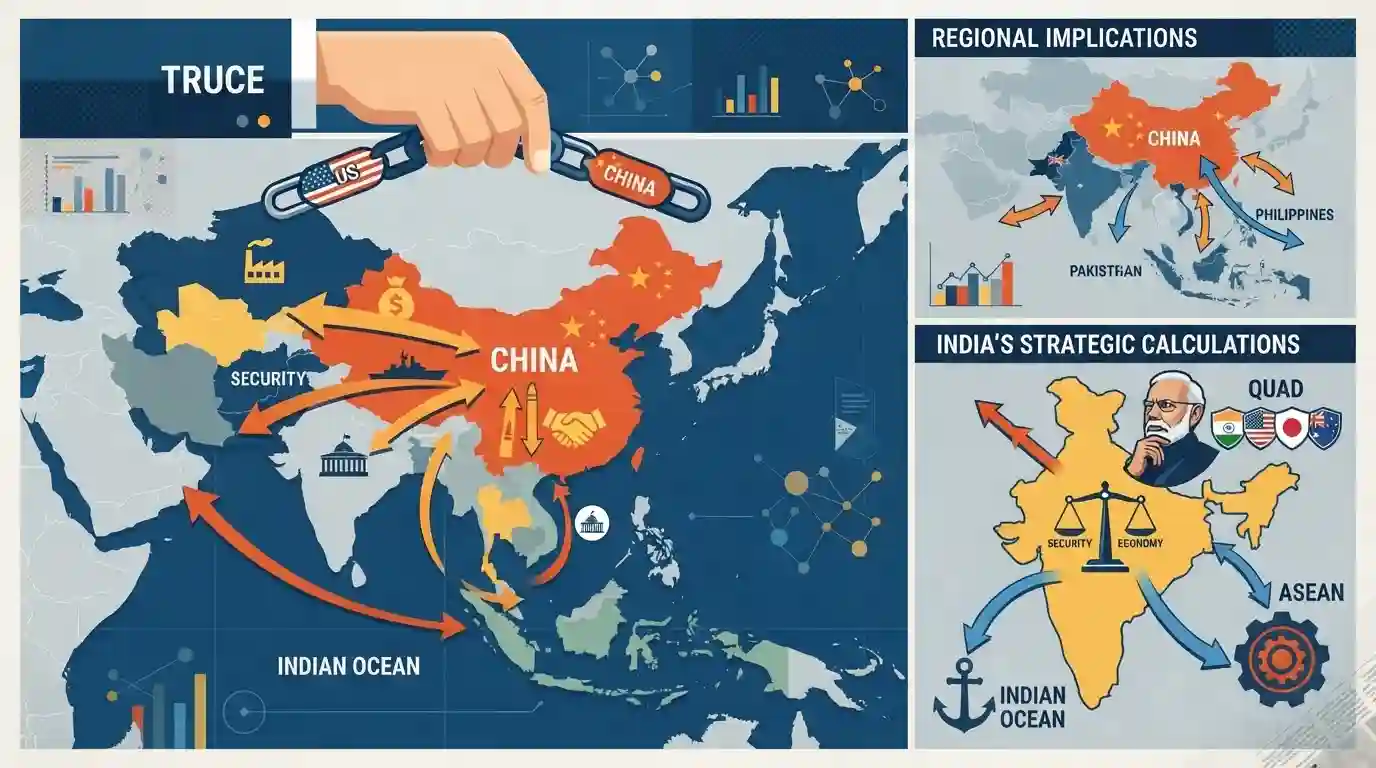
The article analyzes how a stabilization or truce in US-China relations under Trump and Xi allows Beijing to strategically maneuver and reshape the political, economic, and security order in Asia, with significant implications for regional stability and India's strategic calculations.
ముఖ్య అంశాలు
- A truce or stabilization in US-China relations under Trump and Xi provides Beijing room to maneuver and reshape the strategic and economic architecture of Asia.
- China seeks to leverage shifting great power dynamics to consolidate its regional dominance and reduce American influence in Asian multilateral and security frameworks.
- Implications for India include managing a recalibrated regional order, balancing complex great-power competition, and navigating shifts in supply chains and security alignments.
ముఖ్యమైన పదాలు
US

The primary superpower whose diplomatic, economic, and security engagements in the Indo-Pacific shape regional deterrence, trade, and alliances against rising Chinese influence.
UPSC context
GS Paper II - International Relations; important for evaluating major power dynamics, bilateral relations, and India's strategic alignment.
China
A global economic and military power seeking to leverage bilateral truces to expand its geopolitical footprint and reshape the Asian security and economic order.
UPSC context
GS Paper II - Bilateral, Regional and Global Groupings; tests understanding of Beijing's foreign policy goals and implications for India's neighborhood.
ప్రిలిమ్స్ ఉచ్చు
A stabilization in US-China relations permanently ends strategic competition and secures a stable balance of power in Asia.
A US-China truce does not mean a permanent resolution of structural strategic competition; Beijing typically uses diplomatic lulls to consolidate regional economic and maritime hegemony.
అనుసంధానమైన స్థిర భావనలు
What are the key mechanisms and objectives of China's economic and security statecraft in Asia?
- BRI & Trade: Economic Statecraft uses infrastructure investments, trade dependencies, and initiatives like the Belt and Road Initiative (BRI) to secure strategic and diplomatic alignment.
- Gray-zone Tactics: Maritime Coercion involves assertive naval patrolling, island-building, and gray-zone tactics in the South China Sea to alter status quo realities without triggering outright war.
- Institutional Shift: Multilateral Redesign attempts to create alternative institutions (e.g., AIIB, RCEP) where Beijing exercises disproportionate rule-making power compared to Western-led bodies.
అంతర-అంశ నమూనాలు
Great Power Truces & India's Strategic Autonomy
US-China tactical accommodations directly impact India's strategic autonomy, compelling New Delhi to balance maritime security frameworks like the Quad with continued strategic multi-alignment.

US-China truces + Indo-Pacific minilateralism (Quad) will likely appear as a multi-statement IR question on regional security shifts.
అనుసంధాన PYQలు · 2
అనుసంధాన PYQలు · 2
- 2024MainsGS2
‘The West is fostering India as an alternative to reduce dependence on China's supply chain and as a strategic ally to counter China's political and economic dominance.’ Explain this statement with examples.
- 2021MainsGS2
The newly tri-nation partnership AUKUS is aimed at countering China's ambitions in the Indo-Pacific region. Is it going to supersede the existing partnerships in the region? Discuss the strength and impact of AUKUS in the present scenario.
