Private Space Sector Reforms and Commercial Rocket Launches in India
Source:Indian Express ↗
ఇది ఎందుకు ముఖ్యం
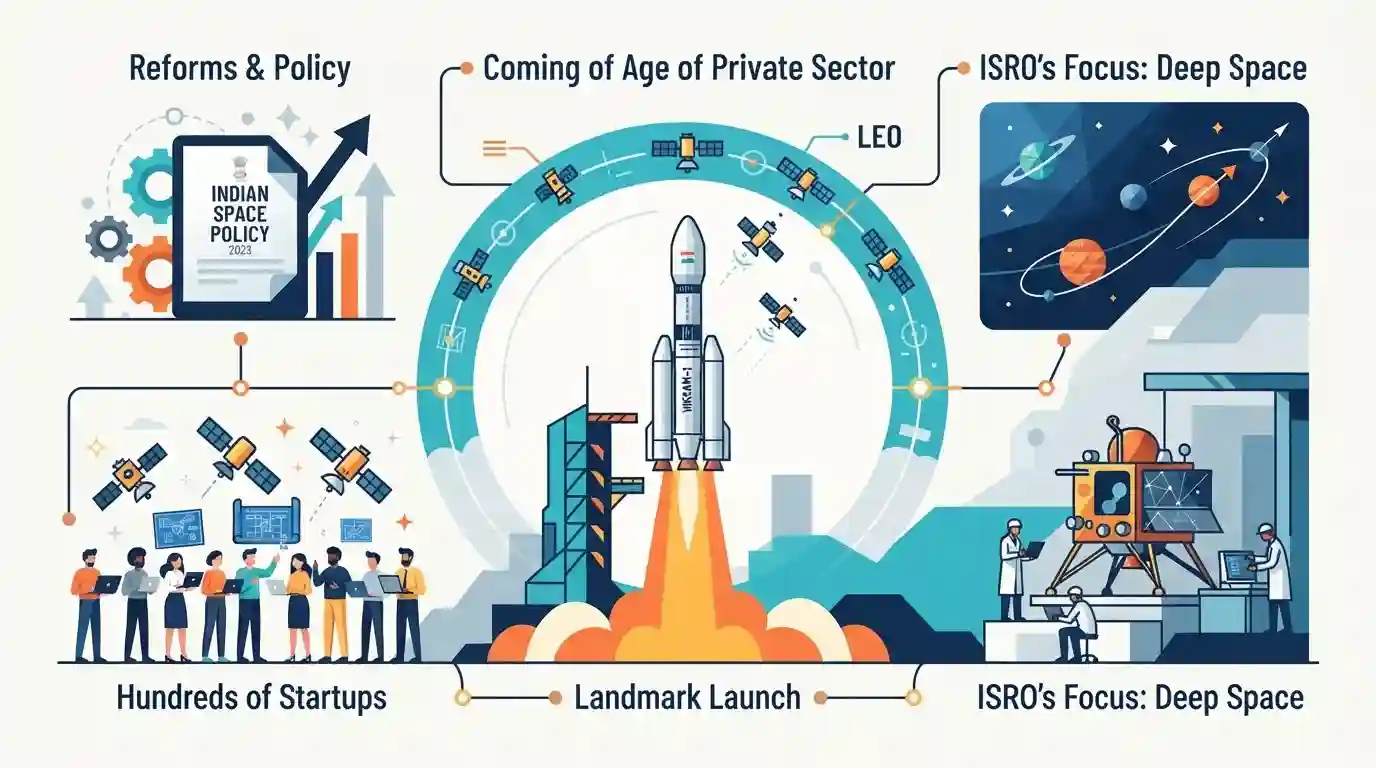
It underscores the paradigm shift in India's space ecosystem from a state-monopolized framework to a vibrant commercial industry driven by private startups, aligning with India's techno-economic ambitions and strategic autonomy in space.
సారాంశం
The editorial discusses the landmark launch of Skyroot Aerospace's Vikram-1 rocket, signifying the coming of age of India's private space sector. It highlights how space reforms and the Indian Space Policy 2023 have enabled hundreds of startups, shifting commercial LEO launches to private enterprises while allowing ISRO to concentrate on complex deep-space missions.
ముఖ్య అంశాలు
- Skyroot Aerospace's successful launch of the Vikram-1 rocket marks a major milestone, making India part of an exclusive group (alongside the US and China) where private companies have independently developed and launched orbital rockets.
- The space sector reforms initiated in 2020 and institutionalised via the Indian Space Policy 2023 have catalyzed nearly 400 space startups, growing the sector economy to roughly Rs 70,000 crore.
- Shifting commercial Low Earth Orbit (LEO) launches to private entities frees ISRO to focus aggressively on deep-space exploration missions such as Chandrayaan and Gaganyaan.
- Unlike the US model where companies like SpaceX operate largely independently of NASA, India's public-private partnership relies heavily on ISRO's foundational handholding and infrastructure support.
ముఖ్యమైన పదాలు
Indian Space Policy 2023

A landmark framework approved in 2023 that enables non-governmental entities (NGEs) to participate in end-to-end space activities, shifting ISRO toward R&D and deep-space exploration.
UPSC context
GS Paper III (Science & Technology): Tests understanding of government policy reforms, privatization, and commercialization of the space sector.
Skyroot Aerospace
An Indian private aerospace startup that successfully developed and launched the Vikram-1 rocket, marking a milestone in private sector participation in India's space missions.
UPSC context
GS Paper III (Science & Technology): Illustrates the growth of private enterprise, startups, and public-private partnerships in India's space economy.
ISRO
The national space agency of India responsible for planning, executing, and promoting space exploration programs, now increasingly focusing on advanced R&D and deep-space missions.
UPSC context
GS Paper III (Science & Technology): Core organization for India's space achievements, institutional frameworks, and technological advancements.
IN-SPACe
The single-window nodal agency established under the Department of Space to authorize, promote, and regulate private sector activities in the Indian space sector.
UPSC context
GS Paper III (Science & Technology): Tests knowledge of regulatory bodies, institutional reforms, and ease of doing business in space technology.
అనుసంధానమైన స్థిర భావనలు
What is the institutional architecture governing private space activities in India?
- IN-SPACe role:: Single-window, independent nodal agency under Department of Space to promote, authorize, and supervise private space activities.
- NewSpace India Limited (NSIL):: Commercial arm of ISRO focusing on marketing space technologies, launch services, and building commercial satellites.
- Indian Space Policy 2023:: Apex policy document that opens the entire space sector to non-governmental entities (NGEs) for end-to-end activities.
అంతర-అంశ నమూనాలు
Space Privatization vs Defense Indigenization (iDEX)
India's space sector reforms leverage public-private partnerships, contrasting with the purely market-driven US model and state-directed Chinese model, mirroring broader debates in defense indigenization and iDEX initiatives.

IN-SPACe role + Indian Space Policy 2023 mandate + ISRO's handholding model is prime material for a Mains analytical question.
అనుసంధాన PYQలు · 1
అనుసంధాన PYQలు · 1
- 2026PrelimsGS1
Consider the following statements with regard to involvement of private entities in India's space programme : 1. The Indian National Space Promotion and Authorisation Centre (IN-SPACe) is an autonomous agency formed to facilitate participation of private entities. 2. Agnikul Cosmos launched the world's first flight using 3D-printed rocket engine. 3. Skyroot Aerospace has developed liquid fuel for GSLV. Which of the statements given above is/are correct ?
