Opposition Targets Home Minister over Police Action on Student Protest
Source:Indian Express ↗
কেন এটি গুরুত্বপূর্ণ
This article illustrates the practical deployment of parliamentary rules (specifically Rajya Sabha's Rule 267) as instruments of executive accountability. It also touches upon human rights and public order issues related to policing methods (e.g., pellet guns) and highlights the backdrop against which upcoming bills, such as the Public Examinations Amendment Bill, will be debated.
সারসংক্ষেপ
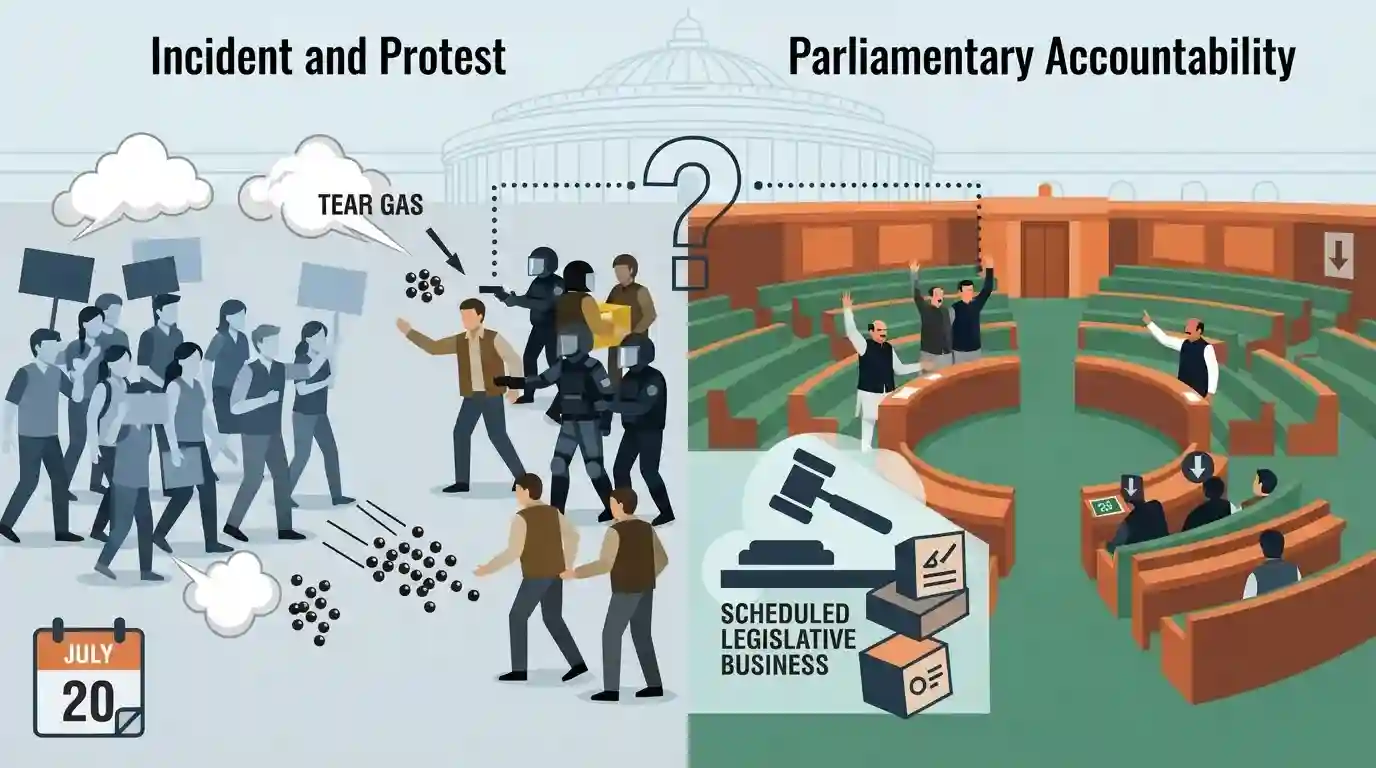
Following the resignation of Union Education Minister Dharmendra Pradhan, opposition parties are shifting their focus in Parliament to target Union Home Minister Amit Shah. They are protesting the police's use of semi-lethal pellet guns, tear gas, and plainclothes personnel against student demonstrators during a July 20 march. To demand accountability, the opposition plans to leverage parliamentary mechanisms like Adjournment Motions under Rajya Sabha's Rule 267, threatening to disrupt scheduled legislative business, including upcoming amendment bills on public examinations and national honor.
মূল বিষয়
- Following the resignation of Education Minister Dharmendra Pradhan, the Opposition has pivoted its strategy to target Union Home Minister Amit Shah over alleged police excesses on student protesters.
- The controversy stems from a July 20, 2026 student march to Parliament, where security forces reportedly used tear gas, lathi charges, and semi-lethal pellet guns, leading to serious injuries of a student (Sahil Lochab) and a journalist.
- Leader of the Opposition in Lok Sabha, Rahul Gandhi, wrote to Amit Shah demanding accountability, questioning whether the Home Minister sanctioned the use of pellet guns and authorized plainclothes personnel to beat students.
- Opposition parties, including the Congress, TMC, and CPI(M), are planning to submit adjournment motions under Rule 267 of the Rajya Sabha to suspend routine business and force a debate on the issue.
- The political standoff comes on the eve of crucial legislative debates, specifically regarding the Public Examinations (Prevention of Unfair Means) Amendment Bill, 2026, and the Prevention of Insults to National Honour (Amendment) Bill, 2026.
গুরুত্বপূর্ণ শব্দ
Rule 267 (Rajya Sabha Rules of Procedure)

A Rajya Sabha rule enabling the suspension of the day’s pre-listed business, with the Chairman's consent, to facilitate immediate discussion on a matter of urgent public importance.
UPSC context
GS Paper II (Polity) — Parliamentary functioning, executive accountability, and rules of procedure in the Upper House.
Public Examinations (Prevention of Unfair Means) Amendment Bill, 2026
A proposed legislation seeking to amend the 2024 Act by introducing stricter penalties, fast-track courts, and time-bound investigations to deter malpractices and paper leaks in public examinations.
UPSC context
GS Paper II (Governance) — Educational integrity, anti-cheating mechanisms, and executive policy interventions to safeguard competitive examinations.
Prevention of Insults to National Honour (Amendment) Bill, 2026
A legislative proposal that amends the 1971 Act to extend legal protection and penalties against intentional insults and disturbances to India's National Song, 'Vande Mataram'.
UPSC context
GS Paper II (Constitution) — Statutory protection of national symbols, fundamental duties under Article 51A, and related judicial precedents.
প্রিলিমস ফাঁদ
An Adjournment Motion to censure the government can be formally moved under Rule 267 in the Rajya Sabha.
Adjournment Motions (Rule 56) are exclusive to the Lok Sabha to censure the government. The Rajya Sabha has no provision for Adjournment Motions; Rule 267 only suspends procedural rules.
সংযুক্ত স্থির ধারণা
What are the operational differences between Rule 267 and Rule 176 in the Rajya Sabha?
- Procedural suspension: Rule 267 completely halts scheduled business, whereas Rule 176 permits a short-duration discussion without disrupting the day's main agenda.
- Duration limits: Rule 176 limits debates strictly to 2.5 hours, while Rule 267 discussions have no pre-defined procedural time limit once admitted.
- Voting outcomes: Rule 176 discussions conclude without any formal motion or voting, whereas Rule 267 can culminate in a voting procedure.
How does Section 148 of the Bharatiya Nagarik Suraksha Sanhita (BNSS), 2023 govern public assembly dispersal?
- Authorized authorities: An Executive Magistrate or police officer (Sub-Inspector rank or above) is empowered to command an unlawful assembly to disperse.
- Graded escalation: Force deployment must systematically transition from warnings and tear gas to physical force, utilizing weapons only as a proportional last resort.
আন্তঃবিষয় প্যাটার্ন
Parliamentary rules vs. Executive accountability
Linking Lok Sabha Adjournment Motions and Rajya Sabha Rule 267 highlights how asymmetric bicameral rules impact the opposition's procedural power to enforce executive accountability.
Fundamental Duties and statutory restrictions
Statutory protection of Vande Mataram tests how courts balance Article 51A(a) Fundamental Duties with Article 19(1)(a) freedom of expression.

Distinction between Rajya Sabha Rule 267 and Lok Sabha Adjournment Motions, paired with BNSS assembly powers, is highly probable for 2026.
সংযুক্ত PYQ · 3
সংযুক্ত PYQ · 3
- 2012PrelimsGS1
In the Parliament of India, the purpose of an adjournment motion is:
- 2017PrelimsGS1
The Parliament of India exercises control over the functions of the Council of Ministers through 1. Adjournment motion 2. Question hour 3. Supplementary questions Select the correct answer using the code given below:
- 2021MainsGS2
To what extent, in your view, the Parliament is able to ensure accountability of the executive in India?
