Rationalisation of Food and Fertiliser Subsidies in India
Source:Indian Express ↗
આ શા માટે મહત્વનું છે
With declining poverty rates, examining the rationalisation of food and fertiliser subsidies is essential for fiscal consolidation, ecological sustainability in agriculture, and redirecting resources toward capital investments and social development.
સારાંશ
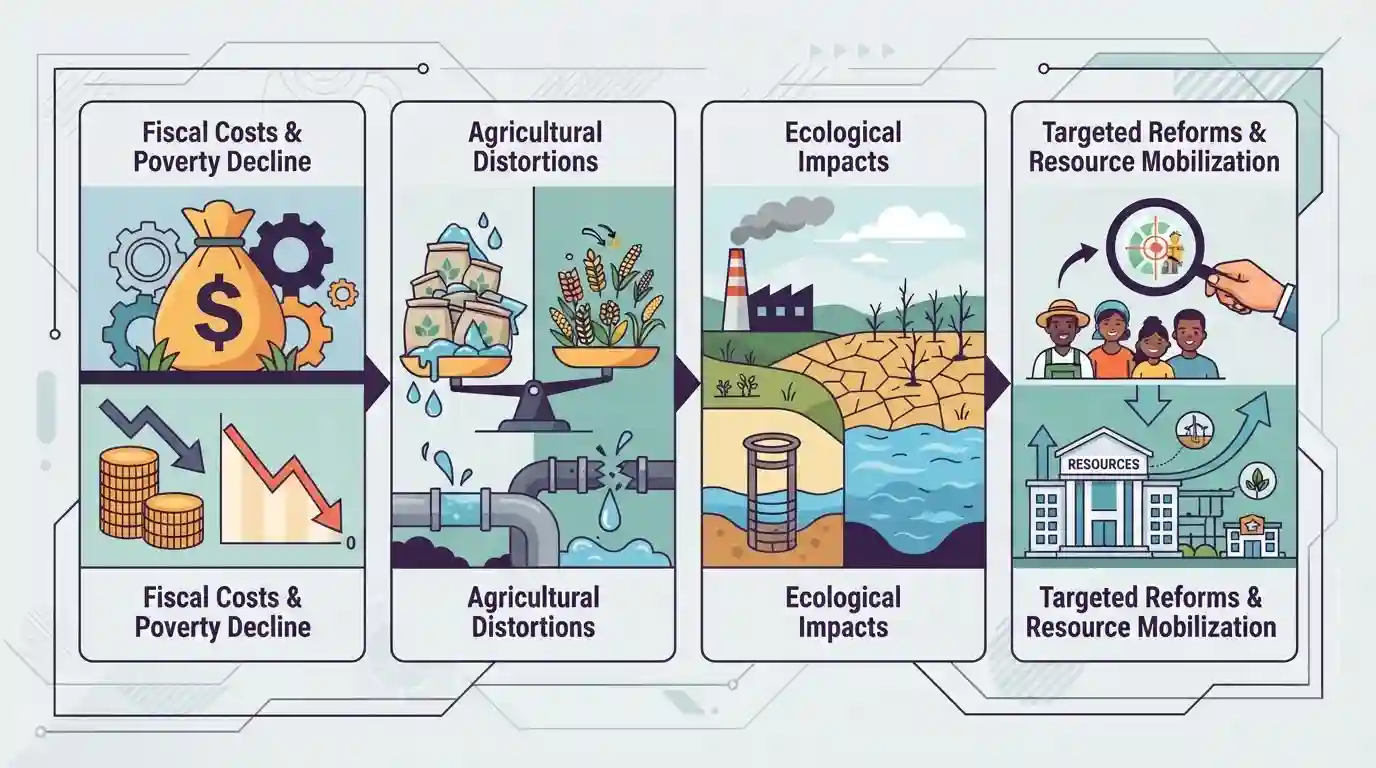
The article discusses the pressing need to revisit and rationalise food and fertiliser subsidies in India in light of declining poverty levels to historic lows. It highlights the fiscal costs, distortions in agricultural practices, and the ecological impacts of untargeted subsidies, advocating for better targeting and structural reforms.
મુખ્ય મુદ્દા
- India's poverty levels have reached historic lows, opening a policy window to re-evaluate and rationalise massive food and fertiliser subsidies.
- Food subsidies through programs like the Public Distribution System (PDS) and free food grains need better targeting, moving away from universal coverage to protect only the genuinely vulnerable.
- Fertiliser subsidies suffer from severe leakages, overuse of chemical fertilizers like urea, and ecological degradation, requiring a shift towards direct benefit transfer (DBT) or nutrient-based rationalisation.
- Rationalising subsidies is crucial for creating fiscal space for capital expenditure, infrastructure development, and climate-resilient agriculture.
મહત્વપૂર્ણ શબ્દો
Public Distribution System (PDS)

A government-sponsored safety net ensuring food security by distributing subsidized food grains and essential commodities to vulnerable populations through a network of fair price shops under the National Food Security Act.
UPSC context
GS Paper II & III (PDS, Food Security, Poverty, Governance). Tests understanding of welfare delivery mechanisms, fiscal costs, and leakage challenges.
Pradhan Mantri Garib Kalyan Anna Yojana (PM-GKAY)
A flagship central scheme providing free food grains to over 80 crore poor beneficiaries, supplementing regular entitlements under the National Food Security Act to cushion vulnerable households against economic shocks.
UPSC context
GS Paper II & III (Government Schemes, Social Sector, Welfare Economics). Evaluates fiscal burden and targeting efficacy of post-pandemic relief measures.
World Trade Organization (WTO)
A global international organization regulating trade between nations, whose rules on agricultural support and domestic amber box subsidies frequently intersect with India’s minimum support price and public stockholding policies.
UPSC context
GS Paper III (International Trade, Agriculture, Subsidies). Tests knowledge of global trade rules, de minimis limits, and the Peace Clause.
સંલગ્ન સ્થિર ખ્યાલો
What are the structural components and economic implications of India's major agricultural subsidies?
- Food Subsidy: Food Subsidy covers the economic cost of procurement, storage, and distribution of foodgrains via the PDS and PM-GKAY.
- Fertiliser Subsidy: Fertiliser Subsidy absorbs the differential between production/import cost and MRP of fertilizers like urea, often causing nutrient imbalance (NPK ratio distortion).
- Fiscal Strain: Fiscal Impact massive subsidies constrain capital expenditure (capex) and increase the revenue deficit of the government.
આંતર-વિષય પેટર્ન
Food Subsidy vs WTO Peace Clause
Large food stocks from universal PDS procurement complicate domestic stocking norms and trigger WTO dispute challenges regarding public stockholding for food security.

Poverty-subsidy rationalisation tied to fiscal space will feature in Mains GS3 (Agriculture/Budgeting) as a core structural reform theme.
સંલગ્ન PYQ · 4
સંલગ્ન PYQ · 4
- 2017MainsGS3
How do subsidies affect the cropping pattern, crop diversity and economy of farmers? What is the significance of crop insurance, minimum support price and food processing for small and marginal farmers?
- 2023MainsGS3
What are the direct and indirect subsidies provided to farm sector in India? Discuss the issues raised by the World Trade Organization (WTO) in relation to agricultural subsidies.
- 2013MainsGS3
What are the different types of agriculture subsidies given to farmers at the national and at state levels ? Critically analyse the agricultural subsidy regime with reference to the distortions created by it.
- 2022MainsGS3
What are the major challenges of Public Distribution System (PDS) in India ? How can it be made effective and transparent ?
