India Semiconductor Mission and Global Supply Chains
Source:Indian Express ↗
Why It Matters
The global competition for semiconductor dominance is reshaping international relations and economic security. Understanding India's policy responses, like the ISM and PLI schemes, is critical for answering questions on technology indigenization, industrial policy, and global supply chain resilience.
Summary
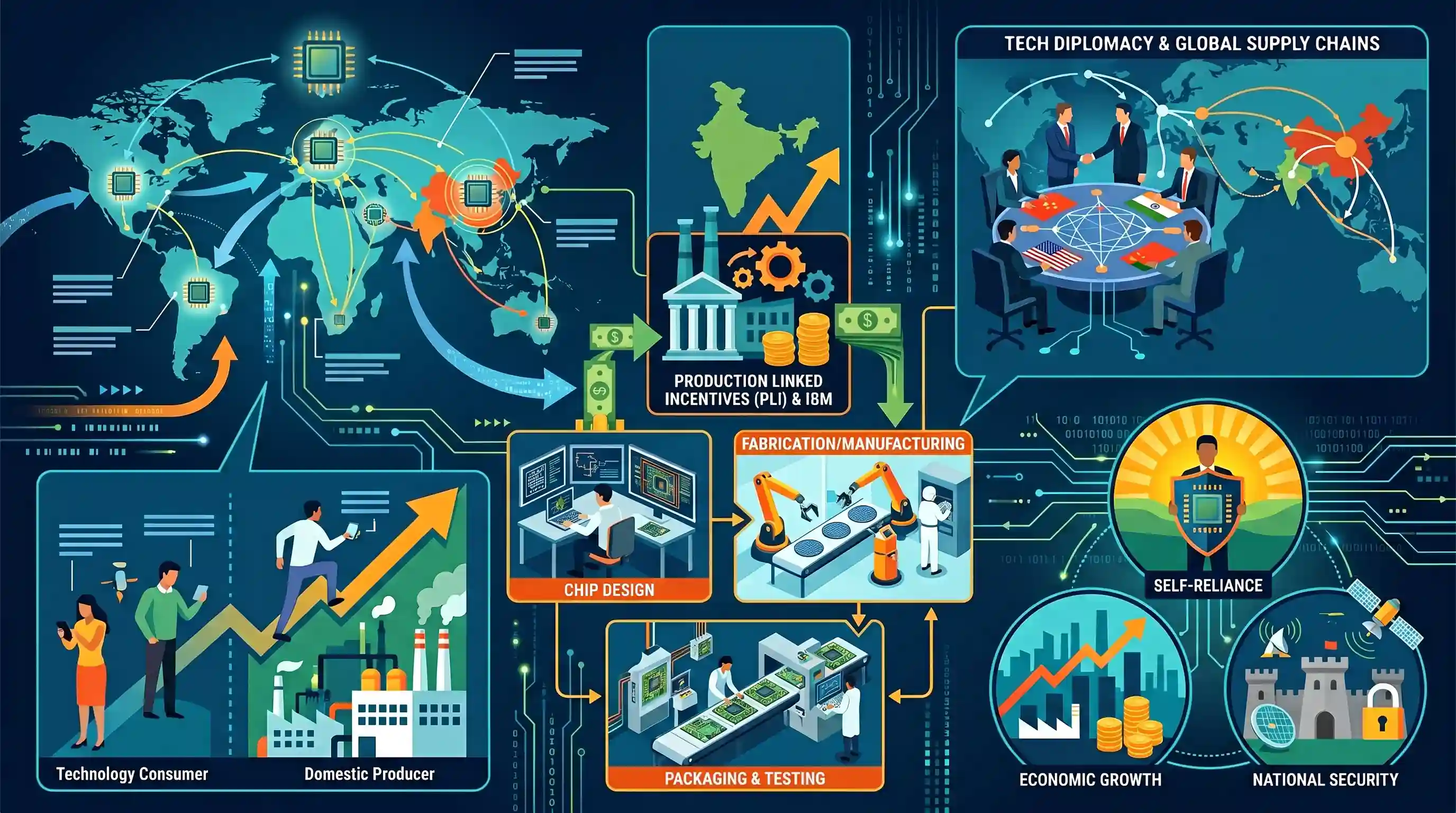
The article discusses the emergence of 'Pax Silica'—a new global geopolitical order defined by dominance in semiconductor technology and supply chains. It highlights India's strategic push to transition from a technology consumer to a pivotal node in the global semiconductor ecosystem. Driven by government initiatives like the India Semiconductor Mission (ISM) and Production Linked Incentive (PLI) schemes, India is aggressively building domestic capabilities in chip manufacturing, design, and packaging. By leveraging the global 'China-plus-one' strategy and engaging in proactive tech diplomacy, India is securing a vital 'seat at the table,' thereby ensuring self-reliance, driving economic growth, and fortifying national security in the digital era.
Key Points
- The global geopolitical order is transitioning into 'Pax Silica,' where power is determined by control over semiconductor supply chains and silicon chip manufacturing.
- India is strategically moving from being a mere consumer of electronics to becoming a critical player in global tech manufacturing to avoid technology colonialism.
- Initiatives such as the India Semiconductor Mission (ISM) and Production Linked Incentive (PLI) schemes are successfully catalyzing domestic manufacturing, packaging, and design capabilities.
- By capitalizing on the global 'China-plus-one' supply chain de-risking strategy and forming strategic partnerships, India is securing a 'seat at the table' in global tech rule-making.
Important Terms
Pax Silica

A US-led strategic framework (2025) aimed at building 'trusted' semiconductor and AI supply chains among allies to reduce dependence on adversarial actors and ensure global technological security.
UPSC context
GS Paper 2 (International Relations); tests understanding of technology-led geopolitics and India's strategic alignment with global high-tech alliances.
India Semiconductor Mission (ISM)
A specialized nodal agency under the Ministry of Electronics and IT, launched in 2021 with ₹76,000 crore to build a sustainable semiconductor and display manufacturing ecosystem in India.
UPSC context
GS Paper 3 (S&T/Economy); central to topics on indigenization of technology and achieving self-reliance in the electronics sector.
Production Linked Incentive (PLI) Scheme
A government scheme providing fiscal incentives to domestic and foreign manufacturers based on incremental sales, aimed at boosting local manufacturing and making India a global supply chain hub.
UPSC context
GS Paper 3 (Indian Economy/Manufacturing); essential for understanding industrial policy and the 'Make in India' initiative.
China Plus One Strategy
A global business strategy where multinational corporations diversify their manufacturing operations away from China to alternative destinations like India to mitigate geopolitical and supply chain risks.
UPSC context
GS Paper 3 (Economy); relevant for discussions on Global Value Chains (GVCs) and India's role in the shifting global trade landscape.
Tech Diplomacy
The use of technological collaboration as a core tool of foreign policy to build strategic partnerships, secure critical supply chains, and shape international norms for emerging technologies.
UPSC context
GS Paper 2 (International Relations); reflects the modern shift where technology is as strategic as traditional defense in bilateral ties.
ATMP / OSAT
The labor-intensive 'back-end' of semiconductor manufacturing involving Assembly, Testing, Marking, and Packaging (ATMP) or Outsourced Semiconductor Assembly and Test (OSAT) before chips are used in devices.
UPSC context
GS Paper 3 (Science & Technology); focuses on the specific segments of the semiconductor value chain where India is currently building capacity.
Prelims Trap
"Pax Silica is a WTO-backed plurilateral agreement regulating global semiconductor trade."
Pax Silica is actually a US-led multilateral geopolitical framework focused on securing semiconductor, AI, and critical mineral supply chains, not a WTO trade mechanism.
Static Concepts Connected
What is the institutional structure and mandate of the India Semiconductor Mission (ISM)?
- Institutional structure: It operates as an independent, specialized business division within the Digital India Corporation (DIC) under the Ministry of Electronics and IT (MeitY).
- Financial mandate: It acts as the nodal agency providing flat 50% fiscal support for setting up semiconductor fabs, display fabs, and ATMP/OSAT packaging facilities.
Which critical minerals are most essential for advanced semiconductor manufacturing?
- Gallium & Germanium: Vital for compound semiconductors used in high-frequency and power electronics. China currently dominates the global supply and refining of both elements.
- High-purity Silicon: The foundational substrate for wafers, refined from high-purity quartz through highly energy-intensive chemical processing.
Cross-Topic Patterns
Pax Silica & Minerals Security Partnership
India's integration into Pax Silica directly complements its role in the US-led Minerals Security Partnership, explicitly linking downstream chip fabrication to upstream critical mineral and rare earth element (REE) security.
Semiconductors as the new 'Oil'
Similar to 20th-century petro-politics, 'Pax Silica' signifies a shift in India’s strategic autonomy doctrine—moving from Middle East oil dependencies to mitigating Indo-Pacific tech supply chain chokepoints.

Expect a 2026 multi-statement question linking Pax Silica's US-led origin, ISM's 50% fiscal support, and Gallium/Germanium trade curbs.
Linked PYQs · 2
Linked PYQs · 2
- 2025MainsGS3
India aims to become a semiconductor manufacturing hub. What are the challenges faced by the semiconductor industry in India? Mention the salient features of the India Semiconductor Mission.
- 2025MainsGS3
Discuss the rationale of the Production Linked Incentive (PLI) scheme. What are its achievements? In what way can the functioning and outcomes of the scheme be improved?
