Evolution of India National Security Counter Terror Doctrine
Source:Indian Express ↗
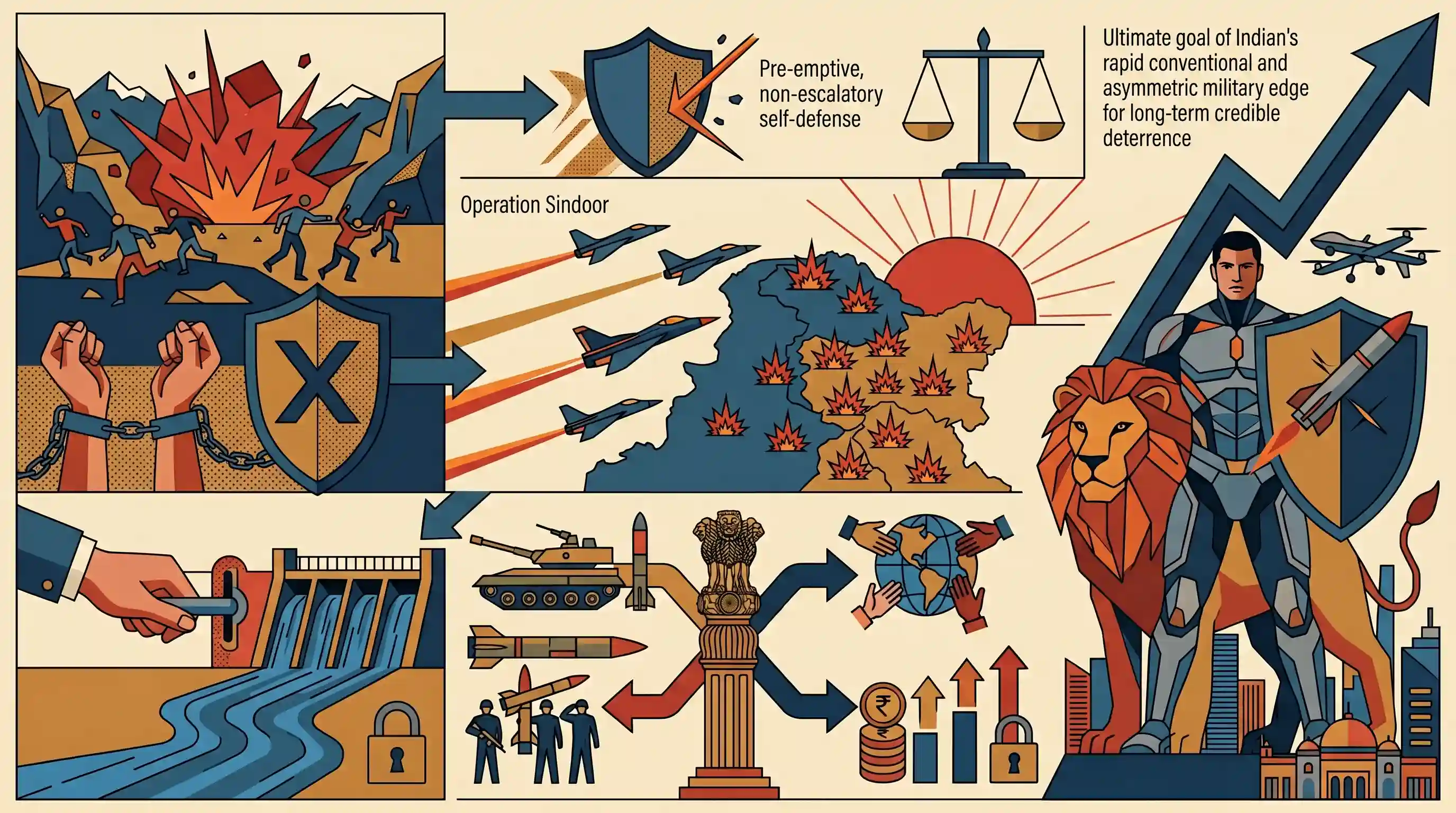
Why It Matters
The article details a significant paradigm shift in India's security doctrine from strategic restraint to proactive cross-border military strikes. It provides vital context for UPSC aspirants on how India responds to cross-border terrorism, balances the risk of escalation, and uses bilateral agreements like the Indus Waters Treaty as strategic leverage.
Summary
The editorial analyzes India's strategic shift in countering cross-border terrorism through 'Operation Sindoor,' which involved targeted air strikes on nine terror sites in PoK and West Punjab in retaliation for the Pahalgam attack. Moving away from historical strategic restraint, India framed the strikes as pre-emptive, non-escalatory self-defense. Furthermore, India placed the 1960 Indus Waters Treaty in abeyance, integrating military, diplomatic, and economic pressure. The article concludes that to establish a credible, long-term deterrence against Pakistan, India must rapidly acquire an unambiguous conventional and asymmetric military edge.
Key Points
- India launched 'Operation Sindoor', executing targeted air strikes on nine terror-related sites in PoK and West Punjab (including Sialkot, Muridke, and Bahawalpur) in response to the Pahalgam terror attack.
- The military response broke the historical taboo of striking deep within Pakistani territory, marking a shift from strategic restraint to active, pre-emptive self-defense.
- India combined its military action with diplomatic and economic leverage, most notably by keeping the 1960 Indus Waters Treaty (IWT) in abeyance.
- The editorial argues that for this new policy of deterrence to be sustainable, India must actively build and maintain an unambiguous conventional and asymmetric military superiority over Pakistan.
Important Terms
Indus Waters Treaty (1960)

A 1960 World Bank-brokered water-sharing agreement between India and Pakistan. India placed it in 'abeyance' in 2025 to exert pressure following cross-border terror attacks.
UPSC context
GS-II International Relations. Crucial for understanding transboundary water disputes and the use of resource diplomacy in neighborhood relations.
Operation Sindoor
A 2025 Indian military operation involving precision air and missile strikes on nine terror launch pads in PoK and Pakistan's Punjab province following the Pahalgam attack.
UPSC context
GS-III Internal Security. Tests awareness of modern military doctrines (offensive-defense) and recent kinetic responses to cross-border terrorism.
Pre-emptive Self-Defense
A legal doctrine under international law allowing a state to use force to neutralize an imminent threat; India cited this to justify its 2025 retaliatory strikes.
UPSC context
GS-II IR/International Law. Tests knowledge of India's legal justifications for 'surgical strikes' and its alignment with Article 51 of the UN Charter.
Strategic Restraint
India's long-standing policy of avoiding military escalation despite provocations from Pakistan. Recent strikes signal a departure from this doctrine toward a cost-imposition strategy.
UPSC context
GS-III Security. Essential for analyzing the evolution of India's National Security Doctrine and the shift toward proactive deterrence.
UN Security Council (UNSC)
The primary UN organ responsible for maintaining international peace; the forum where India reported Operation Sindoor and where the 2025 crisis was discussed.
UPSC context
GS-II International Institutions. Relevant for studying India’s engagement with global multilateral bodies and its quest for permanent membership.
Water Diplomacy
The use of water resources and treaties as leverage in foreign policy to achieve strategic goals or manage transboundary security challenges.
UPSC context
GS-II International Relations. Important for discussing non-traditional security tools and India's 'water-as-a-weapon' strategic shift in South Asia.
Prelims Trap
"India abrogated the 1960 Indus Waters Treaty, completely cutting off all Western river waters to Pakistan."
India placed the treaty in "abeyance" (temporary suspension of talks/commission), not abrogated it entirely. Furthermore, India still possesses rights to non-consumptive use on Western rivers under the IWT framework.
Static Concepts Connected
How does the 1960 Indus Waters Treaty allocate transboundary river waters?
- Eastern Rivers: Unrestricted use of Ravi, Beas, and Sutlej is allocated to India.
- Western Rivers: Allocated to Pakistan, but India retains rights for domestic, agricultural, and non-consumptive uses (like run-of-the-river hydroelectric projects).
- Dispute Mechanism: Establishes the Permanent Indus Commission (PIC) with commissioners from both sides to resolve disputes and share data.
What is the basis for "pre-emptive, non-escalatory self-defense" under international law?
- UN Charter Article 51: Recognizes the inherent right of individual or collective self-defense if an armed attack occurs against a Member of the United Nations.
- The Caroline Test: Customary international law dictating that the necessity for pre-emptive self-defense must be "instant, overwhelming, and leaving no choice of means."
- Non-escalatory Targeting: The doctrine limits targets to non-state actors (terror camps) to avoid classification as an act of war against the host state.
Cross-Topic Patterns
Water diplomacy as asymmetric deterrence
India's use of upper-riparian leverage by placing the IWT in abeyance mirrors global trends (e.g., China on the Brahmaputra), shifting transboundary water treaties from developmental frameworks to active coercive security tools.
Blurring the nuclear threshold
Striking beyond PoK into West Punjab tests Pakistan's stated tactical nuclear redlines, forcing a recalibration of South Asian deterrence theory and the limitations of the nuclear overhang.

Expect a 2026 GS2/GS3 Mains question linking water diplomacy (IWT abeyance) with cross-border terrorism and Comprehensive National Power.
Linked PYQs · 2
Linked PYQs · 2
- 2016MainsGS3
The terms 'Hot Pursuit' and 'Surgical Strikes' are often used in connection with armed action against terrorist attacks. Discuss the strategic impact of such actions.
- 2021PrelimsGS1
With reference to the Indus river system, of the following four rivers, three of them pour into one of them which joins the Indus direct. Among the following, which one is such river that joins the Indus direct?
