Jal Shakti Abhiyan Catch the Rain and Groundwater Security
Source:Indian Express ↗
Why It Matters
Water scarcity and groundwater depletion are major economic and environmental vulnerabilities for India. Questions regarding the effectiveness of water harvesting systems, watershed development, and schemes like the Jal Shakti Abhiyan frequently appear in UPSC Mains.
Summary
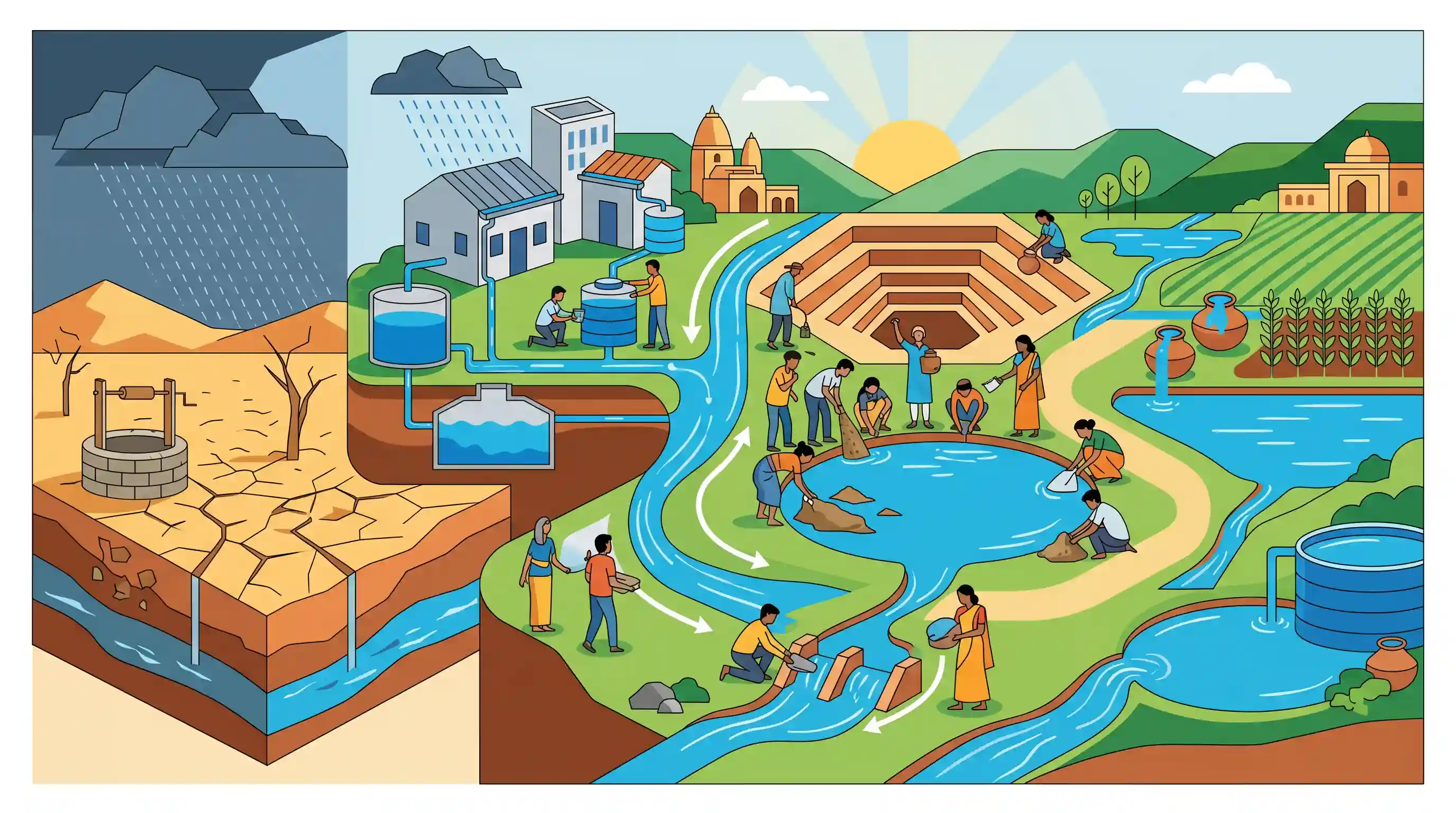
The article highlights the critical importance of rainwater harvesting and water conservation during the monsoon season. Amidst changing climate patterns and rapidly depleting groundwater reserves, it underscores the need for proactive initiatives like the 'Jal Shakti Abhiyan: Catch the Rain'. By emphasizing the rejuvenation of traditional water bodies, localized watershed management, and strong community participation, the article advocates for a decentralized approach to ensuring long-term water security in India.
Key Points
- Uneven spatial and temporal distribution of monsoon rainfall necessitates effective and decentralized rainwater harvesting systems.
- The 'Jal Shakti Abhiyan: Catch the Rain' initiative focuses on constructing and maintaining water harvesting structures across urban and rural areas.
- Depleting groundwater levels present a critical challenge to food and water security, requiring an urgent shift toward aquifer recharge strategies.
- Rejuvenation of traditional water bodies, wetlands, and the creation of percolation tanks are vital for augmenting groundwater tables.
- Sustainable water conservation demands active community participation and a decentralized approach to watershed management.
Important Terms
Jal Shakti Abhiyan

A mission-mode campaign launched in 2019 to promote water conservation and security through community participation, primarily targeting water-stressed districts and blocks across India.
UPSC context
GS Paper II (Government Policies) & GS III (Environment). Tests understanding of community-led resource management and water security strategies.
Catch the Rain campaign
An annual initiative under Jal Shakti Abhiyan with the tagline 'Catch the rain, where it falls, when it falls,' focusing on decentralized rainwater harvesting in all rural and urban districts.
UPSC context
GS Paper III (Conservation/Environment). Relevant for questions on localized water management and climate change adaptation in both urban and rural settings.
Ministry of Jal Shakti
Formed in May 2019 by merging the Ministry of Water Resources and the Ministry of Drinking Water & Sanitation to provide integrated, holistic management of India's water resources.
UPSC context
GS Paper II (Governance). Important for institutional framework analysis and understanding administrative reforms for integrated resource governance.
Central Ground Water Board (CGWB)
A scientific statutory organization under the Ministry of Jal Shakti responsible for monitoring, managing, and regulating India's groundwater resources through surveys and aquifer mapping.
UPSC context
GS Paper III (Environment/Resource Management). Key for questions on groundwater depletion, sustainable irrigation, and scientific monitoring of aquifers.
Mission Amrit Sarovar
Launched in 2022 to rejuvenate or develop at least 75 water bodies in every district, promoting rainwater harvesting and local ecological restoration during the 'Azadi Ka Amrit Mahotsav.'
UPSC context
GS Paper II & III. Focuses on the rejuvenation of traditional water bodies and localized watershed management.
Prelims Trap
Jal Shakti Abhiyan: Catch the Rain is implemented only in water-stressed blocks of rural India.
UPSC often uses geographic restrictions as traps. The Catch the Rain campaign is actually implemented across ALL districts (both rural and urban) in the country, not just water-stressed ones.
Static Concepts Connected
What are the key traditional water harvesting systems across India?
- Khadins and Tankas: Traditional surface runoff harvesting systems predominantly used in the arid regions of Rajasthan to capture monsoon rain.
- Ahar-Pynes: Indigenous floodwater harvesting and distribution systems historically utilized in the semi-arid regions of South Bihar.
- Surangams: Horizontal tunnel systems excavated for groundwater extraction in the laterite rocks of the Western Ghats (Kerala/Karnataka).
How is groundwater legally regulated and managed in India?
- CGWA Statutory Backing: The Central Ground Water Authority (CGWA) was constituted under the Environment (Protection) Act, 1986, not the Water Act.
- Easement Act 1882: Inherently links groundwater rights to land ownership, complicating equitable regulation and driving over-exploitation by wealthy landowners.
- Atal Bhujal Yojana: A World Bank-assisted central sector scheme focusing on community-led sustainable groundwater management in priority water-stressed states.
Cross-Topic Patterns
MSP driving groundwater depletion
Assured MSP procurement for water-intensive crops like paddy and sugarcane heavily skews cropping patterns, driving extreme aquifer depletion in semi-arid states like Punjab and Haryana.
Urban flooding and aquifer depletion
Unplanned concretization and loss of urban wetlands act as a double-edged sword: preventing natural aquifer recharge (causing water stress) while maximizing surface runoff (causing urban flash floods).

Expect a 2026 prelims question merging CGWA statutory backing (EPA 1986), India's global groundwater extraction share, and crop MSP impact.
Linked PYQs · 4
Linked PYQs · 4
- 2018MainsGS1
The ideal solution of depleting ground water resources in India is water harvesting system." How can it be made effective in urban areas?
- 2025MainsGS3
Examine the factors responsible for depleting groundwater in India. What are the steps taken by the government to mitigate such depletion of groundwater?
- 2020MainsGS3
What are the salient features of the Jal Shakti Abhiyan launched by the Government of India for water conservation and water security?
- 2020MainsGS3
Suggest measures to improve water storage and irrigation system to make its judicious use under depleting scenario.
