Cultivating Crops in Simulated Lunar Regolith for Space Missions
Source:The Hindu ↗
Why It Matters
With ISRO's future plans and global lunar missions like Artemis looming, extraterrestrial agriculture is a cutting-edge sub-topic within GS-3 (Science and Technology). It highlights the innovative application of biotechnology (mycorrhizal fungi) and organic agriculture (vermicompost) to solve food security and life-support challenges in space exploration.
Summary
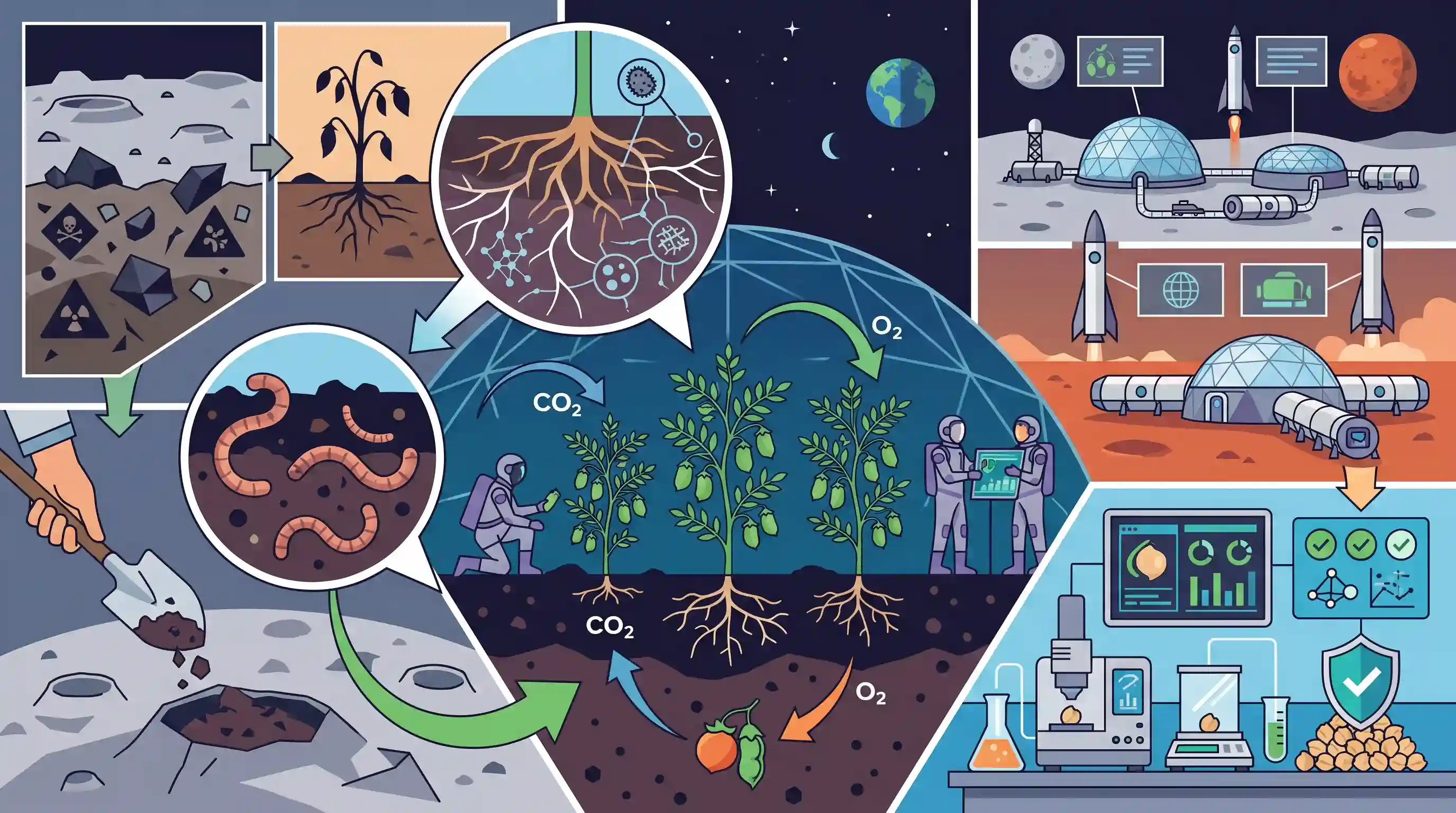
Scientists at Texas A&M University have successfully cultivated chickpeas in simulated lunar regolith, overcoming the soil's lack of organic matter and high metal toxicity by employing beneficial fungi and vermicompost. This breakthrough represents a significant step toward establishing sustainable agriculture and life-support systems for future long-term space missions to the Moon and Mars, though the crops are still undergoing testing to ensure they are safe from heavy metal accumulation.
Key Points
- Researchers successfully grew chickpeas in soil mixtures containing up to 75% simulated lunar regolith, demonstrating potential for sustainable extraterrestrial agriculture.
- Arbuscular mycorrhizal fungi and vermicompost were added to the sterile, inorganic lunar simulant to bind loose particles and reduce heavy metal toxicity.
- Chickpeas were chosen as a strong candidate for space crop production due to their high protein content and essential nutrients, which are vital for long-term astronaut survival.
- The success of these plant-microbe partnerships could help condition regolith and enhance life-support systems (such as oxygen production) for future human settlements on the Moon and Mars.
- Harvested chickpeas are currently being tested for metal accumulation (like aluminum and iron) before confirming they are safe for human consumption.
Important Terms
Lunar Regolith

The layer of loose, fragmented rock and dust covering the Moon's surface. Unlike Earth's soil, it lacks organic matter and is formed primarily by meteorite impacts and solar radiation.
UPSC context
GS Paper III (Science & Tech); relevant for In-Situ Resource Utilization (ISRU) and establishing sustainable lunar colonies.
Bioregenerative Life-Support System (BLSS)
Artificial ecosystems that use biological processes (like plant growth) to recycle waste and provide oxygen, water, and food for astronauts during long-duration space missions.
UPSC context
GS Paper III (Science & Tech); essential for human missions to Mars and deep space exploration.
Astrobiology
The study of the origin, evolution, and distribution of life in the universe. In space missions, it involves testing the habitability of extreme environments through experiments like space farming.
UPSC context
GS Paper III (Science & Tech); tests understanding of extraterrestrial habitability and life-support technology.
Vermicompost
A nutrient-rich organic fertilizer produced by the decomposition of organic waste by earthworms. It enhances soil health, microbial activity, and water retention.
UPSC context
GS Paper III (Agriculture/Environment); tested in the context of sustainable farming and soil restoration in extreme conditions.
Apollo Missions
A series of NASA missions (1961–1972) that first landed humans on the Moon. They returned hundreds of kilograms of lunar soil samples used for current scientific research.
UPSC context
GS Paper III (Science & Tech); historical benchmark for lunar exploration and the foundation of lunar geology studies.
ISRO (Indian Space Research Organisation)
India's space agency, which has conducted major lunar missions like Chandrayaan-3 to study lunar soil composition and the presence of water ice at the lunar south pole.
UPSC context
GS Paper III (Science & Tech); focuses on India's indigenous space capabilities and lunar exploration milestones.
Space Agriculture
The use of In-Situ Resource Utilization (ISRU) to grow crops in space or on other planets, reducing reliance on Earth-based resupply for long-term survival.
UPSC context
GS Paper III (Science & Tech/Agriculture); vital for colonizing the Moon and Mars under resource-constrained conditions.
Prelims Trap
Plants can be cultivated directly in pure lunar regolith relying solely on its natural mineral composition.
Lunar regolith is entirely sterile, lacks organic carbon, and has high heavy-metal toxicity. Successful plant growth strictly requires organic and biological inputs like fungi or compost.
Static Concepts Connected
How do Arbuscular Mycorrhizal Fungi (AMF) aid in bioremediation and plant growth?
- Symbiotic network: AMF form a symbiotic network with plant roots, significantly expanding the surface area for absorbing water and essential nutrients.
- Heavy metal buffering: Fungi act as a buffer by sequestering or binding toxic heavy metals outside the plant's root system, preventing internal tissue damage.
- Toxin neutralization: Microbes facilitate the breakdown of toxic compounds, a core principle of bioremediation used in both polluted terrestrial soils and sterile space regolith.
What distinguishes Lunar Regolith from terrestrial Earth soil?
- Absence of organics: Earth soil contains humus and organic carbon bonds formed by life. Lunar regolith is completely inorganic, sterile, and void of organic matter.
- Formation process: Earth soil forms via biological and chemical weathering. Regolith is created by continuous micrometeorite impacts, resulting in sharp, jagged fragments.
- Metallic toxicity: Regolith is highly enriched with metallic oxides (like iron and aluminum) in forms that are naturally toxic to most terrestrial agricultural crops.
Cross-Topic Patterns
Space tech + Bioregenerative Life Support
Using plants to recycle CO2 and organic waste merges space tech with biotechnology, a critical capability for India's upcoming Gaganyaan and future Bharatiya Antariksha Station ambitions.
Extraterrestrial botany + Mining bioremediation
The fungal techniques used to neutralize metallic oxides in lunar dust directly apply to terrestrial bioremediation, offering solutions for reclaiming heavy-metal polluted mining lands in India.

UPSC 2026 may pair lunar regolith characteristics with AMF symbiosis or bioremediation in a multi-statement Science question.
Linked PYQs · 4
Linked PYQs · 4
- 2021PrelimsGS1
Bollgard I and Bollgard II technologies are mentioned in the context of
- 2020PrelimsGS1
What is the use of biochar in farming? 1. Biochar can be used as a part of the growing medium in vertical farming. 2. When biochar is a part of the growing medium, it promotes the growth of nitrogen-fixing microorganisms. 3. When biochar is a part of the growing medium, it enables the growing medium to retain water for longer time. Which of the statements given above is/are correct?
- 2019MainsGS3
How can biotechnology help to improve the living standards of farmers?
- 2009PrelimsGS1
India has recently landed its Moon Impact Probe on the Moon. Among the following countries, which one landed such probe on the Moon earlier?
