Madhya Pradesh plans buffer zone development to manage tiger growth
Source:The Hindu ↗
Why It Matters
India's successful tiger conservation has created a new challenge: managing the spillover of apex predators from core habitats into buffer zones and human settlements. Understanding the ecological carrying capacity of reserves and the socio-economic management of eco-sensitive zones is highly relevant for GS3 Environment and Disaster Management.
Summary
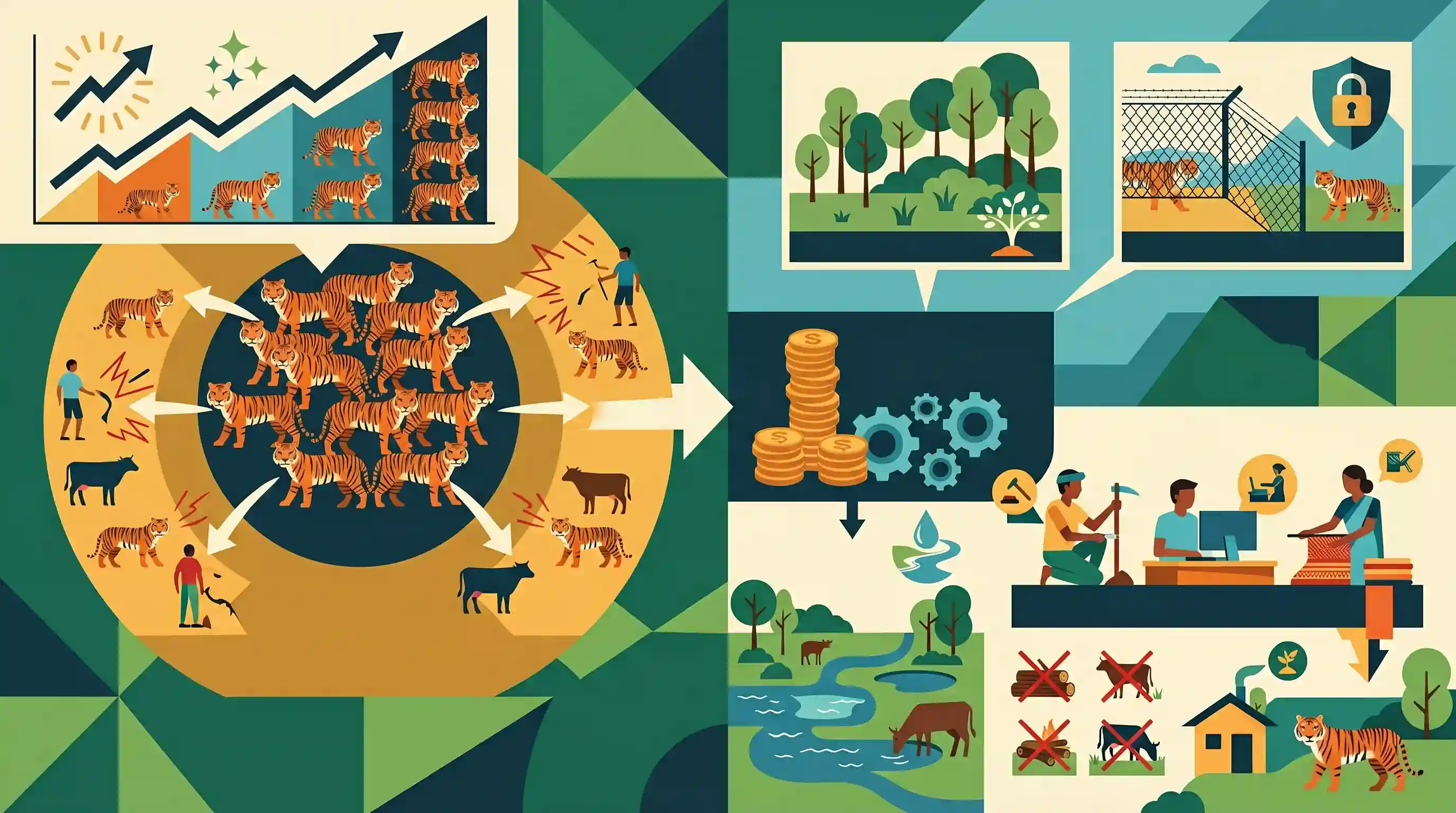
Responding to a substantial 49% growth in its tiger population over four years, the Madhya Pradesh government has announced a ₹145 crore initiative to develop the buffer zones around its nine tiger reserves. As core areas near their ecological carrying capacity, tigers are increasingly moving into buffer zones, raising the risk of human-wildlife conflict. The new project will fund habitat development, security upgrades like chain-link fencing, and water resource management. Crucially, the plan also integrates socio-economic measures, aiming to provide skill development for local communities to decrease their reliance on forest produce and minimize friction with wildlife.
Key Points
- Madhya Pradesh has approved a ₹145 crore project spanning two years (FY26 to FY28) to develop and upgrade the buffer zones around its nine tiger reserves.
- The initiative is driven by a rapid increase in the tiger population within the state's buffer zones, which grew by 49% from 526 in 2018 to 785 tigers.
- The project focuses on ecological and security infrastructure, including chain-link fencing, grassland and water source development, fire safety, and health monitoring for wildlife.
- To mitigate human-wildlife conflict, the state plans to train local communities living near the reserves in alternative livelihoods (e.g., mechanic skills) to reduce their dependence on forest resources.
- Madhya Pradesh's reserves, including Bandhavgarh and the newly added Madhav National Park, play a critical role in India's overall tiger conservation landscape.
Important Terms
Project Tiger

Launched in 1973, it is a Centrally Sponsored Scheme to ensure viable tiger populations. Recently merged with Project Elephant (2023) into the 'Project Tiger & Elephant' (PTE) division for rationalized funding and management.
UPSC context
GS Paper III (Environment); key for questions on flagship conservation schemes and recent administrative shifts in wildlife governance.
Wildlife (Protection) Act, 1972
India's primary legal framework for protecting plant and animal species. Section 38V governs the notification of Tiger Reserves, distinguishing between 'inviolate' core areas and 'multiple-use' buffer zones.
UPSC context
GS Paper II/III; essential for understanding statutory protections, the 2006 amendment, and the legal definition of protected areas.
Carrying Capacity
The maximum number of individuals of a species an ecosystem can sustainably support based on available resources (prey/habitat). When exceeded, wildlife spills into human settlements, increasing human-wildlife conflict.
UPSC context
GS Paper III (Biodiversity); crucial for analyzing the ecological drivers behind rising human-wildlife conflict in success-story landscapes.
Buffer Zone
A peripheral area to the core tiger habitat where limited human activity is permitted. It aims to promote coexistence between wildlife and local communities while providing a dispersal habitat for tigers.
UPSC context
GS Paper III; relevant for questions on community-based conservation, eco-development, and mitigating human-wildlife friction.
National Tiger Conservation Authority (NTCA)
A statutory body under the MoEFCC, established via the 2006 amendment to the Wildlife (Protection) Act. It provides technical and administrative oversight for all 58 Tiger Reserves in India.
UPSC context
GS Paper II/III; vital for governance-related questions on environmental institutions and the implementation of Tiger Conservation Plans.
Madhya Pradesh Tiger Reserves
Known as India's 'Tiger State,' it hosts 785 tigers (2022 Census). As of 2025, it has 9 Tiger Reserves, including the recently added Madhav and Ratapani reserves.
UPSC context
GS Paper III/Geography; important for mapping exercises and case studies on state-led conservation successes and challenges.
Prelims Trap
"Tiger Reserves are notified by NTCA, and both core and buffer zones must be maintained as completely inviolate areas."
State Governments notify Tiger Reserves on NTCA's recommendation. Only core areas (Critical Tiger Habitats) are kept inviolate; buffer zones allow managed human activities.
Static Concepts Connected
How do Core and Buffer zones of a Tiger Reserve differ legally?
- Core Area: Known as Critical Tiger Habitat (CTH), it must be kept legally inviolate for tiger conservation, without affecting the rights of Scheduled Tribes.
- Buffer Zone: A peripheral area aimed at promoting co-existence; it provides habitat supplement for spill-over tigers and allows managed human activities and eco-tourism.
- Notification Authority: Both zones are officially notified by the State Government based on the recommendation of the NTCA under Section 38V of WPA 1972.
What defines Ecological Carrying Capacity in wildlife management?
- Definition: The maximum population size of a biological species that a specific environment can sustain indefinitely, given available food, habitat, and water resources.
- Spill-over Effect: Once core areas reach carrying capacity, territorial apex predators like tigers are pushed into buffer zones and revenue lands, escalating human-wildlife conflict.
Cross-Topic Patterns
Carrying Capacity + Human-Wildlife Conflict
As conservation efforts succeed, biological carrying capacities in core areas are breached, forcing apex predators into human-dominated landscapes and transforming a biological success into an administrative crisis.
Eco-development + Alternative Livelihoods
State interventions are shifting from purely punitive conservation (fences and fines) to socio-economic integration, using skill development to decouple indigenous communities from forest-produce dependency.

Expect a 2026 multi-statement question testing the notification authority of Tiger Reserves and the legal status of Critical Tiger Habitats.
Linked PYQs · 4
Linked PYQs · 4
- 2020PrelimsGS1
Among the following Tiger Reserves, which one has the largest area under "Critical Tiger Habitat"?
- 2019MainsGS3
Define the concept of carrying capacity of an ecosystem as relevant to an environment. Explain how understanding this concept is vital while planning for sustainable development of a region.
- 2022PrelimsGS1
With reference to Indian laws about wildlife protection, consider the following statements : 1. Wild animals are the sole property of the government. 2. When a wild animal is declared protected, such animal is entitled for equal protection whether it is found in protected areas or outside. 3. Apprehension of a protected wild animal becoming a danger to human life is sufficient ground for its capture or killing. Which of the statements given above is/are correct?
- 2019PrelimsGS1
Which of the following are in Agasthyamala Biosphere Reserve?
