Early Monsoon Triggers Strong Kharif Sowing Progress Across Karnataka
Source:The Hindu ↗
Why It Matters
This article provides a real-world example of how the timely onset of the southwest monsoon directly dictates Kharif sowing progress in India. It also highlights the importance of administrative preparedness in agricultural input management (seeds, fertilizers) to leverage favorable weather, which is a key aspect of GS3 Agriculture.
Summary
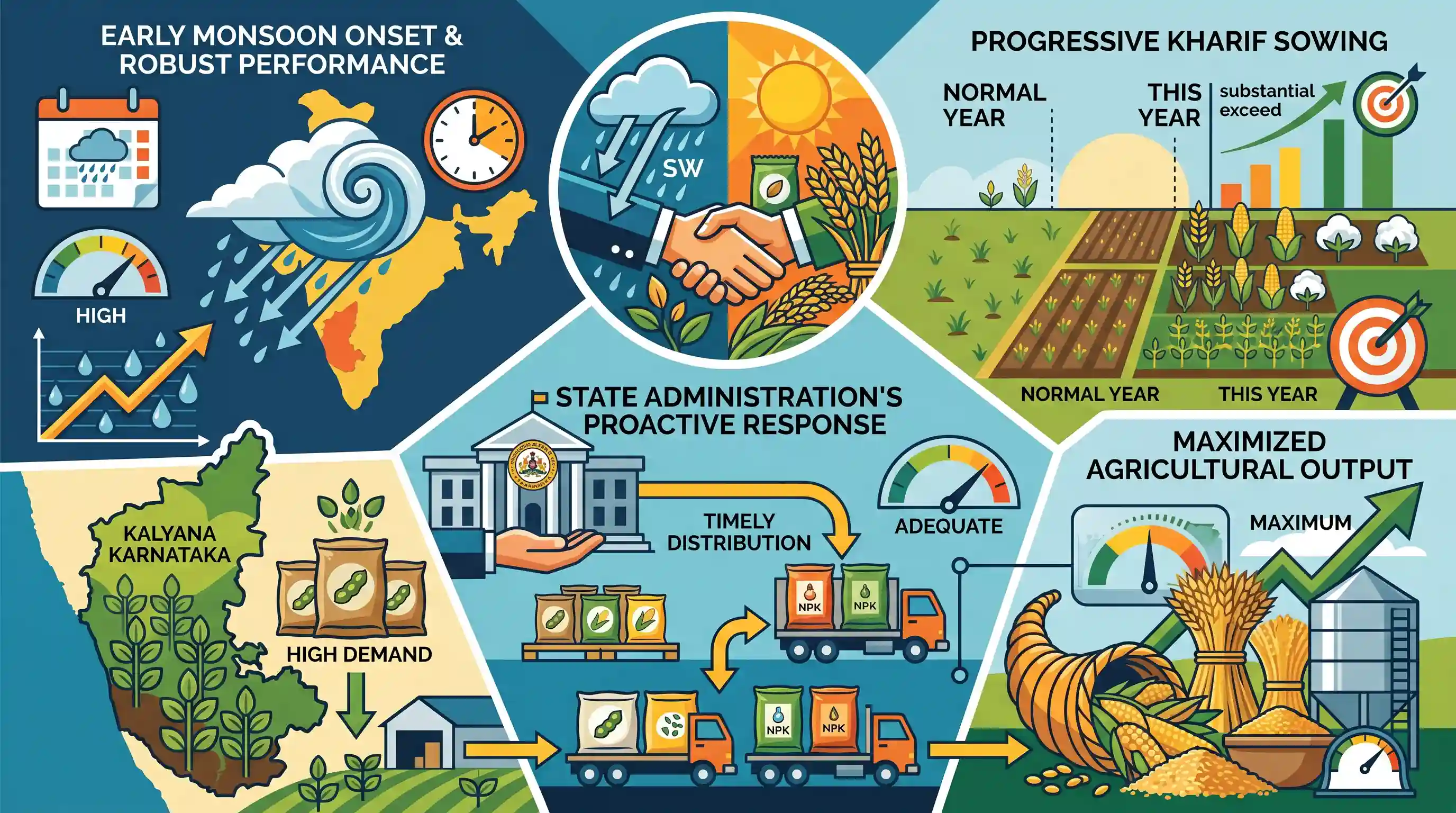
The early onset and robust performance of the southwest monsoon in Karnataka have led to significant progress in Kharif sowing, with agricultural coverage substantially exceeding both the normal and previous year's figures. Favorable pre-monsoon and early monsoon showers have prompted the State's Agriculture Department to proactively ensure the adequate and timely distribution of seeds and fertilizers. This successful management includes addressing a high demand for soybean seeds in the Kalyana Karnataka region, demonstrating the critical link between timely weather events and efficient administrative support in maximizing agricultural output.
Key Points
- The early onset of the southwest monsoon has led to robust Kharif sowing progress in Karnataka, surpassing both normal and last year's coverage figures.
- Sowing has been completed on over 30.56 lakh hectares compared to the normal 22.84 lakh hectares for the current period.
- Karnataka recorded 19% excess pre-monsoon rainfall and 63% higher-than-normal rainfall in June so far.
- The Agriculture Department has proactively ensured an adequate supply of agricultural inputs, effectively managing the high demand for soybean seeds and fertilizers, especially in the Kalyana Karnataka region.
Important Terms
Southwest Monsoon

The primary rain-bearing system in India (June-September), providing ~75% of annual rainfall. It is critical for the Kharif cropping season and replenishing water reservoirs.
UPSC context
GS Paper 1 (Geographical phenomena) and GS Paper 3 (Indian Economy/Agriculture dependency).
Kharif Season
The monsoon cropping season (June to October) in India. It involves water-intensive crops like rice, maize, and soybean that depend on the arrival of the southwest monsoon.
UPSC context
GS Paper 3 (Cropping patterns, food security, and agricultural output).
Raitha Samparka Kendras (RSKs)
Grassroots agricultural extension centers established by the Karnataka government at the hobli (sub-block) level to provide farmers with seeds, fertilizers, and technical knowledge.
UPSC context
GS Paper 2 (Governance/Institutions) and GS Paper 3 (Agriculture/Extension services).
Kalyana Karnataka
A region in northeastern Karnataka comprising six backward districts. Formerly known as Hyderabad-Karnataka, it was renamed in 2019 to honor the 12th-century Sharana movement.
UPSC context
GS Paper 1 (Regionalism/Geography) and GS Paper 2 (Special provisions for backward regions).
Article 371J
A constitutional provision inserted by the 98th Amendment Act (2012) providing special status to the Kalyana-Karnataka region to address developmental disparities through local reservations and funds.
UPSC context
GS Paper 2 (Indian Constitution/Special provisions for states).
Pre-monsoon Showers
Localized rainfall occurring from March to May before the main monsoon. In Karnataka, these are often called 'Mango Showers' as they assist in the ripening of mangoes.
UPSC context
GS Paper 1 (Important Geophysical phenomena/Local winds).
Prelims Trap
Soybean cultivation in India is geographically confined to the central and northern states.
Aspirants often assume soybean is exclusively grown in MP or Maharashtra. Southern states like Karnataka have significantly increased acreage due to shifting cropping patterns.
Static Concepts Connected
What are the local pre-monsoon showers in India and their agricultural significance?
- Mango Showers: Pre-monsoon rains in Kerala and Karnataka occurring towards the end of summer, essential for the early ripening of mangoes.
- Blossom Showers: Also known as Cherry Blossom showers; these are crucial for the flowering of coffee plantations across Karnataka.
- Nor Westers: Violent thunderstorms in Bengal and Assam (Kalbaisakhi) that aid in the cultivation of tea, jute, and early rice.
What are the ideal geographical conditions for Soybean cultivation?
- Climate & Rainfall: Thrives in warm, moist climates (26-30°C). As a major rain-fed Kharif crop, it is heavily dependent on the Southwest Monsoon.
- Soil Requirements: Prefers well-drained, fertile loamy soils. It is highly sensitive to water-logging, which can destroy the seedling.
- Crop Traits: Being a leguminous pulse-cum-oilseed crop, it improves soil health by fixing atmospheric nitrogen, fitting well into crop rotation systems.
Cross-Topic Patterns
Oilseed Security & Import Substitution
Surging soybean acreage in southern states aligns with India's strategic push to reduce its massive edible oil import bill through crop diversification and missions like NMEO-OS.
Article 371J & Kalyana Karnataka
Administrative focus on Kalyana Karnataka highlights the intersection of agro-climatic vulnerability and Article 371J, which grants special status to this historically backward, drought-prone region.

Expect a multi-statement question on Soybean cultivation requirements mapped against pre-monsoon phenomena and edible oil missions in 2026.
Linked PYQs · 4
Linked PYQs · 4
- 2015MainsGS1
How far do you agree that the behaviour of the Indian monsoon has been changing due to humanizing landscapes? Discuss.
- 2019PrelimsGS1
With reference to the cultivation of Kharif crops in India in the last five years, consider the following statements: 1. Area under rice cultivation is the highest. 2. Area under the cultivation of jowar is more than that of oilseeds. 3. Area of cotton cultivation is more than that of sugarcane. 4. Area under sugarcane cultivation has steadily decreased. Which of the statements given above are correct?
- 2013PrelimsGS1
Consider the following crops : 1. Cotton 2. Groundnut 3. Rice 4. Wheat Which of these are Kharif crops?
- 2023MainsGS3
Explain the changes in cropping pattern in India in the context of changes in consumption pattern and marketing conditions.
