Banarasi saree industry faces crisis due to fake powerloom products
Source:etvbharat ↗
Why It Matters
This article highlights state-specific socio-economic issues, the challenges of traditional cottage industries in UP (handloom is the state's largest industrial employer after agriculture), the significance of Varanasi's ODOP and GI-protected Banarasi silk sector, and the policy interventions required to combat counterfeiting.
Summary
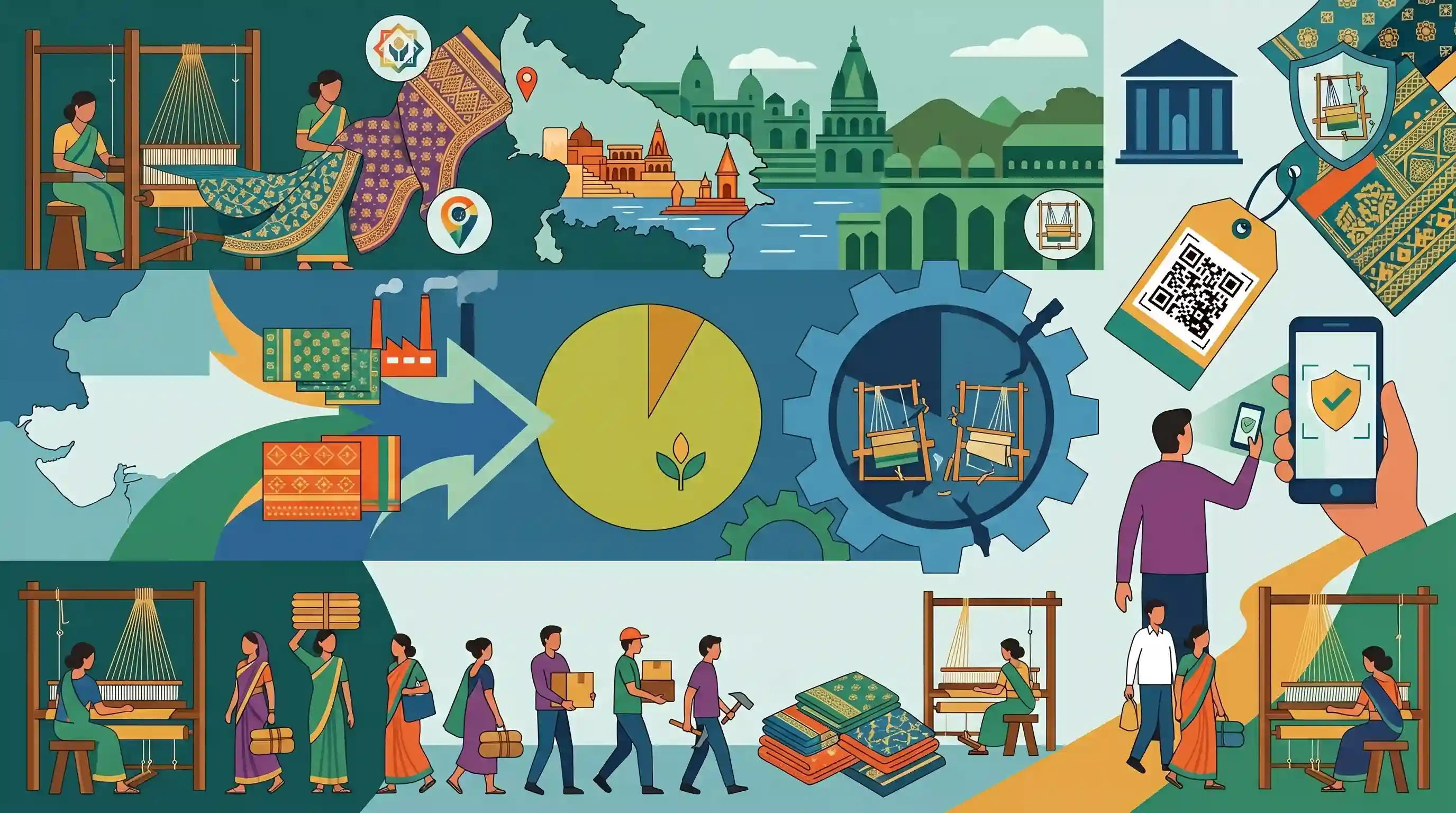
The globally renowned Banarasi saree industry in Varanasi is facing an existential crisis due to rampant counterfeits. Millions of cheap powerloom sarees from Surat and other states are being sold as authentic Banarasi sarees to unsuspecting tourists, capturing 80% of the local trade. This has caused 50,000 of the 100,000 power looms to shut down and forced nearly 4 lakh weavers to migrate or change their professions. To counter this, the Indian Weavers Cell is considering a QR-code-based product verification system to safeguard genuine handloom and powerloom weavers.
Key Points
- Severe crisis in the Varanasi Banarasi saree industry where authentic weavers are fighting to stay afloat due to the influx of cheap, counterfeit sarees sold as originals.
- About 10 to 15 truckloads of counterfeit sarees manufactured on powerlooms in Surat and other states arrive daily in Varanasi, where they are sold at premium rates by deceiving tourists.
- Out of approximately 100,000 power looms in Varanasi, nearly 50,000 (50%) are currently idle. Looms costing Rs 1 lakh to Rs 1.5 lakh are being liquidated as scrap for Rs 10,000 to Rs 15,000.
- Around 4 lakh weavers and artisans have migrated out of Varanasi or shifted to manual labor and retail shops due to meager daily earnings (around Rs 200) and declining work opportunities.
- Rising electricity tariffs and the high cost of raw materials have exacerbated the distress of the authentic weavers.
- The Indian Weavers Cell has proposed introducing a QR-code-based verification system on sarees to protect customers and guarantee authenticity.
Important Terms
One District One Product (ODOP) Scheme

A flagship initiative of the Ministry of Commerce and Industry's DPIIT that identifies, brands, and promotes one unique product from each district to foster balanced regional development and boost local livelihoods.
UPSC context
GS Paper III: Growth, development, and employment; GS Paper II: Government policies and interventions for local development.
Geographical Indications of Goods (Registration and Protection) Act, 1999
An Indian act enacted to register and protect goods carrying geographical indications, preventing unauthorized users from exploiting the reputation of region-specific products like Varanasi's Banarasi sarees.
UPSC context
GS Paper III: Intellectual Property Rights (IPR); GS Paper I: Preservation of Indian heritage, culture, and traditional crafts.
Indian Weavers Cell
An advocacy and representative association of weavers that works to protect traditional livelihood ecosystems, curb the infiltration of counterfeit textiles, and introduce verification systems like QR codes.
UPSC context
GS Paper III: Issues related to planning, mobilization of resources, employment, and growth in the handloom sector.
Prelims Trap
The Silk Mark certifies both the geographical origin and the handwoven authenticity of silk products across India.
Silk Mark only guarantees 100% natural silk purity. It does not certify geographical origin (which is GI's role) or handloom status (which is Handloom Mark's role).
Static Concepts Connected
How do GI Tags and Silk Marks differ in protecting traditional textiles?
- GI Tag Scope: Administered by DPIIT under the GI Act 1999; certifies geographical origin, traditional methods, and specific regional reputation of products.
- Silk Mark Scope: Managed by the Central Silk Board (Ministry of Textiles); certifies only the 100% purity of natural silk fiber, regardless of origin.
- Regulatory Divergence: A textile can have a Silk Mark without regional GI protection, and vice versa, requiring distinct enforcement mechanisms.
What is the One District One Product (ODOP) scheme's structure?
- Pioneered by UP: Launched first by Uttar Pradesh in 2018 to revive indigenous crafts, subsequently scaled nationally under the Ministry of Food Processing and DPIIT.
- Core Objectives: Aims to preserve heritage crafts, provide credit linkages, improve branding, and promote local products as export hubs.
Cross-Topic Patterns
GI Protection vs. Domestic Market Dumping
Explores how regional GI protections fail domestically when cheaper synthetic powerloom alternatives from other states exploit weak retail monitoring and bypass physical enforcement.
De-skilling and Distress Migration
Socio-economic fallout where artisan distress forces highly skilled heritage weavers into low-wage manual labor, highlighting gaps in craft preservation and rural safety nets.

Expect a Prelims question comparing GI Tag, Silk Mark, and Handloom Mark, testing their distinct regulatory bodies and certifying criteria.
Linked PYQs · 3
Linked PYQs · 3
- 2008UPPSC_PRELIMSGS1
From the employment view point which of the following industry is largest employer in Uttar Pradesh?
- 2022UPPSC_PRELIMSGS1
On the basis of 'one district one product' programme in Uttar Pradesh, which one of the following pairs is NOT correctly matched ?
- 2025UPPSC_PRELIMSGS1
As per the One District One Product (ODOP) scheme of Uttar Pradesh, Moonj products are associated with which of the following districts? 1. Amethi 2. Sultanpur 3. Sant Kabir Nagar Select the correct answer from the code given below:
