US Arctic Ambitions Over Greenland Strain Transatlantic NATO Relations
Source:The Hindu ↗
Why It Matters
This issue is crucial for understanding the changing dynamics of the NATO alliance, US foreign policy under the Trump administration, and the increasing geopolitical contestation over the Arctic region. It serves as an excellent case study for Mains GS2 questions on transatlantic relations, transactional diplomacy, and the strategic scramble for critical minerals.
Summary
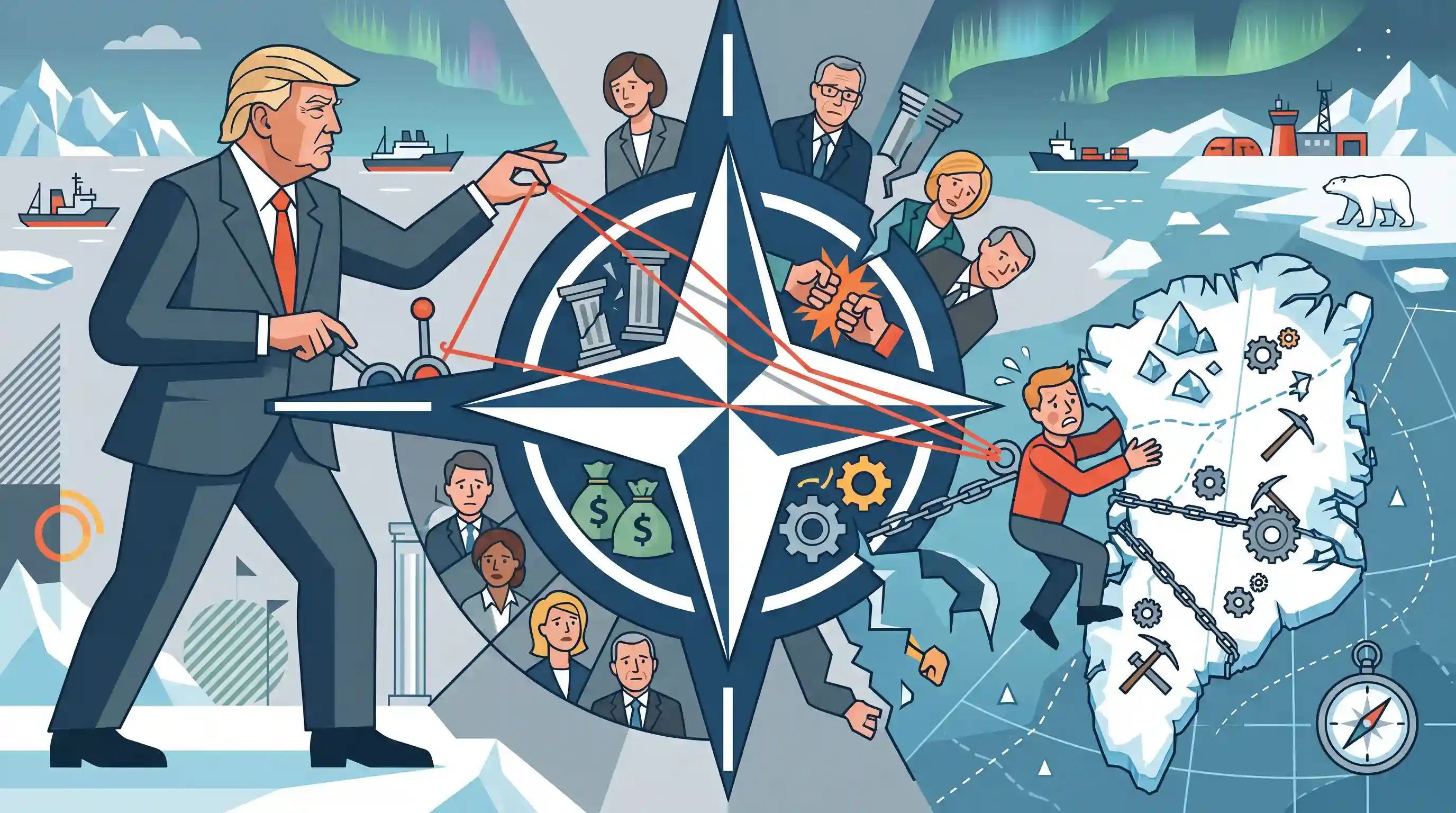
The article discusses US President Donald Trump's strategic maneuvering within the NATO alliance to advance American interests regarding Greenland. Recognizing Greenland's critical location in the Arctic and its rich deposits of critical minerals, the Trump administration is employing a highly transactional diplomatic approach. By leveraging internal NATO divisions—particularly debates over defense spending and security guarantees—Trump is reportedly pressuring Denmark (Greenland's sovereign power) to yield greater US influence or control over the territory. This reflects a broader shift in US foreign policy, where multilateral security alliances are used as bargaining chips to secure tangible geopolitical and economic assets, potentially at the cost of transatlantic unity.
Key Points
- Greenland, an autonomous territory of Denmark, holds immense geopolitical significance due to its strategic location in the Arctic and vast reserves of critical minerals (such as rare earths).
- US President Donald Trump is employing a transactional approach to foreign policy, utilizing NATO's internal dynamics and defense spending debates as leverage.
- By creating pressure within the alliance or questioning security commitments, the US aims to force Denmark into concessions regarding American influence or control over Greenland.
- This strategy highlights a shift in transatlantic relations, where traditional value-based security alliances are being leveraged for direct geostrategic and resource-driven national interests.
Important Terms
NATO (North Atlantic Treaty Organization)

A 32-member intergovernmental military alliance founded in 1949 for collective defense. Its core principle (Article 5) states that an attack on one member is an attack on all.
UPSC context
GS Paper 2: International Relations; structure/mandate of international agencies and their impact on India's strategic environment.
Geopolitics of the Arctic
Strategic competition for influence in the North Pole region, driven by melting ice opening new shipping routes and access to vast untapped natural resources.
UPSC context
GS Paper 2: Effect of policies/politics of developed countries; GS Paper 1: Geography-Resources.
Critical Minerals
Non-fuel mineral resources like Rare Earth Elements (REEs) essential for modern technologies (EVs, defense). Greenland holds some of the world's largest untapped deposits.
UPSC context
GS Paper 3: Economic Development and Resource Security; critical for India's green energy transition.
Transactional Diplomacy
A foreign policy approach prioritizing immediate national self-interest and tangible gains (deals) over long-term alliances, multilateral norms, or shared values.
UPSC context
GS Paper 2: Bilateral/global groupings; analyzing shifts in US foreign policy and their global implications.
GIUK Gap
A strategic naval chokepoint between Greenland, Iceland, and the United Kingdom, vital for NATO to monitor Russian submarine movements into the Atlantic.
UPSC context
GS Paper 2: Geopolitics; critical maritime security architecture.
Pituffik Space Base
The northernmost US military installation (formerly Thule Air Base) in Greenland, critical for missile early-warning and space surveillance systems.
UPSC context
GS Paper 3: Science and Tech/Security; strategic defense infrastructure in the Arctic.
Prelims Trap
Greenland is an independent sovereign state in the Arctic and a direct member of NATO.
Greenland is geographically in North America but politically an autonomous territory of Denmark. Denmark handles its foreign/defense policies and represents it in NATO.
Static Concepts Connected
What are the primary geopolitical drivers behind the 'Scramble for the Arctic'?
- Resource wealth: Melting ice exposes vast, untapped reserves of oil, gas, and critical minerals like rare earths.
- Maritime routes: The Northern Sea Route drastically reduces shipping distances between Europe and Asia compared to the Suez Canal.
- Strategic positioning: Crucial for early missile warning systems and controlling chokepoints like the GIUK (Greenland-Iceland-UK) gap.
How is NATO structured regarding collective defense and funding?
- Article 5: The core principle dictating that an armed attack against one member is considered an attack against all.
- Geographic scope: Legally limited to members' territories in Europe, North America, and North Atlantic islands above the Tropic of Cancer.
- Burden-sharing: A political commitment requiring member states to spend a minimum of 2% of their GDP on defense.
Cross-Topic Patterns
Climate Change & Trade Routes
Arctic ice melt accelerates the viability of the Northern Sea Route, directly linking physical geography changes (GS1) with shifting global trade and geopolitical alliances (GS2).
Rare Earths & China Plus One
The push for Greenland's resources reflects Western efforts to break Chinese rare earth monopolies, mirroring India's own Minerals Security Partnership (MSP) and KABIL initiatives.

A mapping question matching Arctic territories (Greenland/Denmark) with strategic straits or critical mineral types is highly likely in 2026.
Linked PYQs · 2
Linked PYQs · 2
- 2023MainsGS2
‘The expansion and strengthening of NATO and a stronger US-Europe strategic partnership works well for India.’ What is your opinion about this statement ? Give reasons and examples to support your answer.
- 2014PrelimsGS1
Consider the following countries : 1. Denmark 2. Japan 3. Russian Federation 4. United Kingdom 5. United States of America Which of the above are the members of the 'Arctic Council'?
