Industry Academia Collaboration in Frontier Technologies
Source:The Hindu ↗
Why It Matters
Demonstrates India's push to build domestic capabilities in frontier technologies like AI and quantum computing through crucial industry-academia partnerships, which are highly relevant for questions on indigenisation of technology and applied science.
Summary
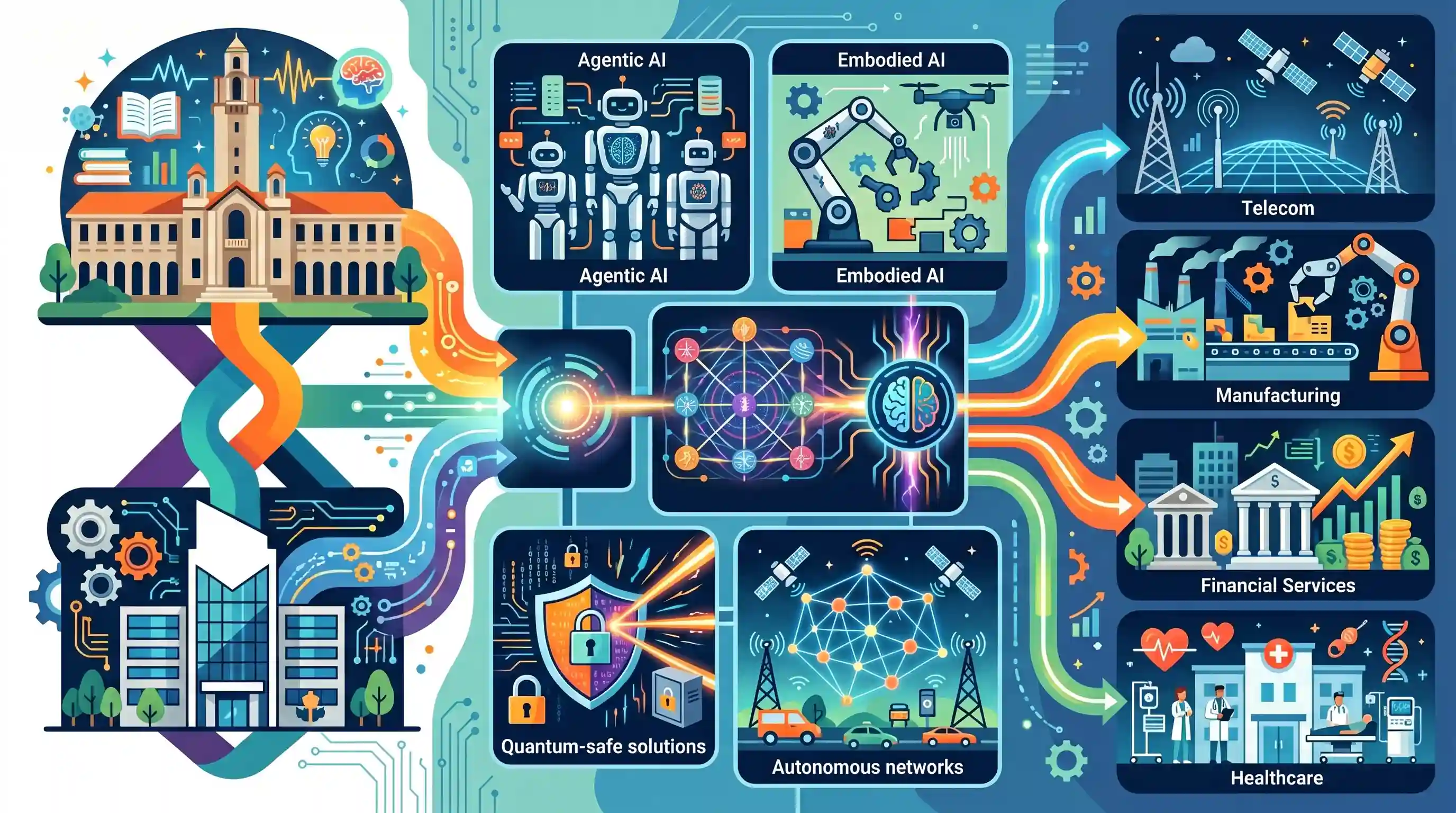
Wipro Ltd has partnered with the Indian Institute of Science (IISc) and the Foundation for Science Innovation and Development (FSID) to advance research and innovation in frontier technologies. The strategic alliance will focus on cutting-edge areas including agentic AI, embodied AI, quantum AI, quantum-safe solutions, and autonomous networks. By bringing together IISc's academic research and Wipro's engineering expertise, the partnership aims to build secure, adaptive, and autonomous digital operations to drive innovation across sectors such as telecom, manufacturing, financial services, and healthcare.
Key Points
- Wipro, IISc, and FSID have formed a strategic alliance to drive research and innovation in frontier technologies.
- The collaboration will primarily focus on advanced fields such as agentic AI, embodied AI, quantum AI, and quantum-safe solutions.
- The partnership aims to develop secure, adaptive, and autonomous digital networks that can be applied across sectors like telecommunications, manufacturing, financial services, and healthcare.
- The initiative highlights the strengthening of industry-academia collaboration in India to translate academic research into commercial and scalable technological solutions.
Important Terms
Indian Institute of Science (IISc)

A premier research university in Bengaluru founded in 1909 by Jamsetji Tata. It is a designated 'Institution of Eminence' leading India's advanced scientific and engineering research.
UPSC context
GS Paper 3: Science and Technology—Development and their applications. GS Paper 1: Modern History/Personalities (J.N. Tata).
Frontier Technologies
Disruptive technologies like AI, robotics, and quantum computing that sit at the intersection of radical scientific breakthroughs and real-world implementation to solve large-scale global challenges.
UPSC context
GS Paper 3: Science and Technology—Awareness in the fields of IT, Space, Computers, and Robotics.
Foundation for Science Innovation and Development (FSID)
A non-profit Section 8 company within IISc that facilitates industry-academia collaboration, deep-tech incubation, and the commercialization of scientific research.
UPSC context
GS Paper 3: Science and Technology—Indigenous technology and developing new technology; R&D ecosystems.
Agentic AI
AI systems possessing 'agency' or autonomy, capable of independent reasoning, multi-step planning, and executing actions to achieve goals with minimal human oversight.
UPSC context
GS Paper 3: Science and Technology—AI and its applications/security implications.
Embodied AI
AI integrated into physical bodies (robots or vehicles) that allows them to interact with and learn from the physical world through sensors and actuators.
UPSC context
GS Paper 3: Science and Technology—Robotics and Artificial Intelligence.
Quantum AI
The fusion of quantum computing and artificial intelligence, utilizing quantum bits (qubits) to solve complex problems and train machine learning models exponentially faster than classical computers.
UPSC context
GS Paper 3: Science and Technology—National Quantum Mission and emerging AI trends.
Quantum-Safe Solutions
Cryptographic methods and security protocols, also called Post-Quantum Cryptography (PQC), designed to protect data against the decryption power of future quantum computers.
UPSC context
GS Paper 3: Internal Security—Cybersecurity and IT; S&T applications.
Prelims Trap
Quantum-safe cryptography requires quantum computers or qubits to encrypt data.
Quantum-safe (Post-Quantum) cryptography uses complex mathematical algorithms on *classical* computers to resist quantum attacks; it does not require quantum hardware itself.
Static Concepts Connected
What distinguishes Agentic AI from traditional Generative AI?
- Generative AI: Primarily produces text, images, or code in response to specific human prompts, relying heavily on continuous human input.
- Agentic AI: Autonomous systems capable of setting goals, planning, and executing complex, multi-step tasks with minimal to no human intervention.
What is Post-Quantum Cryptography (PQC)?
- Classical Algorithms: PQC uses classical mathematical encryption (not quantum mechanics) designed to be mathematically unbreakable by future quantum computers.
- Harvest Now, Decrypt Later: It defends against hackers stealing currently encrypted data to decrypt it once powerful quantum computers become available.
Cross-Topic Patterns
National Deep Tech Startup Policy
The Wipro-IISc alliance mirrors the NDTSP's core objective: bridging the "valley of death" by translating raw academic R&D into scalable, commercial technological solutions.
Quantum Security & Sovereign Defense
Private sector push into quantum-safe solutions runs parallel to India's National Quantum Mission, which prioritizes secure quantum communications for defense, cyber, and finance sectors.

Expect a 2026 Prelims 'match the pairs' question contrasting Generative, Agentic, and Embodied AI capabilities.
Linked PYQs · 4
Linked PYQs · 4
- 2023MainsGS3
Introduce the concept of Artificial Intelligence (AI). How does Al help clinical diagnosis? Do you perceive any threat to privacy of the individual in the use of Al in healthcare?
- 2022PrelimsGS1
Which one of the following is the context in which the term "qubit" is mentioned ?
- 2024PrelimsGS1
Consider the following statements: I. It is expected that Majorana 1 chip will enable quantum computing. II. Majorana 1 chip has been introduced by Amazon Web Services (AWS). III. Deep learning is a subset of machine learning. Which of the statements given above are correct?
- 2025PrelimsGS1
Consider the following statements: I. It is expected that Majorana 1 chip will enable quantum computing. II. Majorana 1 chip has been introduced by Amazon Web Services (AWS). III. Deep learning is a subset of machine learning. Which of the statements given above are correct?
